Harry Potter’s message of inclusion

hp-night.jpg

 
http://www.thehindu.com/news/cities/mumbai/entertainment/harry-potters-message-of-inclusion/article8161488.ece

On February 4, Potterheads will celebrate JK Rowling’s book series by hosting Harry Potter Book Night parties in different parts of the world. Once again, I will sit with my co-host to cut out paper dementors, draw owls on white balloons with a marker, and make fudge flies with chocolates. But more importantly, apart from being a celebration of these fabulous books and fudge, our February gatherings always remind me of a key Patronus message tucked inside the Harry Potter stories: of inclusion and empathy.

In 2014, a study titled The greatest magic of Harry Potter: Reducing prejudice showed the books go a long way in teaching young readers tolerance and compassion. Rowling’s seven-book series constantly shines a light on systems of social hierarchies, like class and caste: there are the privileged magical people, and then there are the others. Muggles are non-magical people and some refer to them as mud-bloods, a filthy word for Muggle-born wizards who have often been ridiculed, tortured, and even killed. Only Pureblood wizards are considered worthy of magic.

Discrimination and prejudice, privilege and merit, inequality and diversity, tolerance and inclusion are an inherent part of our social structure. Yet, we don’t always talk to our children about these issues, and if we do, it’s often framed as something that’s alien to our social fabric. Instances are not contexualised, instead they are viewed as external, far-away phenomena. Children have nascent opinions about what’s right and what’s wrong, and it’s something that has to be nurtured. Especially in our society, with all its complexities. As children grow older, these perceptions, values, beliefs, and attitudes are shaped and solidified by parents, educators, peer groups, and the media they consume (among other things). These become the frameworks within which they’ll go on to interpret people, events, and issues as adults.

Look around us — children’s literature, artefacts, and the visual media are dominated by Hindu mythology and narratives. In comparison, fewer books are published about other folk tales or oral histories of minority communities. Nor do we see that many games, apps or films on these traditions that are equally rich and intricate. In such a scenario, where representation is selective, how do you begin to understand diversity? Most school textbooks are ill-equipped to explain India’s caste system and how it continues to exist in latent and manifested forms. How do you then explain to a young adult what it means that Rohith Vemula, a Dalit scholar, felt forced to commit suicide because of the way society treated him in a city as big and supposedly modern as Hyderabad?

In his suicide letter, Rohith Vemula, wrote, “My birth is my fatal accident. I can never recover from my childhood loneliness. The unappreciated child from my past.” Those words are haunting, as is the rest of the letter. A friend of mine read the note and said that’s how his own childhood feels in hindsight, centred around his identity of being a Dalit. It was like the child didn’t matter, he said, because he grew up in an environment that constantly reinforced discrimination.

As children, we are rarely made aware of our own positions of privilege and as a result, we soak in prejudices — after all, how will we think of examining them if we’re not told prejudice exists or that it’s a topic of discussion? A subtle sneering at the children who play in public parks, or the ones who are “not like us, no” is all it takes sometimes. That difference is always palpable, embossed like an invisible line, whispered in school and college corridors, and even in staff rooms.

To not talk about this inequality, to ignore it, makes us equally culpable. It can only lead to a generation of citizens who would rather not question these complexities, the status quo, or their own source of privilege: caste and class. This further snowballs when it comes to the idea of merit, whether in college, the workplace, or in any other part of our lives.

If by reading a book, children can become more empathetic, then as adults, we can do so much more to encourage them. Maybe start by opening a dialogue. Answer questions. Listen to them with an open mind. Surround them with stories, books, films on inclusion and human rights. And lead by example.

Children are quick on the uptake. In the first Potter book, Draco Malfoy holds out a hand in friendship to Harry, “You’ll soon find out some wizarding families are much better than others, Potter. You don’t want to go making friends with the wrong sort. I can help you there.” Harry didn’t shake his hand.

Bijal Vachharajani writes about education for sustainable development, conservation, and food security. She’s the former editor of Time Out Bengaluru.

From Landour with Love

http://www.thehindu.com/news/cities/mumbai/entertainment/from-landour-with-love/article8099859.ece?ref=tpnews
RUSTY & MAGIC MOUNTAIN

Sitting in a city, surrounded by buildings, enveloped in smog, Ruskin Bond’s books are like a breath of much-needed crisp, fresh mountain air. Bond’s writing takes readers into a world that for many of us is reserved for “vacation time”.

His words take us on a journey through the winding roads of the mountains, where tigers and leopards lurk in deep forests, fallen pine cones and dried leaves crunch beneath footsteps, spooky caretakers and ghosts haunt forgotten houses, and children make imaginary friends.

Even now, bookstores and e-stores are filled with titles from Bond, charming readers. A year and a half ago, when I spoke to the writer about the sheer number of his books that are out there, he said, “When I go to the bank, as I did on Saturday, and I find my bank balance has become alarmingly low, I rush back and immediately get to work at my desk.”

Inimitable humour

His inimitable sense of humour aside, Bond is a compulsive writer. “Even if it wasn’t my profession, I would still write for myself,” he said. “I am fond of writing; I enjoy it, whether I am writing an essay, a story, or a poem.”

Now, almost a decade later, Bond is back with one of his most beloved characters in Rusty and the Magic Mountain . In his ‘By Way of an Introduction’, the author writes, “But I’ll never write another,” said Rusy, “after so much bother.”

And here he is, at his desk near the door… telling a new tale. In this instalment, the Anglo-Indian boy’s “adventure wind” was calling to him. And he sets off to explore Witch Mountain with his friend, little Popat Lal, and wrestler, Pitamber, who is always eating whatever food he can lay his hands on. It’s an odd bunch, Bond’s books offer a deeper understanding of human nature.

Some characters he writes with wit and cleverness, others, he paints with a brush of benevolent malevolence, and some, with compassion. Whether it’s the eccentric Uncle Ken, the food-loving Aunt Mabel, or the shy Mr Oliver, his characters are quirky and colourful.

In Rusty and the Magic Mountain , the three friends find themselves on a fantastical quest: there’s a mysterious one-eyed caretaker who never removes his hat, a cat who has a penchant for blood, a community of dwarves whose forefathers worked in silver mines without sunshine and fresh air, and an evil Rani and the gorgeous Reema. Bond tosses together the supernatural with adventure to put together a hilarious tale that Rusty’s old and new fans will love.

Wayside stations

Bond’s stories evoke a strong sense of place — whether it’s a tea stall tucked away in a dusty corner or a sylvan forest in the valley of a mountain. For instance, he describes a pond in Friends in Wild Places: Birds, Beasts and Other Companions , “To the inhabitants of the pond, the pond was the world; and to the inhabitants of the world, maintained Grandfather, the world was but a muddy pond.”

In another story, he writes about his fascination with small wayside stations. “…these little stations are, for me, outposts of romance, lonely symbols of the pioneering spirit that led men to lay tracks into the remote corners of the earth.” How hard is it then to imagine a muddy pond that’s home to croaking frogs, deserted railway stations, or quaint hill stations? Not very. But mostly, Bond’s stories evoke awe, concern and respect for all things wild and wonderful; whether it’s a blue periwinkle that Rusty plucks from a bush or a leopard crouching in a railway tunnel in Friends in Wild Places .

Lavishly illustrated

This book, lavishly illustrated by Shubhadarshini Singh, brings together stories, some old and others new, about his real and imaginary friendship with animals, birds, and trees.

Bond reminisces about the urban wildlife of Delhi, a tree that gives him a basket of walnuts every year, and a baby spotted-owlet who lived under his bed.

For Bond, his relationship with animals and plants is deep.

As he put it, “After all, animals only kill for food, don’t they? And we humans kill for land property, greed, envy, jealousy — these are our motives for killing. Animals need space, that’s all they want really. Let them have their forest and wilderness.” And maybe, that’s what resonates in his book, reverence and love (and some humour) for humanity and the environment. And that’s why we keep returning to his stories.

Bijal Vachharajani writes about education for sustainable development, conservation, and food security. She’s the former editor of Time Out Bengaluru .

When I find that my bank balance has become alarmingly low, I rush back and immediately get to work at my desk

Ruskin Bond

Bond tosses together the supernatural and adventure to put together a hilarious tale

Bengaluru is waking up to homemade low-cal granola

http://indianexpress.com/article/lifestyle/food-wine/bengalurus-waking-up-to-home-made-low-cal-granola/

Making healthy, tasty granola is easier than you think. Ingredients can be easily swapped, and delicious quirks such as coffee or bits of chocolate make it more interesting.

Maegan

 In his book ‘Food Rules: An Eater’s Manual’, Michael Pollan says: “Don’t eat breakfast cereals that change the colour of the milk.” He goes on to explain, “This should go without saying. Such cereals are highly processed and full of refined carbohydrates as well as chemical additives.” The first Indian city that seems to have heeded his advice is Bengaluru. The city might love its ragi mudde and chow chow bhaat, but it is also a step ahead of the rest of the country as far as home-made breakfast cereals are concerned.


Ecologist Shivani Shah made her first batch of granola this month. Shah says, “I realised that the days I don’t make a slightly elaborate good Indian breakfast, or when I am travelling, I would end up with a make-do breakfast, and that compromise was making me quite unhappy.” Now, when Shah travels, she plans to pack breakfast in a jar.

According to the India Breakfast Cereal Market Outlook, 2021, the Indian breakfast cereal market has grown at a compound rate of 22.07 per cent over the last five years. Whether it is cold cereals such as corn flakes, chocolate or wheat flakes and muesli, or the hot oatmeal and wheat-bran variety, these foods seem to have become a convenient and permanent fixture at the breakfast table. Yet, the average box of supermarket cereal is often highly processed, enhanced with corn syrup and reinforced with synthetic vitamins.

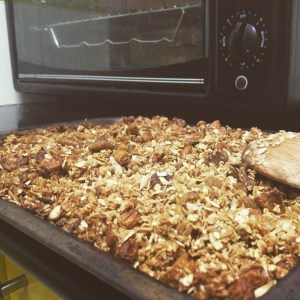
Making granola isn’t a tedious task — toss the ingredients together and roast them in an oven, or on a stove. “An average breakfast cereal in its simplest form contains cooked and toasted grains, a sweetening agent such as sugar or honey, plus a flavour,” says Dr Chinthu Udayarajan, a senior food scientist at Synthite in Kolenchery, Kerala. “Flavour could be out of a bottle, or bits of fruits such as raisins, dried banana or strawberry, or even a pinch of cinnamon powde.” Shah pretty much follows that basic recipe — she roasts rolled oats, mixed nuts and seeds on the stove and adds coffee powder and coffee, along with dates and raisins for a bit of sweetness. The result is a delicious, toasty mix of nuts, fruit, seeds and oats.

The versatility of the granola makes it an appealing breakfast option, or even a nutritious mid-day snack. When journalist Neha Margosa couldn’t find the right mix of granola in stores, she decided to make her own. “I started making my own granola in mid-2015 when I did not have an oven and wanted to experiment with cooking,” says Margosa. “I discovered that granola could be easily made on the stove top.”

Ingredients can be easily swapped, and delicious quirks such as coffee or bits of chocolate make it more interesting. Margosa, for instance, adds toasted slices of coconut and pistachios, and little coffee decoction to her homemade granola. Maegan Dobson-Sippy has been making her own granola for the last six months. “I adapted a BBC Good Food recipe slightly to take into account what ingredients I can easily get,” says Dobson-Sippy, a freelance writer. “For example, I substitute maple syrup for date syrup, and vegetable oil for coconut oil.”

The flip side of home-made granola is that it doesn’t last as long as the one out of a box. “Making cereal at home means we have control on what goes in — that is, fewer and natural ingredients,” said Udayarajan. “If we don’t use antioxidants, the shelf life of the cereal could be reduced by half.”

However, all three granola makers agree that their home-made version is far more cost-effective and healthier than the ones available in the market. “Oats, chocolate and nuts are much cheaper when bought in bulk,” says Margosa. Shah agrees with Margosa. “Yes, it is cost-effective eventually, given that it is full of nutritious ingredients and even literally comparable to the cost of a simple dosa breakfast at mid-range Sagars (chain of restaurants) in the city.”

Home-made granola recipe
(Adapted from BBC Good Food)

Ingredients
2 tbsp coconut oil
125ml date syrup
2 tbsp honey
1 tsp vanilla extract
300g rolled oats
50g sunflower seeds
4 tbsp sesame seeds
50g pumpkin seeds
100g flaked almonds
100g raisins
50g coconut flakes

Method
* Preheat oven to 150 degrees C.
* On the stove, toast coconut on a skillet lightly.
* In a large bowl, mix coconut oil, date syrup, honey and vanilla extract. Add the remaining ingredients, except the dry fruit and coconut. Toss to mix well.
* On two baking sheets, spread the granola mixture evenly. Bake for 15 minutes. Now, add the coconut and dry fruit and bake for another 10-15 minutes.
* Remove from oven and immediately transfer to a flat tray or plate to cool.
* The granola can be stored in an airtight container for a month. Eat with cold milk or yogurt and sliced fruit.

Make-it-yourself

http://www.thehindu.com/news/cities/mumbai/entertainment/makeityourself/article7994680.ece
Displaying 20150503_194926.jpg20150503_194926

I have a confession to make — I can’t stand hobby kits. I look at them with as much loathing as Professor Snape reserved for Harry Potter. Although beautifully packaged, these kits are rarely Do-It-Yourself – everything comes pre-prepared, all the child has to do is cut, fold and glue the bits-and-bobs together. It makes me yearn for long summer days when to construct a candy stick pencil stand or a pistachio shell cottage, we had to make our way through countless mango dollies, choco-bars and salted dried fruits. Now, everything’s bundled neatly into a bag along with specific instructions. Somehow the idea of innovation and experimentation has got buried under mounds of cookie-cutter DIY kits.

Which is why I was excited about the MaKey Makey , an invention kit I bought for my nephew on the recommendation of a friend’s eight-year-old daughter. The kit comes from the hallowed MIT Media Lab and had promise written all over it. MaKey MaKey has been developed by two students, Jay Silver and Eric Rosenbaum, who crowdsourced money on Kickstarter to raise funds for the project. When my nephew ripped apart the wrapping paper, we both opened the box with barely concealed excitement. I couldn’t help but feel a twinge of disappointment as I picked my way through the circuit board, USB cable, alligator clips and jumper wires. I paid three grand for this?

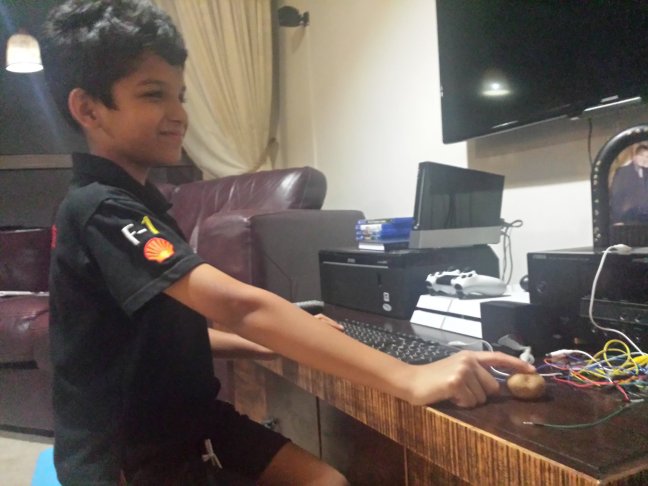
Perplexed, we took to the Internet to help us make sense of what looked like a jumble of wires. We pulled up an online piano page, and hooked up the MaKey MaKey to the computer. Next, we raided the kitchen. My mother came running out, wondering why we needed the French beans that she was prepping for lunch. We connected alligator clips to the veggies, and suddenly, we were playing the piano with a cluster of beans. We’d lift a bean, and it would play a note.

MaKey MaKey connects everyday objects that can conduct a bit of electricity such as fruits, plants, coins, Play-Doh and even marshmallows, and converts these “newly-found inputs into keyboard presses or mouse control”. That means you can play SuperMario with Play-Doh, make a doll cry with foil, and use vegetables and fruits to compose a song. And yes, you can play Minecraft as well.

For my nephew, the excitement was really about the interaction it provided. It got him thinking laterally, wondering what he could hook up to the kit next and transform into a touch pad. He deliberated about objects that conduct electricity – it took a few experiments to figure that potatoes and coins worked, but Lego was a no go.

The wonderful thing about this is that children can connect with science and technology through play. Many children today are familiar with technology, but few understand the workings of their app or game. MaKey MaKey gives another dimension to play – by offering them an insight into the workings of the technology they are experimenting with. Since there are barely any instructions provided by the inventors, it comes down to the child’s imagination and ideas. Without realising it, they end up learning the basics of physics, music, sound, technology. Since it’s participative, a play date can become the start of a music band or a group game.

As the makers wrote on their Kickstarter page, “We believe that everyone can create the future and change the world. So we have dedicated our lives to making easy-to-use invention kits. We believe that the whole world is a construction kit, if we choose to see it that way”. While the MaKey MaKey is a great interface design for children, it’s a handy tool for adults especially designers, artists and engineers. Actually scratch that, most of us would have fun experimenting with this kit.

MaKey MaKey is available on Amazon.com. The writer has now got her own MaKey MaKey kit and has a fridge-full of toys to play with. The writer is the former editor of Time Out Bengaluru and writes about education for sustainable development, conservation and food security.

Play mats

http://www.thehindu.com/news/cities/mumbai/entertainment/plays-mats/article8020403.ece
IMG_7686

Keeping kids occupied at mealtimes just got a tad easier thanks to these activity placemats

Restaurants often offer puzzle placemats to keep diners occupied while waiting for their order. Spot-the-difference puzzles, word games and number challenges serve as appetisers until the real food arrives. Now, entrepreneurs are creating interesting placemats that can keep the little ’uns occupied at the dining table at home as well.

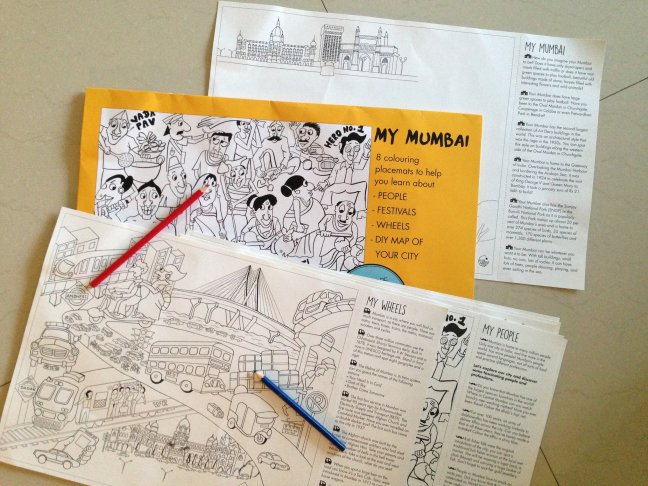
My Mumbai (Rs 500) is a set of eight colouring placemats that introduces Maximum City to children. Perfect for children aged four and above, the black-and-white posters by Yellow Pinwheel Kids Project offer a slice of Mumbai’s life. In one of the placemats, commuters are seen wending their way around the city, passing through the sea link, boarding a local train, and hopping on board a BEST bus. Another one is crammed with the city’s people — street vendors frying vadas for vada pao, Bollywood actors, Koli fisherfolks, paan wallahs, and of course, the dabba wallas. And the third is a glimpse into festivities. The illustrations are done by Abhishek Panchal, who founded Bombay Pencil Jammers.

The placemats encourage children to explore their city with the help of trivia pull-outs. Young explorers will engage with Mumbai’s architecture, the diverse cross-section of its people, and understand its geography. There’s a DIY map of Mumbai, which children have to draw themselves — the map starts at Gateway of India and ends at the Sanjay Gandhi National Park in Borivali. “My Mumbai is targeted for an age group of four to 10. It seems wide but the activity is different for each age segment. The four to six-year-olds will possibly use it just for colouring, but older children will use it as a mapping exercise to discover their city,” said Shinibali Mitra Saigal, who created the activity kit along with Shivani Lath. The entrepreneurs are former journalists, while Mitra Saigal is the co-founder of Kahani Karnival, a Mumbai-based children’s festival.

The Mealtime series by BrownBox Toys (Rs 450) is another charming set of sticker placemats that offer a culinary tour of India, China and England. Each set comes with four posters of typical Indian, Chinese or English meals, with stickers of the food items. The series introduces toddlers to different cultures and helps them understand food habits across the world. For instance, Mealtime England has a poster for fish n’ chips, complete with stickers of tartare sauce, mustard, crisps, peas, vinegar, and other sauces and condiments. Toddlers paste the stickers on the brown paper illustration on the page, to learn what a complete fish n’ chips meal would include. Mealtime India has a range of samosa, thali, kebabs, and dosa and idli. The selection is a mix of familiar and new food, which encourages children to try new dishes as well. The idea is to spark curiosity in young minds.

Then there’s PoppadumArt’s adorable Chalkboard Puzzle Mats (Rs 390) with a range of shapes such as sheep, goats, and bunnies. The animal’s head detaches to become a coaster. Children can write on the mat with chalk, wipe it off, and then scribble again. Made out of medium density fibreboard with a foam backing, the placemat is easy to wipe and reusable, said Saanwari Gorwaney, who started PoppadumArt four years ago to make what she calls “happy things to make spaces happy and bright”. Gorwaney, who is now based out of Gurgaon, worked in advertising before she embarked on this online venture. Out of the three, the chalkboard puzzle mats are easily reusable when it comes to dealing with messy hands. Both Mealtime and My Mumbai would need to be laminated before they can be used as permanent placemats. Of course, they might just end up being displayed on the refrigerator as works of art instead.

To order My Mumbai, visit http://www.facebook.com/My-Mumbai-1701714190047560/?fref=ts. The Mealtime series can be ordered online on http://www.brownboxtoys.com/ and the Chalkboard Puzzle Mats on http://www.poppadumart.com.

Entrepreneurs are creating interesting placemats that can keep the little ones occupied at the dining table

Lightroom Bookstore: The City’s Best-Kept Secret for Kids

https://lbb.in/bangalore/lightroom-bookstore/
Ten-second takeaway

A veritable Narnia for children’s books.

lightroom

A one-stop-shop for children’s books

The delight you feel when stepping into Lightroom Bookstore is comparable to what we think Lucy Pevensie might have felt when she crawled through the cupboard to reach the magical world of Narnia. You can’t help but be spellbound as you walk through the inviting space, surrounded by books and more books.

Aashti Mudnani started Lightroom in 2013, after dreaming about it for seven years. “From the beginning the idea was to have a handpicked selection, keeping books that we believed were good for our children to read,” said Mudnani. “Choosing books is quite an intensive task – we go over endless lists sent to us by publishers, online recommendations, friends’ book lists, reviews etc, to choose the books we keep.”

Go ahead, explore

Lightroom has a range of international and Indian books for children and young adults. Apart from the usual suspects such as Harry Potter, Julia Donaldson, and Percy Jackson, there’s The Amazing Remarkable Monsieur Leotard by Eddie Campbell and Dan Best, Miss Peregrine’s Home for Peculiar Children by Ransom Riggs, and Paper Planes by Dawn O’Porter. There are books published by Tulika, Hachette, Tara, Katha, Pratham, Duckbill, Red Turtle, Puffin, and Young Zubaan, selected by the team at Lightroom.

One wall looks like it belongs on the page of Brain Pickings, Maria Popova’s literary and cultural website. Here you will find displayed the gorgeously-illustrated Animalium: Welcome to the Museum by Katie Scott and Jenny Broom, Neil Gaiman and Chris Riddell’s The Sleeper and the Spindle, and I’ll Be You and You Be Me by Ruth Krauss and Maurice Sendak.

We spent a fair amount of time on the floor perusing Knock! Knock! by Kaori Takahashi. Some of the Lightroom team members joined us in unfolding the beautifully-crafted book. When we gushed over The Giant Game of Sculpture by Hervé Tullet, they opened the book, which transformed into a DIY installation for budding artists. You can also buy notebooks, block stamps and DIY craft kits, apart from children apparel by Hidden Harmony and hand-stitched toys by Blue Mango. Lightroom also holds two events per month.

Why we love them

What makes Lightroom special is its people. Mudnani and her helpful team are knowledgeable and unobtrusive. Need a book for a ten-year-old who loves monsters, a birthday gift, or a first book for your toddler, they know just what you want. And they even smile approvingly if you confess that the book’s actually meant for you.

Where: 1, Lewis Road, Cooke Town

When: Monday to Saturday, 10.30am-6.30pm

Contact: 080 25460466

Price: INR 100 upwards

Find them on Facebook here.

Shopping for dreams

http://www.thehindu.com/news/cities/mumbai/entertainment/the-shop-of-dreams/article8044145.ece?ref=tpnews
IMG_7885

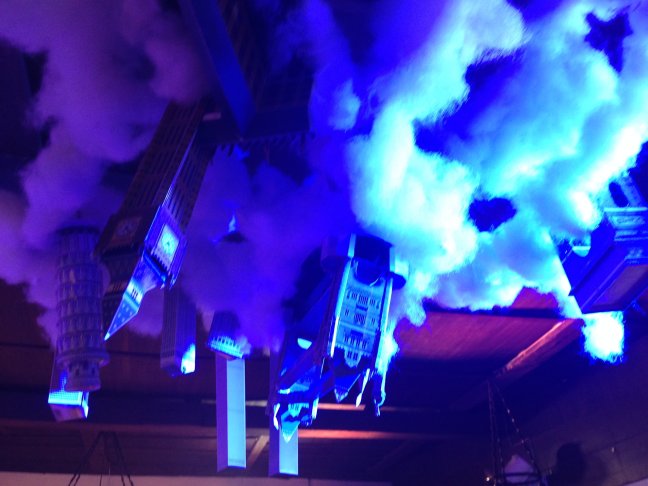
A few weeks ago, I went to a Shop of Dreams, a pop-up store which was actually an exhibition. It was a collaboration between Edinburgh-based artist Symon MacIntyre, faculty/artist Amruta Shah and students of the Srishti School of Art and Design in Bengaluru, as part of their interim project.

Along with a group of children, I was welcomed into a pop-up store that looked like it belonged in the pages of an Enid Blyton book or a Neil Gaiman short story. Like me, the children felt like they had climbed atop the Magic Faraway Tree and were whisked into the fantastical land that was the Shop of Dreams.

The children, a boisterous bunch, excitedly window-shopped for dream jars, where owls nestled in tree holes and upside-down houses, pixie dust in purple and turquoise blue, and the stuff of nightmares was ensconced in matchboxes. You needed drupees, dream currency, to shop and for that, you had to earn them by playing games.

What fascinated me about the exhibition was how it engaged children (also adults) with something as familiar as dreams and nightmares. Play blended with art to become a space where reality was suspended for a little while. Children could explore the exhibits that were not just sterile objects hung on walls. They could pick them up, and examine them to their heart’s content. Well, until the next tot shoved them aside at least.

Since you couldn’t shop with money, you could almost see the conundrum children faced about ‘earning’ enough dream currency to be able to ‘buy’ their favourite fancies. One parent complained that the announcement didn’t mention money, until the students pointed out the concept of a dream currency. She relaxed and set off to make some herself.

In many ways, the exhibition was a stark reminder of growing up in a capitalistic world where even dreams can be traded for the right currency. On the Srishti website, the project was explained: “Every day, in and around us, we see advertisement hoardings selling us some kind of dream. This concept is about the essence of dreams. It is about the de-commercialisation of dreams. Although it is a shop of dreams, the dreams can only be bought by someone prepared to give us something in return. It’s a barter system. There is no currency in our shop. It’s a room full of ideas, imagination and little triggers that can trigger your own imagination.”

And truly, there was a sense of wonder in getting something without actual rupees passing hands, taking them away from their consumerism-centric world. A hark back to the history of money and the barter system. Moreover, the exhibition didn’t have any videos or screens.

In fact, the games were based on traditional board games, word puzzles and a dart board. The Shop of Dreams was all about discovery. A Cheetah-branded matchbox opened to show a skull and bones or a fluffy cloud studded with stars. Inviting bottles were filled with curious potions, where we had to use our imagination to think what a nightmare concoction would taste like. Everyday, objects were transformed into the extraordinary. And I heard a boy and girl decide they were going to try to replicate one of the exhibits for a class project.

As I left the shop — clutching my precious stash of pixie dust, a dream jar, and a nightmare potion — I couldn’t help but think that increasingly what we see and what we touch is becoming homogenised. Our visual culture is more and more limited to screens where images are beamed to us constantly, and games packaged for us. Yet, right here was an example that our experiences don’t have to be limited to screens.

In a city like Mumbai, we are starved for open and play areas, and green spaces. Our idea of a weekend well spent is going to the mall. It would be wonderful if more artists and educators would come to create such spaces where children can play, explore, and innovate. And where going out doesn’t have to be about ‘shopping’.

(The writer is the former editor of Time Out Bengaluru and writes about education for sustainable development, conservation and food security)

My favourite children’s books of 2015

http://www.dailyo.in/arts/childrens-books-2015-the-diary-of-wimpy-kid-mahasweta-devi-greg-heffley-samit-basu-the-adventures-of-stoob-super-zero-payal-kapadia-sundarbans-sarojini-naidu-razia-sultan-/story/1/8112.html

School books, quirky ghosts, funny superheroes- there’s a lot to choose from.

It’s been quite a year for children and young adult books in India. Here’s a look at some of my favourites this year.

School books ruled the roost

Greg Heffley of The Diary of Wimpy Kid fame had serious competition this year. When it comes to schools, the children’s publishing industry was busy with sequels. Samit Basu’s The Adventures of Stoob: A Difficult Stage is a whirlwind read. Stoob’s childhood is firmly behind him, after all he is now in Class 6 and wears full pants. When his classmates are not discussing relationships and icky stuff, they are auditioning for the school play.

Stoob is rip-roaringly funny, and Basu steps into the canvas shoes of a school student with ease. He also takes on certain television series meant for children and manages to make a point about today’s intelligent young audience.

stoob_122415011752.jpg
 The book is rip-roaringly funny, and Basu steps into the canvas shoes of a school student with ease.

Jane De Suza’s little superhero has his hands full in Super Zero and the Grumpy Ghosts. In the second installment of the series, Super Zero has to rid a mall of a motley crew of ghosts. De Suza keeps the reader laughing from the beginning to the end – Super Zero is full of mad-cap jokes and punch lines, with a fun story to match.

sz_122415012125.jpg
 Super Zero is full of mad-cap jokes and punch lines, with a fun story to match.

Horrid High: Back to School by Payal Kapadia returns with another adventure. Horrid High is no longer the horrid school that it once was – Granny Grit is now principal and has a new fleet of teachers.

But when Granny Grit has to rush to the Amazon, 12-year-old Ferg and his friends are left to figure out the mysterious Grand Plan, dodge Cook Fracas’s food fights and attend classes with some weird teachers. A spirited read.

hh_122415012252.jpg
 Horrid High: Back to School by Payal Kapadia returns with another adventure.

Showing their stripes 

Both Nayanika Mahatani’s Ambushed and Mitali Perkins’ Tiger Boyinvite young readers to the forest with their stories. In Ambushed,Gadget-addict Tara stumbles upon an international ring of poachers at a tiger reserve. Now it’s up to the ten-year-old girl and Satya, a tribal boy to save a tigress and her cubs. A wonderful read, Ambushed is a treasure trove of information about the striped cat and the need to save them.

Tiger Boy is the story of Sundarbans, its people and its wildlife. Neel and his sister get together to help a tiger cub who’s gone missing in the mangrove forest. Even though he has a scholarship to study for, Neel forgets everything in order to save the tiger.

ti_122415040619.jpg
It is a story about the complex relationship between humans and animals.

Tiger Boy is a wonderful story about the complex relationship that humans and animals share – fragmented, ethnocentric, wondrous, and symbiotic.

Beautiful picture books

Illustrator Ruchi Shah renders Mahasweta Devi’s Our Incredible Cowinto a gorgeous picture book. Nyadosh, the cow goes about chewing everything in sight, while Shah reinterprets the story imaginatively, giving the cow different avatars of what she eats. Fabric, books, banana leaves, and even onion rings become part of innovative collages to form Nyadosh.

inc_122415012848.jpg
 Ruchi Shah renders Mahasweta Devi’s Our Incredible Cow into a gorgeous picture book.

Roopa Pai and Archana Sreenivasan’s My Space, My Body takes on the subject of personal space and body awareness. Parents often find it hard to talk to their children about these topics, but now help is at hand in the form of siblings Taka and Dimi. Sreenivasan’s illustrations are lively as is Pai’s storytelling.

my-body_122415013219.jpg
 My Space, My Body feaures worksheets and fun activities like this.

8 Ways to Draw an Elephant is an art activity book that not only introduces children to natural history, but also to different Indian art forms. Children will love learning about Asian and African elephants and then tracing, patterning, and colouring the pachyderms in different folk and tribal styles.

Lots of history, some with mystery

Subhadra Sen Gupta’s A Children History of India is an omnibus of sorts. Children can step back into time to ancient and medieval India. Sen Gupta then takes young readers to the British period and then writes about growing up in a free India.

Sen Gupta not only talks about the empires that ruled India but also how the common people lived – the houses they lived in, their clothes, and what kids studied at school. It’s a wonderful way to learn about India and its people.

With the history-mystery series, no one’s ever going to accuse the subject of being dull. Razia and the Pesky Presents by Natasha Sharma is a delightful book about Razia Sultan.

razia_122415014153.jpg
Razia and the Pesky Presents is a delightful book about Razia Sultan.

The Delhi ruler finds herself being sent some really pesky gifts with rude notes. It’s nice to get presents but not if they are challenging your right to rule as a woman. While the series is based on real historical characters, the stories have their own quirks and narratives.

The real super heroes

Written in the form of letters from 12-year-old Sarojini to freedom fighter Sarojini Naidu, Mathangi Subramanian’s Dear Mrs. Naidu is a powerful story about empowerment. Sarojini decides that her government school’s going to have to pull up its socks and do better under the Right to Education Act.

Help is on hand in the form of unlikely friends and a human rights lawyer who is also an evil genius. There are hurdles to face – from a headmaster who can’t be bothered to care, mothers who are busy with thousands of chores, and one of the best characters ever – a nightie-clad councilor tapping away on her phone and ignoring her constituency. Subramanian’s story feels very much real, but in that gritty reality she also finds hope and humour.

naidu_122415014347.jpg
It is in the form of letters from 12-year-old Sarojini to freedom fighter Sarojini Naidu.

Half the Field is Mine is a spunky tale about two friends whose dearest wish in the world is to play football. But the boys’ team does not want girls to play with them any longer, and the two girls set out on different journeys to question gender differences. Swati Sengupta comes up with interesting questions about sports and gender.

Another superhero is nine-year-old Nina in Shabnam Minwalla’s The Shy Supergirl. As the book starts, “But sometimes, just sometimes, they [superheroes] turn out to be small girls who weigh twenty-one kilos and hate Hindi homework.”

shy_122415014608.jpg
 Shabnam Minwalla’s The Shy Supergirl.

Nina, we find out, has a superpower to see if people are nice or nasty, or “a messy mix of the two”. She wields it to solve a mystery in her building. Part of the hOle book series, The Shy Supergirl is about people, and what propels them to be nice or nasty, greedy or kind, sly or compassionate.