On loving and hating Mumbai

29bmdjc-pg5-kid_29_2912739g.jpg

http://www.thehindu.com/news/cities/mumbai/entertainment/on-loving-and-hating-mumbai/article8786404.ece

There’s plenty to love about growing up in the madness of Mumbai, but lots to despise as well. I asked a few parents to share what they love and what they hate about bringing up their children in the city.

Rajesh Tahil works in the media and has three children aged 6, 11, and 15

What I love about bringing up my child in Mumbai

It’s home. They are growing up in a neighbourhood that we have lived in for decades. They are close to family, it’s great to see them grow up with aunts and uncles, and their dogs and cats (and fish).

It is a ‘big city’, so they have rich experiences, like visiting museums, music events and food festivals etc. And while these may not be of the best standards, they are certainly not dissimilar to what one would experience in any other ‘big city’.

What I hate about bringing up my child in Mumbai

The lack of open spaces, lack of clean air, too much noise. People generally drive like idiots, a basic lack of civic sense. And because of that, almost invariably “doing stuff”, which equals to spending money i.e. going for a movie or out for lunch rather than just walking or going to a park.

P.S. Also, no beef burgers and mediocre pizza.

Anita Vachharajani is a writer and has an 11-year-old child

What I love about bringing up my child in Mumbai

Growing up in Mumbai, as a single parent who worked two jobs, I never felt restricted in any way. I hope that sense of safety and freedom continues to stay around longer, so that my child can grow up feeling like her city is a safe one.

I enjoy the limited glimpses of nature that this city still offers. Like the squirrels and the birds that visit our balcony, the trees and the mangroves we get to see.

I like that Mumbai exposes my child to diverse people. There is no one language we all speak, no one food we eat, and no one set of gods we pray to. I feel that simply because Mumbai has, in a sense, fewer pretensions, it teaches you basic humility.

What I hate about bringing up my child in Mumbai

Mumbai doesn’t offer some things that I want for my child: like more open spaces, more access to nature, and stricter traffic rules and road safety. I think children need to play more, and it saddens me that in poorer neighbourhoods and ghettos, children have even fewer spaces to play in. But what I resent most is the diminishing greenery in the city. Everyone mourns the lack of trees, but no one objects to individual trees / groups of trees being cut, and that indifference is also peculiar to Mumbai.

Varsha Pawar works as a domestic help and has a 17-year-old child

What I love about bringing up my child in Mumbai

I love that Mumbai has plenty of opportunities, when it comes to colleges and job options, for my son. There’s so much that he can do here.

What I hate about bringing up my child in Mumbai

I live with my brother. Affordable housing is really difficult to find. If that was sorted, it would be a good place to live in.

Brian Rodrigues works in an IT company and has a 3-year-old child

What I love about bringing up my child in Mumbai

Being in one of the biggest metropolitan cities in the world, Mumbai offers you a plethora of options across all fields and avenues. Infrastructure is at an advanced stage in Mumbai.

You can find loads of institutions, be it for elementary or vocational education.

What I hate about bringing up my child in Mumbai

As we go ahead, bringing up a child becomes very competitive in nature. It almost gets them into rivalry mode at school or day care.

Vankshu Shah is an equity investor and has a three-year-old child

What I love about bringing up my child in Mumbai

It is a multi-cultural environment with a very active social and family life with wide exposure to languages and people.

What I hate about bringing up my child in Mumbai

It’s not a child-friendly city, it’s not easy bringing up a child amidst terrible pollution, and one of the biggest worries is safety. A lack of parks and good beaches are some of the other natural activities that a child misses out on. There is a terrible and expensive rat race when it comes to schooling and a very hectic study culture, denying a child the joy of childhood.

Shinibali Mitra Saigal curates children’s festivals. She has two girls, aged 10 and 4

What I love about bringing up my child in Mumbai

I love Bombay as a city because it lets you be. This is applicable not just to adults but children as well. This sense of freedom is a great thing to equip a child with. It’s also a city where a child can grow up without fear.

What I hate about bringing up my child in Mumbai

Alas, there really isn’t a lot for children to do. It’s not a children’s city. We have green spaces but we don’t do enough to lure children there.

We push indoor play areas but not Rani Bagh and Sanjay Gandhi National Park as zones for children to breathe and play in. In terms of just doing nothing yet having fun, Bombay isn’t your city. Here, it’s all about structure and that kind of breaks my heart
Reading urban dystopia

24bm_lead_pg4_law_2906980g.jpg

http://www.thehindu.com/news/cities/mumbai/entertainment/reading-urban-dystopia-with-lawrence-liang/article8767905.ece

Explore city architecture as seen in comics and graphic novels with lawyer and writer Lawrence Liang


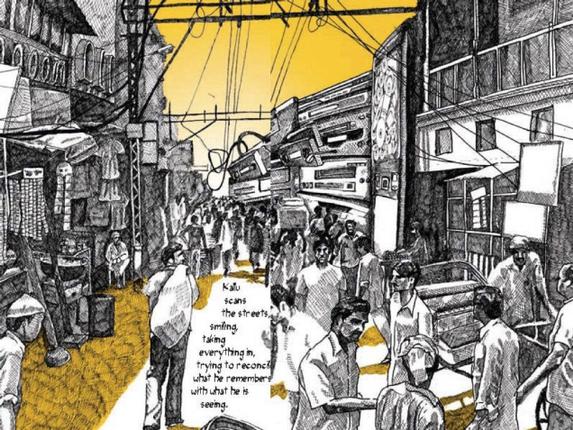
One of the most iconic images that even non-comic aficionados are familiar with, is that of Batman perched on a gargoyle, looking down at Gotham City. “It’s a bird’s eye… a god’s eye view of the city,” says lawyer and writer Lawrence Liang. “But it’s also how a city planner would look at the city.” It’s a very different perspective than the one in The Walking Man by Jirō Taniguchi, pointed out Liang, in which the Manga comic’s protagonist takes a walk around his city. “He takes the time to look around,” he adds. “You experience temporality through that. It’s a contrasting view from the one Batman has of Gotham City – there’s a distinction in seeing a city from the top and walking it.” These are just some of the discussions that participants can look forward to at “Comics and the Urban Imagination”, a four-day course that explores the representation of cities in comics and graphic novels.

Liang will be in Mumbai to teach the course as part of ‘Scaffolds, Layouts and Palimpsests’ at the School of Environment and Architecture (SEA). Participants will be introduced to a slew of international and Indian comics via the tropes of architecture, dystopia and labyrinths. Apart from offering an understanding of comics and graphic novels, the course aims to explore the role of the image and the imagination in shaping urban form. The course, according to SEA website, will examine the intersection of comics and the imagination of the city, in terms of representation and how architectural concepts may offer a new way of understanding the formal properties of comics.

Although Liang is best known for his work at the Alternative Law Forum in Bengaluru, of which he is the co-founder, he is also a film and media scholar. “I have been reading comics seriously for quite some time now,” he says. “I have always had an interest in visual culture.” According to Liang, when it comes to the visual archives of the city, both photography and cinema have been extensively mined for their ability to capture an experience. “As archives of the city, they are both intentional and unintentional,” he says. “If you look at cinema, you are often shooting on location. You capture more than what you intend to – the ambience and the archive of the city at a particular time.” Further, today’s selfie-happy culture, people are constantly taking photographs. “Rather than seeing better, there is a visual blindness,” he adds.

Which is one of the reasons that Liang is drawn to comics – while a photograph is taken, a drawing is made, creating a representation of the urban space. “What you leave or include becomes more acute in a drawing,” he says.

While landscapes are intrinsic to comic books, cityscapes are predominant in many of the narratives. No matter what their origin, superheroes have made mega cities – real and fiction – their homes and the base to fight crimes from. Phantom may feel left out, but urban landscapes are pretty much inherent to the aesthetics of comic books now. The form also gives the space to create allegorical cities, and to reinterpret the future of the cities, in all their utopian and dystopian possibilities. “The history of the city is essential to the narrative imagination of a comic,” explians Liang. “Like Batman and Gotham City. It creates a perceptual archive.”

Liang adds that there has always been a strong linkage between architecture and comics. Graphic novels and comics give free reign to the architectural imagination, making urban centres the protagonist of the narrative at times. Chris Ware’s Building Stories is one such book about the people who live in a three-level building in Chicago. It comes as a box containing 14 little books, some made from cloth, some paper. “Chris Ware slows down the action,” says Liang. “Very little happens, but there are so many images. It slows you down, to take in the minute and intricate detailing. In Building Stories, the protagonist is the building.” Then there’s Les Cités Obscures by Belgian comics’ artist François Schuiten and writer Benoît Peeters. Schuiten studied architecture and his education serves as a firm foundation for the surreal, metaphysical landscapes he conjures up here.

Liang points out the different approaches that comic book artists and writers can take while reinterpreting the city within their panels. For instance, in the Tintin books, he explains the landscape is elaborately researched. “The designs of the beams and the chairs, [Hergé] used archival material, a historical approach,” he elaborates. Science-fiction comics use the future approach, the narratives reflecting the anxieties and hopes of a city as a shared living experience.

As urbanscapes take over our literary, cinematic, and every day imagination, the phenomenon is also symptomatic to our idea of progress and development – vertical, shiny, and sleek like the cities in the pages of these graphic novels. In sharp contrast is the idea of wilderness, rural landscapes, and other unfamiliar spaces. This is an idea cleverly encompassed in The Gigantic Beard That Was Evil by Stephen Collins. The monochromatic graphic novel tells the story of Dave, who lives in an island called Here, where everything is perfect. Liang says that in Here, the city is imagined as a seamless space – a perfect realisation of modern planning. In contrast is the mayhem of There, a place of supposed chaos and fear. “It’s a space full of incredible anxiety and fear,” says Liang. “The contrast plays out interestingly, when aspects of There start emerging Here.” The Gigantic Beard may be fiction, but it the neurotic fear and anxiety it depicts, is familiar and eerily real.

Alphabet Soup

screen-shot-2016-06-21-at-11-46-39-am.png

http://www.thehindu.com/todays-paper/tp-national/tp-mumbai/alphabet-soup/article8730537.ece

Ever asked a toddler to recite the alphabet, or for that matter even an adult? Chances are they will rattle it back to you in a breathless singsong manner, while bouncing on the balls of their feet. Learning the alphabet is usually presented to children in a simple manner, where A is for apple with an illustration of a glossy red apple, B is for ball, Z is for Zebra and so on. For toddlers, books are designed to teach them the letters: the phonetics, their shapes, and basic word associations.

15bm_Kid_s-Colu_15_2895048g

One of the most iconic alphabet books was Rabindranath Tagore’s Sahaj Path , which introduced toddlers to Bengali as a beautiful picture book way back in 1930. The two-part series was accompanied by lino-cut illustrations by Nandalal Bose. The first part centered around the structure of the Bengali alphabet and its pronunciation, and the second used them in sentences and couplets. Then there’s the exquisitely created ABC: Touch and See (Karadi Tales) by Shobha Vishwanath, which is part of their Dreaming Fingers series. The handcrafted pictures are created with a collage of materials and textures, and the printed text goes along side Braille letters to make a tactile book. But ABC books are not just meant for toddlers. Alphabet books for older children, and even adults, are a great starting point to introduce novel ideas and concepts, and they also make for fun reading.

Prabha Mallya’s The Alphabet of Animals and Birds (Red Turtle) is a lovely way of getting children to learn about the collective nouns for animal and birds. The gorgeous illustrations show groups of animals with their collective names: A is for a shrewdness of apes, who are poring over a swarm of ants, while F is for a stand of flamingos, as they, well, stand among a skulk of foxes.

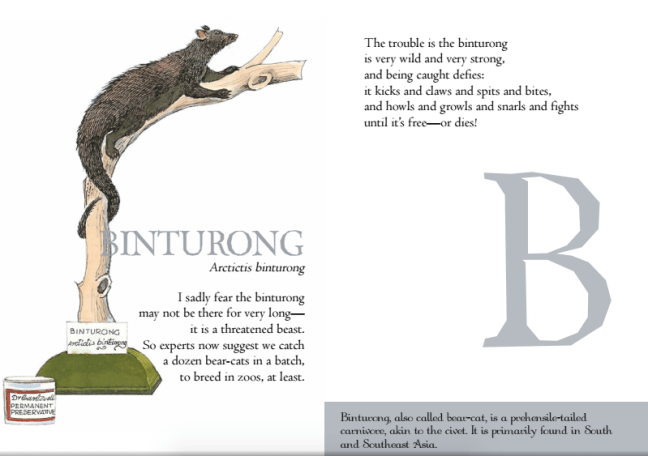
More recently, Duckbill published legendary naturalist, wildlife photographer and writer, M. Krishnan’s Book of Beasts: An A to Z Rhyming Bestiary . The alphabets lead the readers on a global jungle safari where they can meet some unusual animals. B, for instance, is for binturong, which the writer fears “may not be there for very long.” With its cat-like face, long body and prehensile tail, the curious looking animal, the reader finds out, “is very wild and very strong”. M. Krishnan wrote some of these animal verses for his granddaughter Asha Harikrishnan’s birthday, gifting the first set to her in 1990. The quirky poetry and facts are a lesson in conservation, at the same time, they point out the adverse impacts humans have on the natural world.

Alphabet books can be enchanting, irreverent or fabulously dark. Neil Gaiman and Gris Grimly’s The Dangerous Alphabet (Harper) is a subversive “piratical ghost story” where two children embark on a journey in a B for boat which pushes off in the dark in a R which is a river “that flows like a dream”, where E is for the “evil that lures and entices”. Ominous and riveting. Written by Jerry Pinto and illustrated by Sayan Mukherjee, Hey! That’s an A! (Tulika Books) is a delightful romp where the letters race around the page, accompanied by clever puns and verse.

Oliver Jeffers’ Once Upon an Alphabet goes beyond the alphabet. Each letter has its own story, rendered imaginatively, in the characteristic lucid yet dreamy form of Jeffers’ illustrations. And in his classic way, he explores themes in a few words – his verses are tinged with whimsy, fear, sadness, cleverness, and friendship.

Adults will love ABC3D (Tara Books) by French artist Marion Bataille, a book that takes the concept of pop-ups to another dimension, integrating design, architecture and movement. As you open the book, the letter C folds over to form a D, while the lower bar of the letter E retracts to become an F, and the letter V’s reflection becomes a W. The letters, which are rendered in black, white and red, move three-dimensionally across time and space, making the book a delight.

One of the most unlikely alphabet books was recommended to me by an American friend who works in sustainable fashion. He said both his daughter and he love A is for Activist (Triangle Square) by Innosanto Nagara. The board book teaches words that are important, but are not often found in picture books. ““A is for activist. Advocate. Abolitionist. Ally. Actively answering a call to action. Are you an activist?” writes Nagara. His warm and vivid illustrations are the perfect backdrop for his equally bold text. “Equal rights,” he writes, “black, brown, or white. Clean and healthy is a right. Every place we live and play environmental justice is the way!” Feminist, indigenous, immigrant, justice, LGBTQ, are not just words here. Nagara gives them meaning.

Insta-bytes of knowledge

1bm_kids_column_pg_2876817g.jpg

http://www.thehindu.com/news/cities/mumbai/entertainment/instabites-of-knowledge/article8675766.ece

Guess what this is?” asked wildlife photographer and filmmaker Kalyan Varma on his Instagram feed (@kalyanvarma). At first glance, the image looked like a radiating collage of Chiclets, the white chewing gum we were all addicted to as kids. Teeth, I wondered, looking at the hashtags #texture and #wildlife for clues. Finally, Varma answered, “It’s the underside of a Croc called Gharial.” This question was part of a short quiz series where Varma put up close-up shots of animals. What a wonderful idea!

Lately, I have been finding that Instagram can be a wonderful educational tool for children. There are environmental groups talking about the impact of climate change, forums to explore space, art and science, and ideas for the next dreaded craft project. Varma, for instance, posts about his travels in forests in India and different parts of the globe. His photographs inspire awe for the natural world: a shy baby stump-tailed macaque glances at his camera; a plump rare bird, resplendent in sunset colours, from the eastern Himalayas looks askance ‘ a spider hides between spores of a fern in the Western Ghats.

For teens looking for more such information, National Geographic (@natgeo) and Discovery (@discoverychannel) are packed with stunning photographs of the natural world: animals, strange flora, and remote worlds.

The magazine Time for Kids also has its @timeforkidsmagazine handle and it’s full of fascinating trivia. From learning what is lightning to why is Friday the 13th considered unlucky and interviews with filmmakers to sports, it’s all in there. Right now, there’s a call out for their Kids Reporter programme, which sounds very exciting.

Then there’s NASA’s Instagram account (@nasa), which is a wonderful way to “explore the universe and discover our home planet.” Kids can learn about the Hubble Space Telescope, the moons of different planets, and discover geography through satellite images. The photographs are stunning. Mars, for instance, looks like a covetable shiny marble, with its frosty polar caps shining bright among its “rust-coloured landscape.”

In another post, the Nili Fossae region of Mars is similar to a rugged denim-covered outcrop. There are videos of solar flares, images of aurora from space, and solar eclipses. It’s quite a journey into the universe, one told by the experts.

Art projects can do with some inspiration. Get ready to be awestruck by Colossal (@colossal). The six-year-old award-winning blog explores art and visual culture. Photography, animation, installations, drawings, street art are just some of the gorgeous stuff on their feed. As the website says, “Colossal is also a great place to learn about the intersection of art and science as well as the beauty of the natural world.” Then check out Kids Crafts (@produmamka) and Craft Ideas Magazine (@craftideasmag) for more practical inspiration: reusing plastic glasses for art work, making your own paper and creating mini cacti pincushions. Then there’s Emma Mitchell (@silverpebble2), a writer, designer and naturalist. Her Instagram feed is full of beautiful flowers, some fresh and others flattened as part of sketchbooks. It’s a wonderful way to get acquainted with diverse flora. Don’t be surprised if your child’s interest in craft projects suddenly goes up.

Techno-savvy children can check out littleBits (@littlebits), who say they are on a “mission to unleash creativity by empowering everyone to create inventions, large & small, with out platform of electronic building blocks.” On April Fool’s Day, they put up a video of a motion-triggered confetti machine, which looks like the ultimate prank. Then there’s a DIY grand piano for young engineers as well as animatronic animals and characters. Their Instagram handle is only a showcase place: you have to visit the website to understand how to create projects.

For those looking for real time updates, Everyday Climate Change (@everyday climatechange) brings together a group of photographers from five continents who document climate change. Their feed shows how the changing climate is impacting people and landscapes across the world. Don’t miss photographer and writer Arati Kumar-Rao’s (@aratikumarrao) images on Bangladesh and India on the feed.

So, tap away. But cyber safety, of course, is important; note that children below the age of 13 are not allowed to have accounts. Having a private account is also a good idea, so you can control who views the photos.

Bake this soft focaccia bread this weekend

img_9965.jpg

http://indianexpress.com/article/lifestyle/food-wine/bake-this-soft-focaccia-bread-this-weekend-foodie-2847214/

What’s a brunch without good bread? For this one, a fine olive oil makes all the difference.

Growing up, convenience foods were an alien concept for my family. My mother loves to cook; and fresh, home cooked food was something we took for granted. For instance, breakfast would be fresh coriander-flecked poha, steaming hot upma, or aloo paratha topped with homemade butter. Little surprise then that bread was not a usual occurrence in our house, especially as a breakfast item. At the most, it made an appearance as a crouton in tomato soup.

I can still remember the first time I ate toast. I must have been something like five or six years old, and on a play date at a friend’s house (We didn’t call it a play date then, it was just playing). As an evening snack, my friend’s mother gave us slices of hot toast, generously buttered with Amul butter. I took a crunchy bite, relishing the crumbly texture, the oozy butter, and I couldn’t help but wonder why had this wondrous thing been missing from my life all this while. I went home and badgered my mum to make us toast. I am pretty sure she rolled her eyes – here she was making us fresh food, and there I was, demanding processed white bread.

We moved from Delhi to Mumbai in the early Nineties, and I was amazed to see the range of bread being delivered to your doorstep. Our feisty neighbour, Mrs. Batliwala, would give the bread wallah’s basket a once over for fresh paav, local bread, and buns, apart from kharis and nankhatais. It was at her house that I first came across Wibs with its iconic blue, white, and red waxed paper packaging. And then later, the fabulous street side sandwiches of the city.

Years later, we found out that this white-maida bread was as evil as Voldermort’s horcruxes. So we turned to whole wheat versions and discovered the joys of artisanal bread. Then we found out that processed brown bread often is just maida with caramelized sugar giving it the brown colour. And now all that news about processed bread possibly containing carcinogens.

Bit of a problem, given that bread makes for a cheap, convenient food. On week days, breakfast is a choice between homemade granola and dahi, or toast and chai. On days I don’t feel like cooking, it’s easy to fix a quick sandwich. More and more, I find myself baking whole wheat bread at home. My friend Deborah gave me a quick bread making class – she makes the lightest ragi bread I have ever eaten. My friend’s father, Sujit Sumitran, showed me how to make a wonderful sourdough bread. Bread, I am discovering, isn’t that difficult.

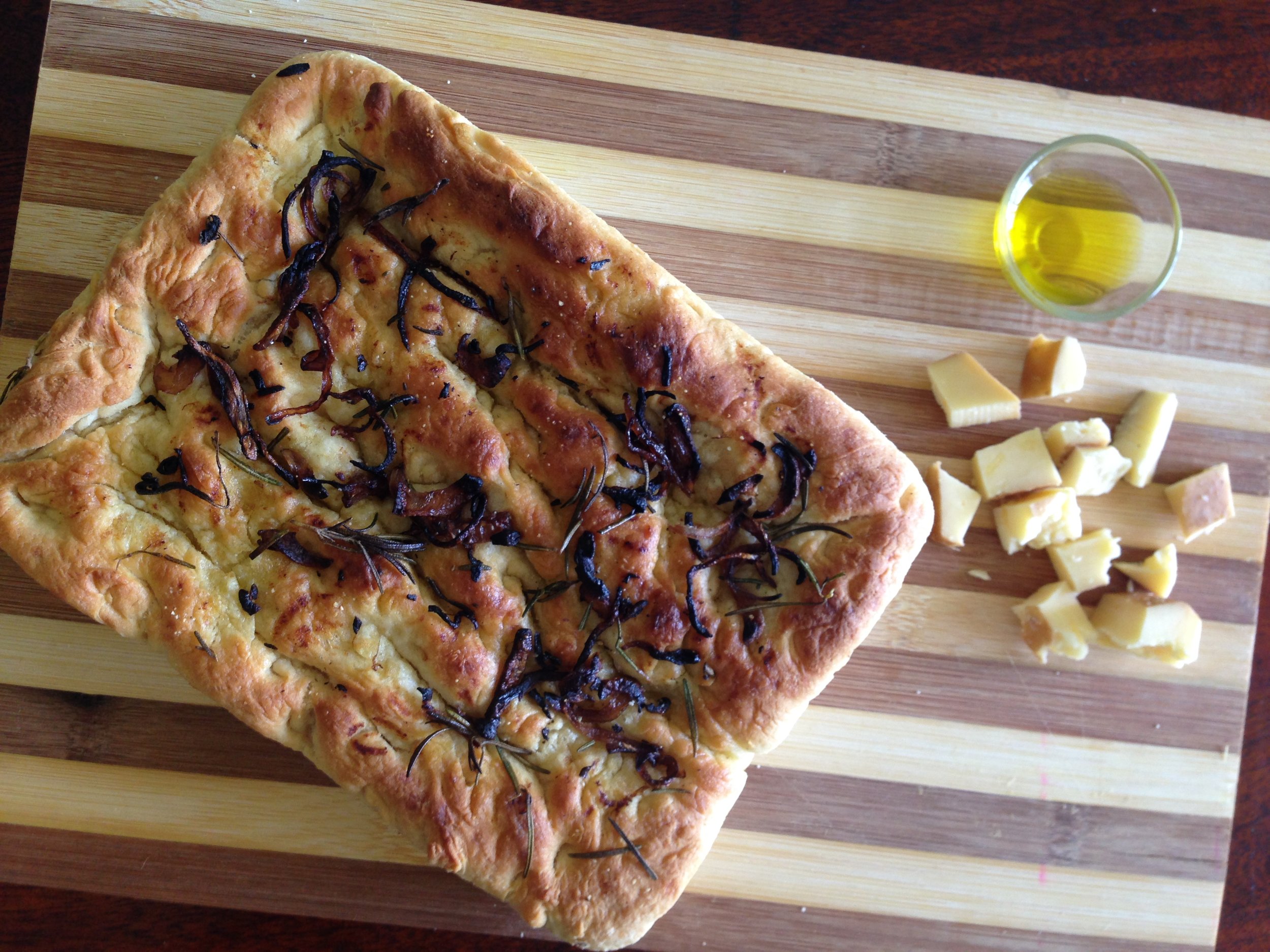
Of course, I don’t always make heathy breads. On days that I am feeling more indulgent or have friends coming over, I make this focaccia. One tip: use good olive oil for it – I used Cannan, an organic, cold-pressed, extra virgin olive oil from Palestine. Amazon stocks it, and as the label says, it helps “farmers stay on their land. It is produced by farmer cooperatives”. If you’re spending good money on an olive oil, try and find one where the money goes back to the farmers.

The focaccia has been baked using extra virgin olive oil. Use premium olive oil for best results. (Photo: Bijal Vachharajani) The focaccia has been baked using extra virgin olive oil. Use premium olive oil for best results. (Photo: Bijal Vachharajani)
Ingredients (Adapted from Jamie Oliver’s recipe)

For the toppings
2 onions
Sea salt
½ tsp- Ground black pepper
A drizzle of extra virgin olive oil
Few sprigs of rosemary
3 tbsp- Balsamic vinegar

For the dough
400g- Maida, organic and unbleached
100g- Whole wheat flour
7g- Dried yeast
½ tbsp- Fairtrade castor sugar
325ml- Lukewarm water
2 tbsp- Semolina
Sea salt to taste
Extra virgin olive oil to taste

Method
* Put the tepid water in a glass and mix yeast and sugar into it with a fork. Leave aside for a few minutes. You know the yeast is active when it starts to foam, and if you “listen” to the mixture, there’s a distinct hum.

* Mix the atta and maida with ½ tbsp. of sea salt and make a well in the middle. Pour in the yeast mixture and stir with a fork.

* Put the dough on a clean, flour-dusted surface and knead for five to seven minutes. To knead, push the dough away from you, and bring it back towards you.

* Put in a greased bowl, pour some olive oil and cover with a clean kitchen towel. Leave to prove for half an hour.

* To prepare the topping, slice the onions. Sauté them with rosemary in olive oil until the onions are translucent. Add balsamic vinegar and fry for another couple of minutes. Keep aside. You can make your own topics – cheese, basil, and tomato; cheese and rosemary; sundried tomatoes and olives – it’s up to you.

* Preheat the oven to 220C/ 425F. Line your baking try with some semolina.

* When the dough has doubled in size, pound it and place it on the tray, so that it covers the bottom.

* Pour some olive oil on the bread, and push it down with your fingers so that it becomes like small hills and valleys.

* Press the onion toppings on the focaccia. Top with sea salt, pepper and a good drizzle of olive oil. Leave to rise, covered with a wet kitchen towel, for around 30 minutes.

* Bake for 20 minutes. When it comes out of the oven, top the bread with some more olive oil to keep it moist.

Bake a jamun clafoutis this weekend

img_4568.jpg

http://indianexpress.com/article/lifestyle/food-wine/bake-a-jamun-clafoutis-this-weekend-foodie-2834292/

Celebrate the season of jamuns with this uniquely boozy version of the French dessert.

Jamuns, bers, and star fruits are the stuff childhood memories are made of. Newspaper cones filled with squishy crimson bers, ensconced in salt and chilli powder, taking a walk in Sanjay Gandhi National Park and cooling down with fat slices of shiny green star fruits, and sticking purple-stained tongues out after eating too many sweet-sour-astringent-tasting jamuns.

Jamuns are entrenched in our myths and legends. For instance, the jambudvipa – jamun island – according to Hinduism, Buddhism, and Jainism cosmologies – is where humans lived at the beginning of time.

Today, all sorts of jamun delicacies are available in the market – from strips of diabetes-friendly jamun chips to jamun juice and kala khatta golas and jamun vinegar. I was gob smacked to learn from a story by food writer Vikram Doctor that jamuns are the basis of kala khatta, along with sugar, rock salt, and nimbu. Apparently, everyone knows about it. But then kala khatta gola has a ring to it, unlike a jamun gola. Well, I’m definitely plotting a jamun sorbet soon.

My friend Deborah had a jamun tree outside her house in Cooke Town in Bengaluru and promptly tucked ripe jamuns under a bed of oats, butter and sugar, to make one of the most interesting fruit crumbles I have had. Given its unique flavour, it’s a bit of a surprise that we don’t have a bevy of jamun desserts. Instead, we haul blueberries and blackberries from halfway across the world, rather than celebrating our mulberries and jamuns.

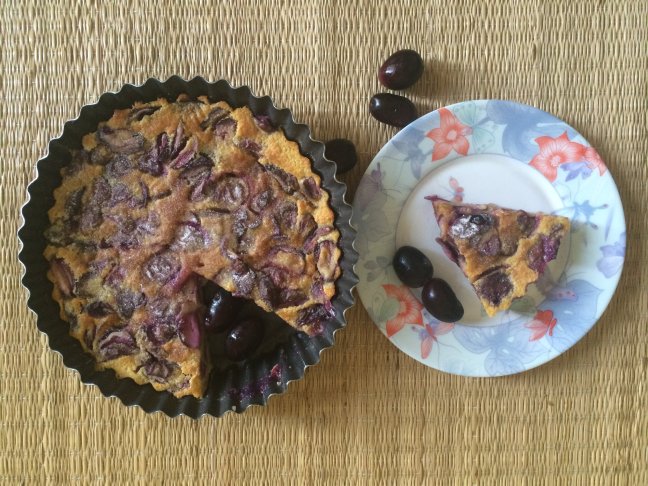
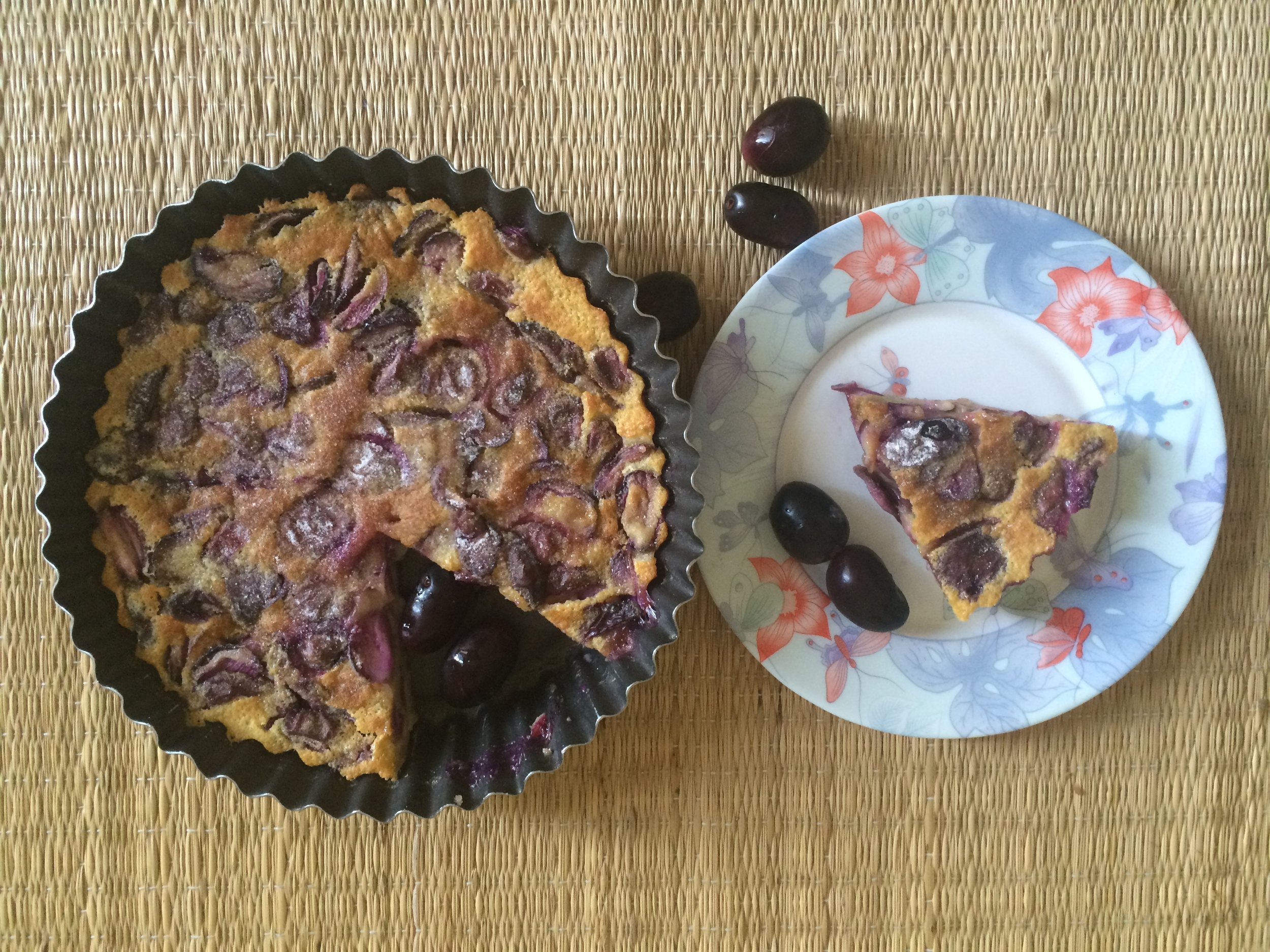
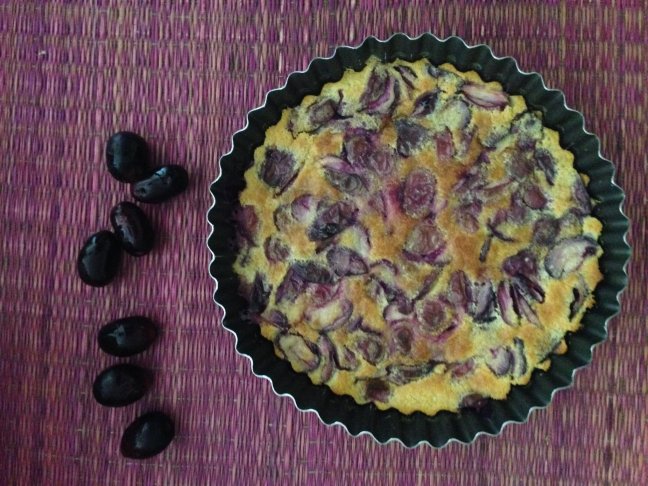
Which is why I decided to bake it into a clafoutis, a classic French dessert which is usually made with cherries. A clafoutis has a delightful custard consistency which does wonders to the astringent jamun taste. For the recipe, cherries are usually marinated in kirsch or brandy. I marinated the jamuns in a Sula Riesling white wine, on a friend’s suggestion. But it works fine without that as well.

Jamun Clafoutis

Ingredients
Adapted from a recipe by Nigel Slater
500g- Jamun
2 tbsp- Sugar
2 tbsp- White wine (optional)
80g- Sugar
2- Free range eggs
90g- Flour
150ml- Milk
½ tsp- Vanilla extract
30g- Butter, melted
2 tbsp- Demerara sugar
Some icing sugar for dustingIMG_9943

Method
*Stone the jamuns and cut them in half.

* Toss them with 2 tbsp of sugar and wine. Leave to macerate for a couple of hours.

* Butter a baking dish and dust it with the demerara sugar.

* Put the jamuns at the bottom of the pan.

* Preheat oven to 180C/ 350F.

* Beat the sugar and eggs together.

* Add sieved flour, milk and vanilla extract, and mix well. Stir in the melted butter.

* Pour the batter over the jamuns. Bake for 35 minutes until golden brown.

* Dust with icing sugar.

* Serve warm with custard or ice cream. Though a cold jamun clafoutis is quite delicious as well.

Once upon a summer’s day

img_9552.jpg

A round-up of the coolest books to keep your kids occupied during these infernal summer holidays

http://www.thehindu.com/books/lose-yourself-in-these-pages/article8649561.ece

The Boy Who Swallowed a Nail and Other Stories Cover AGN.new_Page_1


Summer vacation means the kids get to curl up with a book, a plate of sliced mangoes, and drift off to Storyville. There’s plenty of exciting stuff happening in the world of books this summer. The new Rick Riordan is just out – The Hidden Oracle: The Trials of Apollo I, and then in July, Harry Potter and the Cursed Child – The Rehearsal Edition will be published in the muggle world. Here’s a list of books to add to the reading list this summer.

For Young Adults

Asmara’s Summer by Andaleeb Wajid: A spunky story about Asmara, a hip and popular teen who finds herself relegated to her grandparents’ decidedly not-so-posh place on Tannery Road in Bangalore for the summer. Asmara’s shorts are the cause of horror to her Nani, there’s that stuffy neighbor aunty to contend with, and worse, there’s no Wi-Fi! Asmara decides not to tell her friends about this one-month interlude in her life, so she’s pretty much friendless in the area, apart from Rukhsana who’s about her age. Things start looking up when Asmara discovers that Rukhsana has a gorgeous brother. While Asmara entertains herself by starting an Instagram account to poke fun at the fashion disaster of a neighbourhood, she also discovers that there’s more to life than the way people dress and talk. A breezy read, Asmara’s Summer is also warm and has moments that are wonderfully poignant.

Hedon by Priyanka Mookerjee: Hedon is the story of the millenials. Tara Mullick meets Jay Dhillon at a wedding when she’s a teenager. An awkward, plump teen, that too. Soon she heads off to the USA to study, but she keeps in touch with Jay over texts and quick phone calls. Priyanka Mookerjee writes the story of the privileged – Tara goes to a posh school in Kolkata and then to a US college. She’s surrounded by money and yet it all feels pointless to her. Hedon is a story of debauchery, of existential questions, and of pop-culture. But it also talks about that feeling of alienation, the lusciousness of poetry, and just life as it unravels.

Tanya Tania by Antara Ganguly: An epistolary novel by Antara Ganguly, parts of Tanya Tania are set in the early ’90s. Letters fly between Tanya in Pakistan and Tania in Bombay, talking about their lives, school, home, friends and boyfriends. In many ways, the two pen-friends are self-involved, writing more to share, rather than listen. But ultimately, finding comfort in words. And slowly, the letters begin to reflect the political and social tensions in both countries. A coming-of-age book, Tanya Tania is about aspirations, sexuality, class differences, political ideologies and how they impact everyday people, gender differences, and of course, friendships. A heart-wrenching read, Tanya Tania is also a reminder of how two decades on, very little has really changed.

For Tweens

The Boy Who Swallowed a Nail and Other Stories by Lalita Iyer: A fresh voice in kid lit, journalist Lalita Iyer’s memoir is reminiscent of the simplicity and innocence of childhood. Children will fall in love with her quirky family, where one day Appa is pondering about buying a buffalo much to the horror of the children, and on another, Ammini is telling an impressive story about a fart. It’s the little things that count – such as Amma’s habit of washing clothes in every hotel they stayed in during holidays or the description of foods such as aloo parathas with dollops of white butter and dahi. There’s even a recipe for this tomato jaggery chutney by Paatumami. Shamika Kocharekar’s illustrations are as happy as the stories. The tales are almost like sitting at your grandmother’s knees, listening to one anecdote, after another.

Monkey Trouble and Other Grandfather Stories by Ruskin Bond, illustrated by Priya Kurian: There’s always a steady stream of old and new Ruskin Bond stories jostling for space on bookshelves. But now some of these stories have a new avatar with Priya Kurian’s splendid illustrations in the comic book, Monkey Trouble and Other Grandfather Stories. Kurian takes three of Bond’s stories – “Monkey Trouble”, “Eye of the Eagle”, and a “A Special Tree” and renders them in delightful colours. The most memorable one is “A Special Tree”, where a Ruskin Bond like grandpa encourages his grandson to sow a cherry tree seed and together they marvel at its growth through different seasons.

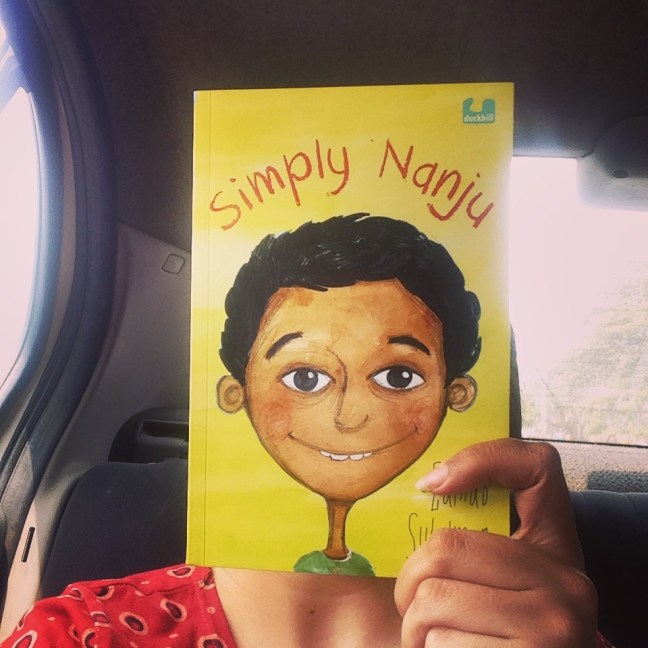
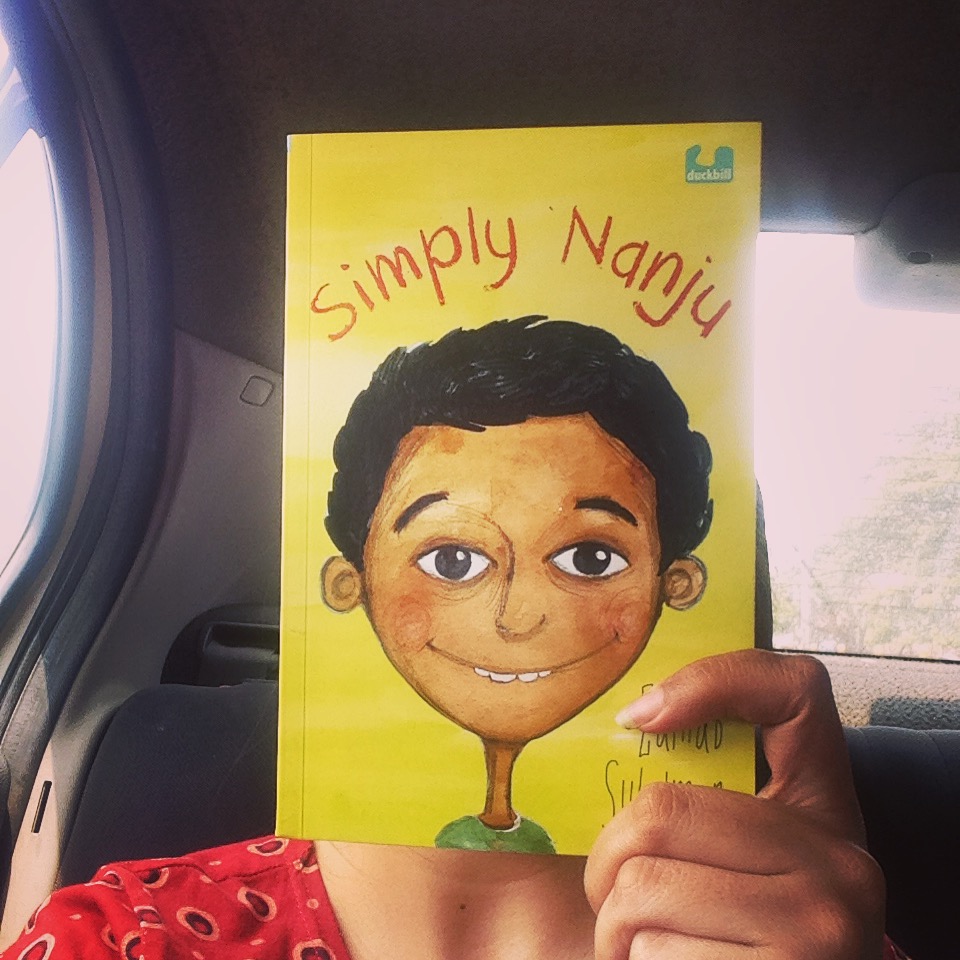
Simply Nanju by Zainab Sulaiman: Life isn’t easy for Nanju – he was born with a spinal problem and is often bullied at school. To make matters worse, Appa is threatening to send Nanju away if his marks don’t improve and someone’s flicking the topper’s notebooks in class, and Nanju is a key suspect. But the boy finds solace in his very smart best friend and plants. Zainab Sulaiman sets her story in a school for the differently-abled, writing about it with sensitivity and masterfully. Simply Nanju is about inclusion, but it’s also about class structures, bullying, and just navigating the bumpy path of school life.

For the younger ones

A Helping Hand by Payal Dhar and illustrated by Vartika Sharma (available on StoryWeaver.org.in): Miss has told “me”, the protagonist of the story, to be the mentor to the new girl in class and show her around. In a series of letters that are never meant to be read, the girl pours her heart out – about her reluctance to befriend the new girl because she’s different. At one point, she writes about a conversation with her older sister. “I told her, ‘There’s a girl in my class and she has a fake hand,’ and she said that the term is ‘prosthetic hand’.” Payal Dhar writes convincingly from the point of view of a child and has shades of empathy, bullying, discrimination, and inclusion. Vartika Sharma’s illustrations are hauntingly beautiful and stark, making the story a memorable one.

Kasturba by Tanaya Vyas: The young Nina is quite an actor. She’s played all sorts of strong female protagonists – from Sita to Razia. But for her next play, Nina’s got the role of Kasturba. She can’t help but wonder about the role, after all she asks herself, Kasturba was only Gandhiji’s wife, wasn’t she? But when Nina starts preparing for the role, she finds out there was more to her than just being a wife.

Thatha at School by Richa Jha and illustrated by Gautam Benegal: Delhi-based Oviyam may just be in second standard but she has a looming black cloud above her head. The school is celebrating their annual Grandparents Day and all grandpas and grandmas are invited. Oviyam’s embarrassed to bring her lungi-clad Thatha, but he’s ever-so excited about it. Richa Jha writes a wonderful, nuanced tale about a child’s relationship with her cherished, if sometimes embarrassing Thatha. Gautam Benegal’s illustrations are spirited and reflect Oviyam’s constantly changing moods perfectly.

The author writes about education for sustainable development, conservation, and food security. She’s the former editor of Time Out Bengaluru

What’s your sustainability quotient?

img_9281.jpg

http://www.thehindu.com/news/cities/mumbai/whats-your-sustainability-quotient/article8613855.ece

Last week, an adorable cat meme popped up on my social media timeline. Yes, just one of many adorable memes, gifs, videos that inhabit the Internet. In this one, a mommy cat was cleaning her face with meticulous care, and in the background, her kitten was trying hard to copy her actions, albeit a little clumsily. The meme went on to impart the gyaan that children learn from their parent’s actions. Didn’t really need a copycat to remind us that children — especially babies and toddlers — learn by copying adult behaviour.

But now is a good time to consider our actions as grown-ups, and for some, privileged grown-ups. India is going through a mega water crisis, which as journalist P. Sainath reminds us, is a drought that is not just the product of the failure of monsoon. Our landfills are smoke-belching, bloated trash monsters. According to India Together , the country is chucking out some 36.5 million tonnes of municipal solid waste every year. Temperatures are soaring while the air quality is plummeting, we may as well log onto eBay and start buying bottles of fresh air, along with the cartloads of stuff we are constantly ordering. All swathed in layers of unnecessary plastic and thermocol. We have also earned the dubious distinction of being number 12 in the top 20 countries to dump heaps of plastic into the ocean, according to a study published in the journal Science.

Let’s leave aside what sort of a planet the kids are going to inherit. Instead, think about how our unsustainable (or sustainable) traits can easily pass on to children, along with beaky noses, eye colour and chin clefts. At “The contribution of early childhood education to a sustainable society,” a UNESCO workshop held in 2008, there was “a strong consensus that educating for sustainability should begin very early in life. It is in the early childhood period that children develop their basic values, attitudes, skills, behaviours and habits, which may be long lasting.” The report further elaborated that at a younger age, children pick up “cultural messages about wealth and inequality” and that’s the time to foster values that support sustainable development “e.g. wise use of resources, cultural diversity, gender equality and democracy.”

Take for instance, water. It’s easy enough to get the society secretary to order water tankers when your building is facing water cuts. We pay so little for water that it’s equally convenient to forget that our reckless water consumption in cities adversely impacts people in remote regions and those living around us. When disasters such as droughts occur, children are the most vulnerable to the crisis.

Here’s a quick water audit. When you travel on holidays or even around the city, do you carry refillable bottles of water, or just buy packaged water? Studies have shown that packaged water is often adulterated or misbranded, and there are valid environmental concerns about the procurement of the water. The bottle is just one more bit of plastic to end up in a landfill and the ocean. It’s suddenly a less gargantuan task to carry a bottle of water from home.

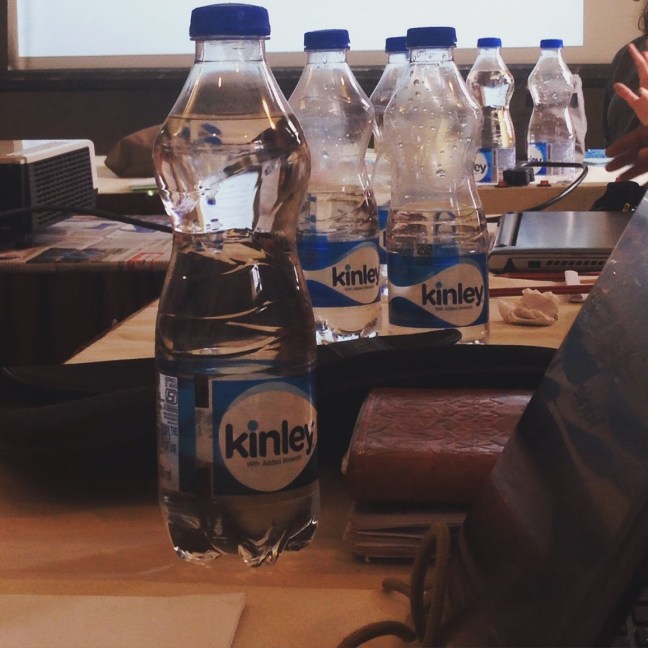
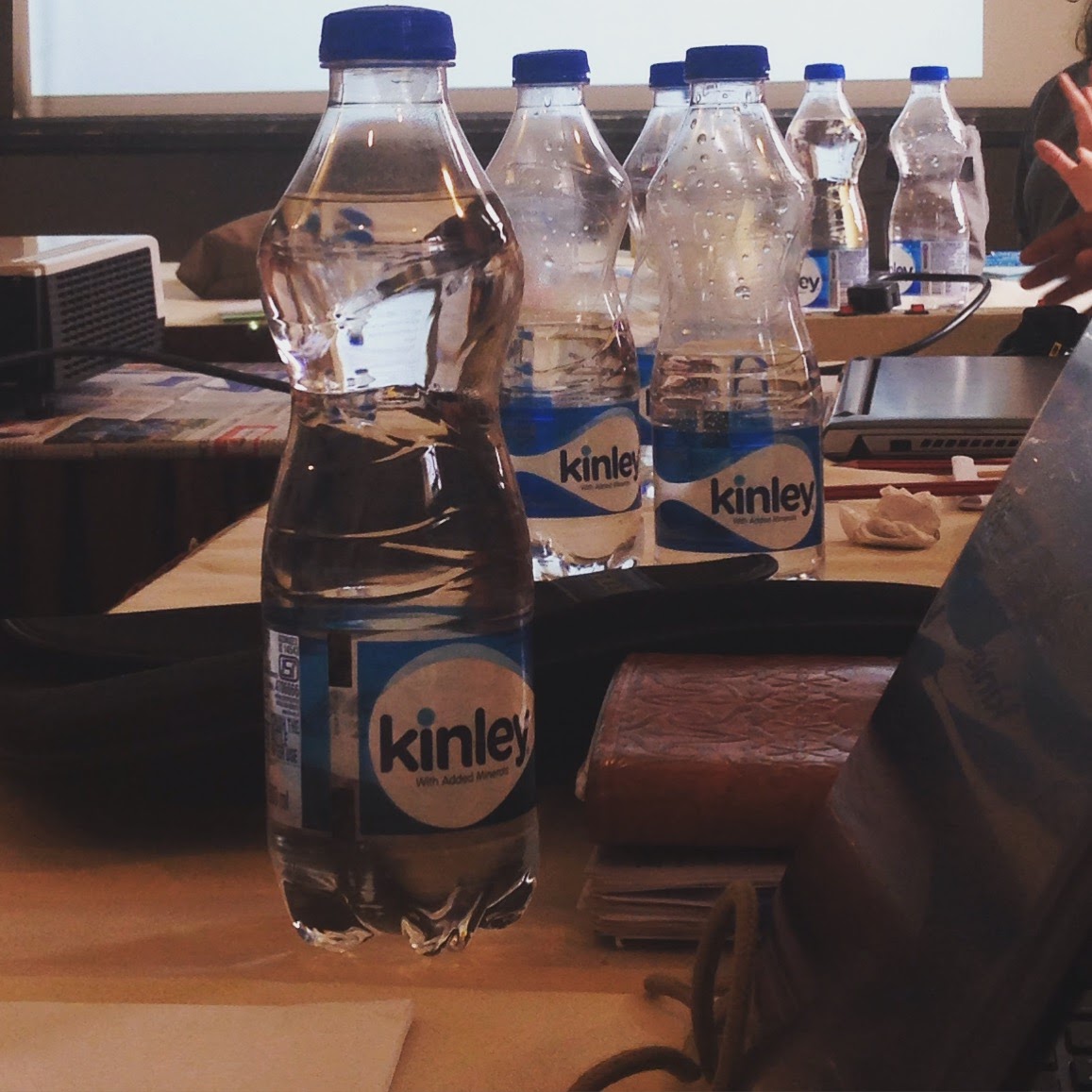
The last time I was at a meeting, I was horrified by the number of bottled water that cluttered the conference table, along with laptops, pens, and fresh notepads, that would also be chucked after a doodle, a note or two. We could take a cue from the Nephelai — Greek nymphs who poured water from pitchers to make it rain — and pour ourselves a glass of water from a jug kept on the table.

Perhaps someone in the house leaves the water running in the bathroom or kitchen and then you lecture the kids about saving water? In Sophie Kinsella’s young adult book Finding Audrey , she makes a clever point about the use of technology. While the parents yell at their son for being addicted to a video game, they can’t do without their phones. No surprise then if lectures fall on deaf ears.

Of course, it’s not easy. Sometimes there is no option but to buy bottled water. Never mind that access to clean drinking water is a right, and should not be a commodity. At other times, you’re compelled to; like in theatres that don’t allow you to carry water bottles inside the cinema hall. How do you wash down the over-priced popcorn during the interval? You buy packaged water or a glass of flavoured sugar water. Maybe float yet another petition, this time to the theatres to allow water bottles in, instead of forcing us to buy packaged water?

So then how do we, as grown-ups, step out of our cosseted liminal world clasping our children’s hands? Talk to children about wasteful practices. You will be astounded at how much they already know. Could we perhaps buy less packaged water? Reuse leftover food — wasting food equals wasting water. Car pool instead of taking a massive SUV to drop just one child to school. Hit pause on the endless obsolesce of gadgets and buying shiny new ones, even if the old phone/ tablet/ indoor entertainment gadget is working perfectly fine?

At the same time, instead of playing football on a virtual field, perhaps step out to a park, if you can find one that is. Start a balcony garden? Even our matchbox houses can sustain a window sill one. Grow easy plants such as tomato and herbs that are hard for even the brownest of thumbs and greyest of smogs to kill off. The other day, someone called me and asked, “What is vermicomposting? My child has a project in class.” Possibly a good place to start is by reading up and becoming a “know-it-some” at least. Children have a natural affinity for the environment, but watching grown-ups being callous often transfers the indifferent behaviour onwards.

All this is intuitive and stuff of common sense. You don’t need to read an article to tell you this. But to use a cliché, let’s lead by example. Because even if children’s heads are eclipsed by a screen or they are breathlessly running from one class to another, they are picking up cues from adults. It’s not just Big Brother who is watching us all the time.

The author writes about education for sustainable development, conservation, and food security. She’s the former editor of Time Out Bengaluru

Read the movie!

in-front-of-the-posters.jpg

Nagesh Kukunoor’s new film Dhanak has been novelised by children’s writer Anushka Ravishankar

http://www.thehindu.com/news/cities/mumbai/read-the-movie/article8623588.ece?ref=tpnews

Dhanak


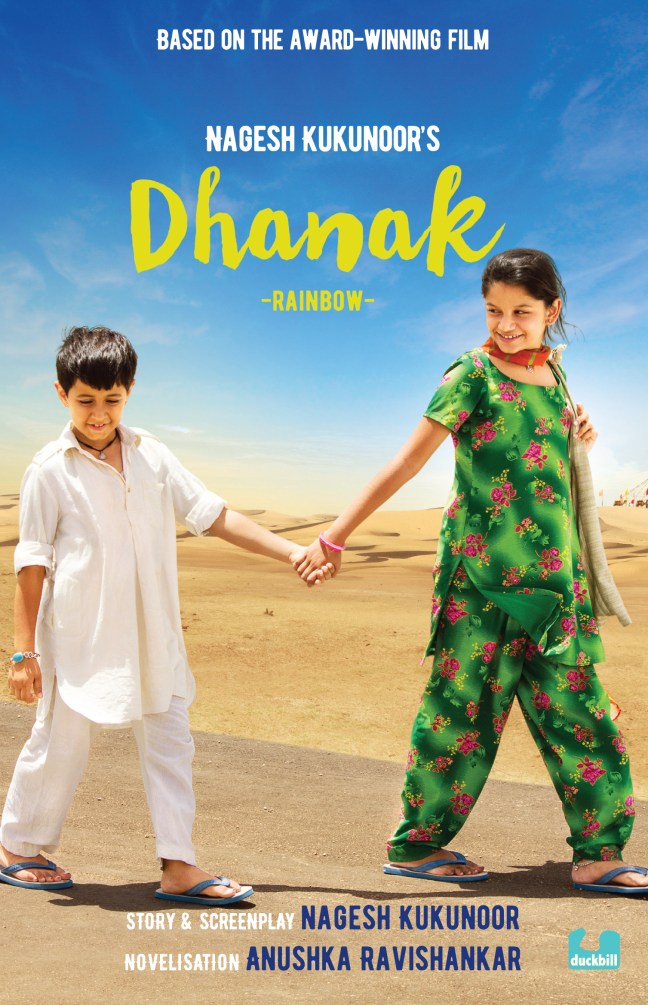
All eyes are on Nagesh Kukunoor as the much-awaited film Dhanak is set to release next month. This time around, before they watch the film, children can now read the movie. Duckbill Books is publishing Dhanak ’s novelisation on June 10, a week before the film releases. The book is written by one of India’s beloved children’s books writers, Anushka Ravishankar, one of the founders of Duckbill.

“We’ve been seeing some really good children’s films in Indian languages,” said Ravishankar, over email. “and it has often struck us that the kind of stories being told in films are very different from the kind of stories that are written for children’s books: more experimental, more unusual. Some of those films would make wonderful books.” A friend told Sayoni Basu, Duckbill co-founder, about Dhanak . She then floated the idea to Elahe Hiptoola, one of the producers. “They were cautiously enthusiastic, and sent us a preview of the film,” Ravishankar says. “We saw it and thought it would make a great book.”

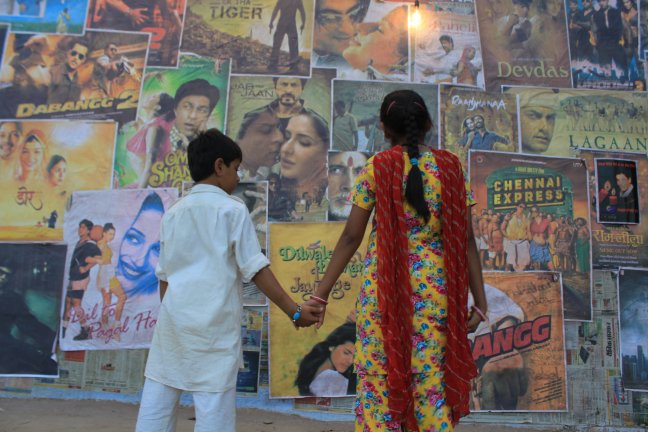
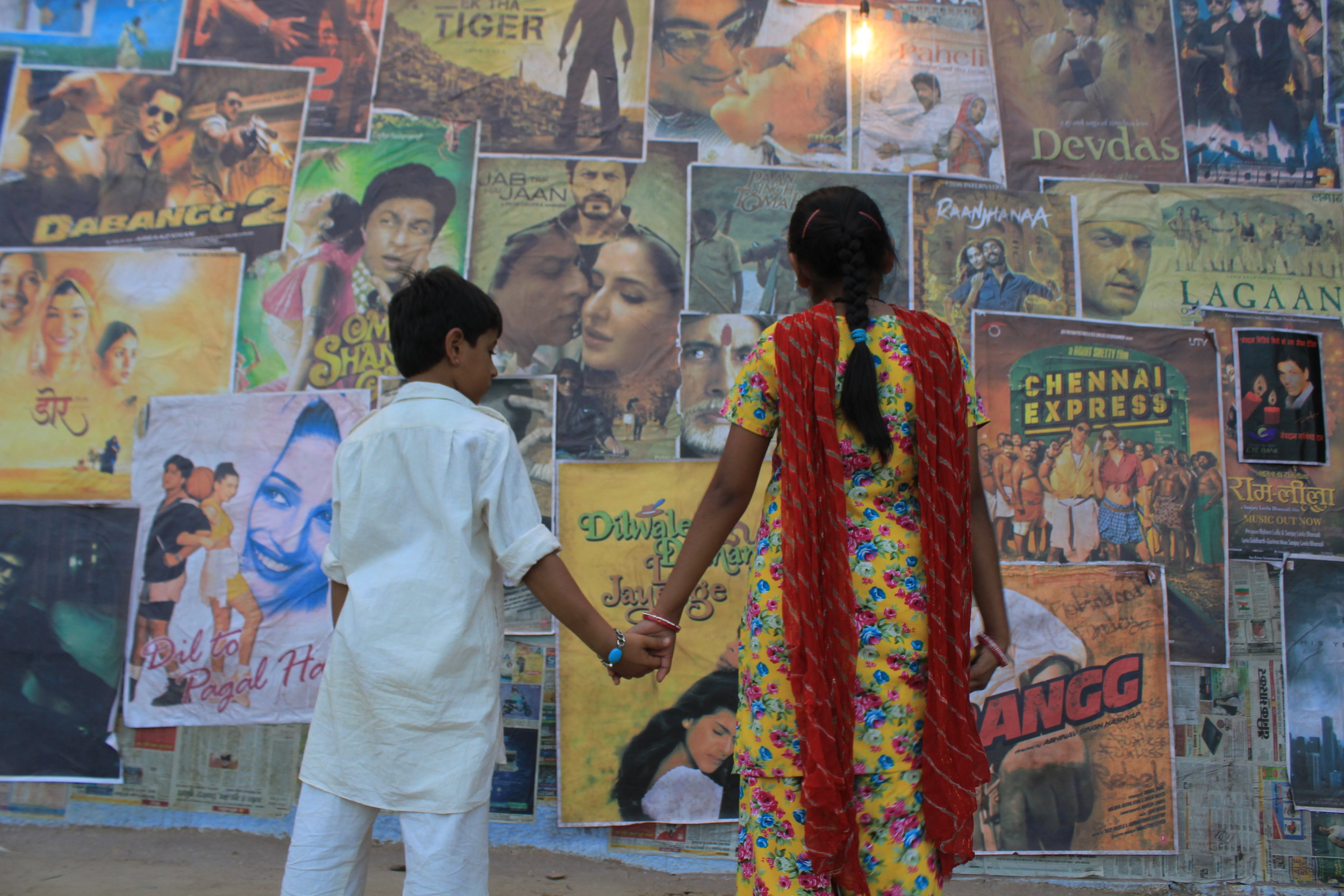
Dhanak ’s trailer already looks promising, and it has been garnering attention internationally. The story is about a pair of siblings who live in Rajasthan with their uncle and aunt. Pari is determined that Chotu will get his eyesight back before his ninth birthday, but that’s barely a couple of months away. Things look up when Pari sees a poster with Shah Rukh Khan urging people to donate their eyes. She starts writing letters to the actor, asking him to help Chotu. When Shah Rukh Khan comes to Rajasthan for a shoot, Pari and Chotu set off on a road trip, determined to meet the actor and get Chotu’s eyesight back. En route they encounter all sorts of people: some helpful, others kind, some horrid, and others mysterious. The book also includes eight pages of colour photographs and interviews with Hetal Gada and Krrish Chabria, the actors who play the siblings.

Ravishankar described the process of turning the film into a book for children as exhilarating and frightening. “It’s a very visual film, and Nagesh has captured both, the spectacular landscape of Rajasthan, and the joyous optimism of childhood. To translate all of that into words seemed like a daunting task. But since I’d never done it before, it was quite an exciting journey of discovery for me. I had to think about practical things like POV [point of view], because it works very differently in a novel as compared to a film. I also had to convert expressions and observations into interior monologue and description. I’ve never been very enthusiastic about describing things in my books, so that was quite a change for me!”

To write the book, Ravishankar spoke to Kukunoor a couple of times. “It was quite lovely. I spoke to him only a couple of times, but they were longish chats, about character, about specific plot points and timelines, what he felt the essence of the film was. He was helpful and forthcoming and I felt comfortable talking to him, even when I didn’t entirely agree with him! If I hadn’t felt that degree of comfort, I suspect it would have been harder to write the book.”

The story is all about moments: the banter between the siblings over Salman and Shah Rukh Khan, Chotu’s incessant demand for food, and the warmth and solidity of their relationship. Rajasthan is an intense, vibrant backdrop, its characters flitting in and out in all shades of grey and myriad colours. Unlikely friendships, the kindness of strangers, and preserving against all odds are themes woven into the plot.

Of course since Dhanak is a Bollywood film, there have to be songs. But Ravishankar manages to integrate them into the story quite seamlessly. “There’s the wedding party which the children join, and there’s the American man with whom Chotu sings and the Kalbeliya singers/dancers whom they sing with around the campfire. None of the situations are implausible. I ignored the songs that were part of the background score, of course!”

At some point, you forget that this is a novelisation of a movie; it’s easy to get lost in the story.

But then Ravishankar has written memorable children’s books such as Tiger on a Tree , Catch that Crocodile! , To Market! To Market! , and Moin and the Monster . Her mathematics degree has been put to good use in Captain Coconut & The Case of the Missing Bananas .

According to the Duckbill founders, Dhanak is the first Indian novelisation of a children’s film. In the past, K.A. Abbas has novelised Bobby and Mera Naam Joker , but there aren’t that many examples. And none for children’s films.

“Children’s films in India seem to be doing interesting things,” said Basu. “but it is really hard to track them down to watch! We still need many more diverse kinds of stories and voices in children’s books, and I do hope we can find them.”

Ravishankar says that one of the problems is that there are few spaces to exhibit children’s films. “Many of them don’t even see theatre releases, and if they do, they probably have one morning show on one screen! I think that is a crying shame. I wish schools would make the time and space for children to see good cinema. There are so many talented filmmakers making powerful children’s films. They need to be seen.”

The author writes about education for sustainable development, conservation, and food security. She’s the former editor of Time Out Bengaluru

Eating a revolution

food-rev54504_preview.jpg

British celebrity chef Jamie Oliver is hoping to bring about a change in the way they approach food and nutrition

Today, British celebrity chef Jamie Oliver’s campaign, Food Revolution, kicks off in 10 countries across the world. In what he calls a global day of celebration, Oliver is hoping to get people to think about the world health crisis by raising awareness, sparking discussions, and inspiring people to bring about a change in the way they approach food and nutrition.

The campaign focuses on children and the need for a robust and fun food education system. On his website, Oliver points out that “millions of kids are eating too much of the wrong food, while millions more don’t get enough of the good stuff to let them grow and thrive. We need to unite as one strong, single voice to force governments and businesses to create a healthier, happier world for the future.” In India, chef Kunal Kapur and actor Jacqueline Fernandez will be cooking live on Facebook from Pali Village Café in Bandra.

In an email interview, the chef talks about food education, his online presence, and how Indian foods have influenced his palate. Edited excerpts:

Tell us the idea behind Food Revolution. What is new this year?

The Food Revolution is my attempt to create a worldwide campaign to discuss, debate and adopt a healthier way of eating. The statistics, especially concerning children, are startling and this makes me scared about global health. 159 million children are too undernourished to grow properly, whereas 41 million children under the age of five are overweight.

I have been campaigning for healthier food and better education about nutrition for 15 years now. One of the first TV shows I created in 2010 was called Food Revolution. It was centered on reforming school lunches in US schools and also trying to create a conversation about healthy food and nutrition in America.

This year the Food Revolution is taking place on a huge scale with 10 countries involved in the campaign, in an attempt to spread the conversation to a global audience. It kick-starts on May 20 with live-streaming on my Facebook page. I cook healthy meals, provide advice and of course have lots of fun. The live-streaming makes this an interactive medium where people from different countries can be a part of the Food Revolution. And the best thing is that I have some of the best chefs and best known personalities coming on board, teaching people watching them in their countries just how easy and inexpensive it is to make nutritious food. The campaign will then continue in Australia, India, Germany, Netherlands, Brazil, USA, Kenya, Tanzania, Canada and Nigeria.

This is the first time you are officially doing something in India for the Food Revolution. What can we expect?

Being British, I can safely say that Indian food has influenced my palette. The British love Indian food precisely for the reasons it is famous for. It’s wholesome, fresh and delicious. My blog is filled with Indian recipes! Therefore, I really feel a connection to India and I am so glad the Food Revolution has spread to India.

I want people to be better educated about food. In a country like India, which has the world’s youngest population and where starvation and obesity exist simultaneously, it is important that people are made aware about how our diet impacts our daily life. In India, the government is trying to reduce the number of malnourished children by launching initiatives like Infant and Young Child Feelings Counselling Centres in certain states. At the same time, it is beginning to tackle the obesity crisis by raising awareness of the negative impact that poor dietary and lifestyle choices can have on health, with programmes like the National Programme for Prevention and Control of Cancer Diabetes, Cardiovascular Diseases and Stroke. However, still more can be done. I’m also looking forward to one of India’s top chefs, Kunal Kapur, cooking with actress Jacqueline Fernandez to show the audience just how fun and easy cooking can be.

Food Revolution is a massive online campaign. Tell us about running the campaign through social media.

The live-streaming feature makes the entire event interactive and inclusive to a global audience, through a virtual medium. But even prior to this event we have constantly used the support of social media to get our message of healthy eating out there. We have started a petition to include practical cooking for school children and people all around the world have signed it and most importantly shared the petition for others to sign. The world is now at our fingertips and social media helps in uniting everyone especially for important causes like global health. With our Food Revolution Day website anyone will be able to access information regarding the campaign and we hope the #FoodRevolutionDay trends worldwide to spread the importance of eating healthy around the world.

At a time when people are increasingly obsessed with food, we are also increasingly spending less time making our food. It’s a trend we are seeing in urban India as well. How does one start to bring change then?

The Food Revolution is an initiative wherein we use our buying power as consumers to take a stand against unhealthy practices. As consumers we have the power to make a lot of change in the food industry.

Many people believe that healthy food is more expensive than junk fast food. We help clarify these myths. That is why it is important to start this discussion so people can debate, ask questions and become more aware.

We especially encourage parents and schools to adopt healthier eating habits so it can impact their children’s lives for the better. Small steps like cooking with your children, reading up current issues about the food industry can come a long way in educating your child about nutrition.

By adopting a healthy lifestyle you are allowing future generations to access, consume and understand food better than we ever could.

That is why a campaign like Food Revolution is important as it encourages better food education.

One of the campaigns you actively advocate is involving kids in food appreciation. Tell us about the importance of food education for children.

Like I said our children are our future, and with India’s having the world’s youngest population. the youth are fundamental to India’s growth as a nation.

To better educate them about food means to better education future generations to come. It is essentially to adopt a healthy eating lifestyle early and at the same time ensure that the kids are excited and eager to learn more about food.

The Kitchen Garden is a program I started that teaches school children how to plant a seed and eventually cook a meal with the ingredients they have grown. Whether you are a teacher or a parent inspire your children to love food.

Becoming a good food advocate is especially critical as a climate adaption method. How far do you think campaigns such as Food Revolution Day help people think about how their food is grown?

Campaigns such as Food Revolution Day are based on accessing and using fresh, local produce. That is why campaigns such as Kitchen Garden help children to learn and think about how their food is grown and what they are putting into their body.

One of the most important campaigns I have worked on is the Ministry of Food Campaign. It aims to keep cooking skills alive as it has been proven that cooking from scratch has many healthy benefits to your eating habits. Through a national network of food advisers and cooking teachers we help make the public make better choices about food and nutrition.

Being a food advocate means imparting your knowledge and allowing people a chance at a better food education, which is what the Food Revolution campaign aims to do.

As a chef, how do you ensure a transparent supply chain for the food you cook with?

Sales of organic and more responsibly produced food are on the rise, and like anything, if we demand more, more will become widely available. I find it impossible to be 100 per cent organic, but I do trade up whenever I can. When we trade up to organic meat, it will be more expensive, but really this change is to instigate the habit of eating less meat, and choosing the best when you do. It’s all about quality over quantity. When you buy organic meat you are also ensuring the animal has led a good life before this and that’s what it is important to me. We have to be ethical and compassionate in our food industry. At the same time if they have lived longer you are eating a healthier bird! You are reducing the fertilisers and chemicals you are ingesting. I also love growing my own food. Therefore I adopt these principles as far as I can.

Do we expect to see more of Jamie Oliver in India?

I hope now that we have introduced the Food Revolution Day in India it will never stop. We will ensure that the fight for healthy eating continues and hopefully India will continue the campaign. I do also of course have my restaurant Jamie’s Italian in Delhi so a piece of me is already there!

Chef Kunal Kapur and Jacqueline Fernandez will be cooking live on Facebook today at 3.30pm.

For more details, see jamies foodrevolution.org