Technology and great outdoors, can kids have both?

http://www.dailyo.in/lifestyle/anshumani-ruddra-minecraft-hogwarts-finding-audrey-sophie-kinsella-parenting/story/1/4661.html

Author Richard Louv underlines the importance of adults helping children ‘detach from electronics long enough for their imaginations to kick in’.

Three books for children that take bullying by the horns

http://scroll.in/article/732492/three-books-for-children-that-take-bullying-by-the-horns

YA fiction in India is increasingly pitching kids into real-life situations instead of fantasies, offering strategies for coping.
Bijal Vachharajani  · Jun 06, 2015 · 03:30 pm
Three books for children that take bullying by the horns
20.2K
Total Views

Bullying is often a staple theme in children’s literature – whether it’s Draco Malfoy bolstered by his cronies Crabbe and Goyle in the Harry Potter series or even a teacher like the horrid Miss Trunchbull in Matilda by Roald Dahl. These fictional worlds are not all that different from the ones that children grow up in, even without magical moving staircases or telekinetics.

Here in India, children’s books are tackling the subject of bullying with some solid storytelling and generous doses of humour. These books celebrate diversity, and in doing so remind kids that standing up to bullies takes courage and is the right thing to do. Here are three that take on the issue:

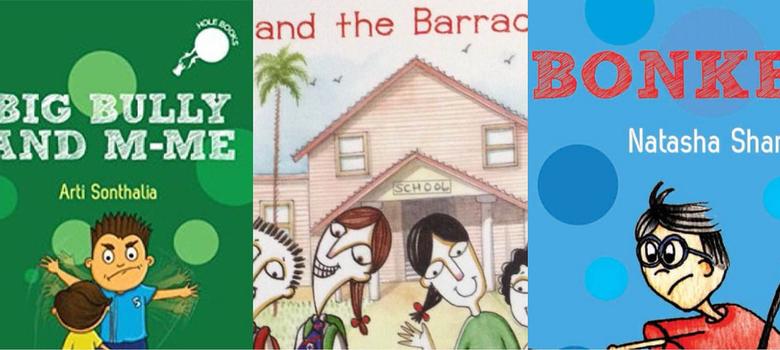
The Dugong and the Barracudas, Ranjit Lal
If you have spent your life hooked onto Animal Planet, you may know that a dugong is a large marine mammal that is known to be quite languid. In nature writer Ranjit Lal’s book, Sushmita is the dugong – a sweet 13-year-old girl who is “not quite like girls her age” because she’s overweight, big and slow.

When she joins Rugged Rocks High School, it’s like a battery of barracudas – her classmates – sinking their teeth into her good nature, pulling no punches while humiliating her. On the first day of her class, the children snicker among themselves, “Fat, fat, fat… everywhere!” and even call her “Mother of all hippos!”

As things take a turn for the worse, Sushmita fights back, but in her own sweet way. Lal tackles the difficult subjects of prejudice and bullying deftly with his usual incisiveness and quirkiness, making the reader chuckle, laugh out loud and think at the same time.

Big Bully and M-Me, Arti Sonthalia
Big Bully and M-Me is part of the delightful Hole Books Series. Meet Krishna, who prefers to be called “Krish without the Na!” You soon realise that Krish is the last one to be picked for team sport because he is the shortest, skinniest boy in class. He finds himself in a fix, when as part of a class assignment, he has to give an extempore speech. For Krish, that’s the hardest thing in the world because of his stammering. And, worst of all, his partner for the assignment is Ishaan, who happens to be “the tallest, meanest bully in the world”.

As Krish preps for the extempore, his Mom gives him some sound advice, “If you get stuck just say ‘I can, I can, I can’”. Arti Sonthalia’s story is short and sweet, and she compels the reader to put themselves into the shoes of Krish and think about his struggle with speech and how it impacts his confidence and relationships.

Also in this series is Bonkers, by Natasha Sharma, which features the bespectacled Armaan and Bonkers, his crazy dog who has just chewed up a cricket ball that belongs to TT, a bully who is the leader of the Ghastly Groundhog Grang. With a combination like that, only chaos can ensue, along with insane amounts of fun and a message that help can come from the most unlikely of sources.

Talking of Muskaan, Himanjali Sankar
Jay Asher’s book Thirteen Reasons Why was a dark book about a teenager who commits suicide and then through a series of audio tapes explains how bullying and abuse drove her to this desperate act. Himanjali Sankar’s protagonist Muskaan also tries to commit suicide in Talking of Muskaan.

As the 15-year-old is fighting for her life in the hospital, three of her classmates narrate the story from their perspective. Muskaan, the reader finds out, has always been different. And for that, her friends tease her brutally. When the teenager confesses to BFF Aaliya that she likes girls, the teasing takes on a cruel edge. Her one confidante Subhojoy has also been dubbed “weirdo” by his classmates because he’s a class topper and hails from a less privileged background. Talking of Muskaan is a compelling, coming-of-age book that brings to the forefront the subject of sexual orientation, class and individuality in an increasingly-homogenous world.

When Bijal Vachharajani is not reading Harry Potter, she can be found traipsing across tiger reserves. In her free time, she is a consultant with Fairtrade India. 

We welcome your comments at letters@scroll.in

Freedom is a bird taking to the skies

http://www.dailyo.in/variety/peta-caged-bird-cockatoos-parakeets-mynahs-sparrows-wildlife-protection-act/story/1/3793.html
bird-embed_051815092305

In recognising for our birds the fundamental right to ‘live with dignity’, the Delhi High Court has done a commendable job.

The rose-ringed parakeet sat dolefully on a window ledge. Like countless other birds raised in captivity, Shawnu couldn’t fly because his wing feathers had been clipped, condemning him to a life where he had to hop from one place to another. Which is why he sat on the wrong side of the window – inside a house, rather than outside perched on a tree or flying happily with his friends.

Rescued from a fortune teller by volunteers of the People for the Ethical Treatment of Animals (PETA) in Mumbai, the rose-ringed parakeet was tiny, almost as if his growth had been stunted from spending a lifetime in a dingy cage the size of an iPad Mini. When anyone came close to Shawnu, he would fluff up his feathers, roll his eyes in fear and make an angry, throaty sound. He constantly groomed himself, to the point that his fragile body was dappled with bald, grey patches. This obsessive, repetitive behaviour called zoochosis is often seen in animals in captivity.

Who could blame Shawnu for being so angry and frightened of human beings? Although trade in indigenous bird species is banned in India, thousands of parakeets, munias and other birds are snatched from their forest homes and smuggled in atrocious conditions to different parts of the country and the world, destined to live a miserable life in captivity. Earlier this month, alarming pictures of yellow-crested cockatoos squeezed into plastic water bottles and smuggled from Indonesia were published online. The photos are truly horrific. The birds look like lifeless feather dusters shoved inside water bottles, their eyes glazed by the trauma. When I worked with PETA India, I came across appalling instances of cruelty to birds – from hornbills being used as roadside entertainment to munias being hawked at traffic signals and chicks being dunked in lurid colours to be sold at Rs 10 apiece.

bird-embed_051815092305.jpg
 The Delhi HC gives ammunition to fight cruelty to birds. Photocredit: Alan Abraham/ PETA India

That is why the Delhi High Court’s observation on May 17 was a shot in the arm for the anti-trafficking movement. Justice Manmohan Singh said, “Birds have the fundamental right to ‘live with dignity’ and fly in the sky without being kept in cages or subjected to cruelty” and “running their trade was a violation of their rights”. It’s a fact that India has strong laws to protect wildlife. The Wildlife (Protection) Act, 1972 prohibits the trade in over 1,800 species of wild animals, plants and their derivatives, and so does the Prevention of Cruelty to Animals Act, 1960.

But ultimately, this violation of rights is down to our apathy and greed. Our desire for entrapping these winged beauties has led to centuries of torture and violence on birds. In his piece Animal Magnetism, evolutionary biologist David P Barash explores our obsession with watching animals and writes, “Animals in captivity might satisfy our desire to cross the existential barrier that separates us from other creatures”. He then goes on to point out, “But for sheer pleasure, there is little doubt that watching birds tops the list. Despite their dinosaur origins… birds are the most assiduously watched wild animals and for good reason: many of them are fantastically lovely, brightly coloured or gloriously iridescent”.

Indeed, there’s nothing more wonderful than watching a bird in the wild – whether it’s a pair of brown sparrows scratching in the dust, a serpent eagle perched majestically on a tree or an owl peeking out of her tree hole. And you don’t have to visit a forest to watch birds. On hot summer days like these, my mother leaves out a bowl of fresh water for birds on our window ledge, and parakeets, mynahs and sparrows swing by for a drink or two. I have spent many mornings standing in my balcony in Bangalore, watching kites soar gracefully above the cityscape.

In the introduction to his book Birds from My Window and the Antics They Get Up To, Ranjit Lal talks about urban bird life. He writes that he has been watching birds from his window and balcony for several years and finds it a “wonderful way of never having to get bored… Peacocks, bulbuls, babblers and sparrows are always at hand to distract him”. And then it’s not hard to understand, why the caged bird does not sing.

Guest post for Snuggle With Picture Books

http://snugglerecommends.blogspot.in/2012/10/bijal-vachharajani.html

When people visit my house, they often think that I am surrounded with books that are meant for my five-year-old nephew. What I don’t tell them is that most of those picture books are mine. While this is in no way an exhaustive list nor does it have all of my favourite books, but these are just some of the top-of-my-mind favourite picture books.

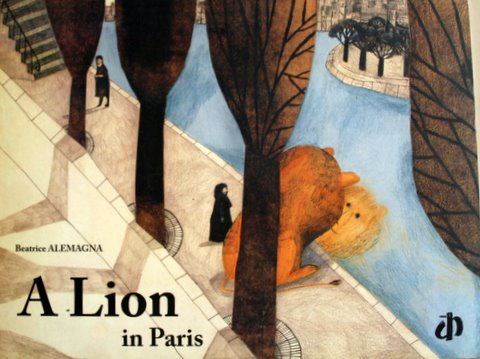
A Lion in Paris: Richa’s already done a fantastic review of this book by Beatrice Alemagna. This is a warm and beautiful book about a lion leaving his Savannah home in search for work, love and a future in Paris. He ambles down the beautiful streets of Paris, wonders why Parisians are carrying swords (read French baguettes) and not challenging anyone to a duel, roars loudly at the underground metro station and then finally settles down in his new found home. Thanks to this book, my poor friend had to suffer Paris with me as I dragged her across the city to take lots of photos in front of a statue of a lion. I am not sure if I found the right one, but hey, it was a lion in Paris. Katha, Rs 150.

The Adventures of Captain Underpants: Parents aren’t going to love me for saying this, but I love this non-superhero series. I have a boxed set that every time you open chimes “Tra-la-la”, the war cry of the school principal Mr Krupp aka Captain Underpants. Harold and George, the resident school trouble makers, successfully hypnotiseMr Krupp into thinking he is a superhero who can fly around in his underpants. And the stories by Dave Pilkey are so much fun: talking toilets, evil cafeteria ladies and there’s even professor called Poopypants.  There’s even a flip book tucked within the pages, which brings the adventure alive. Scholastic.Rs 125 each.

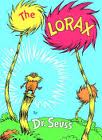
The Lorax: Dr Seuss came late into my life, actually I bought my first book for my nephew and ended up buying another copy for me. Published in 1971, The Loraxstill continues to be an iconic green book. Once-ler, a reclusive man, cut down the Trafulla trees to knit Thneeds – an invention of his that “everyone needs” – at a polluting factory.And the incessant deforestation goes on despite the warning of the Lorax who “speaks for the trees, for the trees have no tongues”. I find the story haunting, with a poignant environmental message, that we continue to ignore. If only the Once-lers of the world would listen to the Lorax more often.

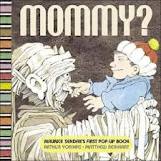
Mommy?:It broke my heart (and many others), when Maurice Sendak died and all I did for the next few days was troll the web for stories about him. I love all Sendak books, but I recently found a copy of Mommy?at Shree Book Centre in Mumbai. This pop-up book designed by Matthew Reinhart and Al Yorinkstakes storytelling to another level. A baby crawls into a haunted house looking for his mommy and just when you think the scary monsters are going to spook him out, you realise why children love monsters. And in this book, the monsters love the baby too, even though he’s not as defenseless as he seems. Every page is a delight, with little pop-ups tucked in every corner.

Thumb Thumb books: The humble thumb art ups its ante with Tulika’s Thumb Thumb books. Featuring Thumb ThumbThambi and Thumb ThumbThangi (try saying it fast), these picture books are illustrated with thumb art. Turquoise thumb prints come together to form a peacock, pink ones form a flower and so on. A lovely book series for beginner readers.Tulika Books.Rs 45 each.

Posted 11th October 2012 by Richa Jha

Review: Dear Mrs. Naidu

http://goodbooks.in/node/7068
By : Bijal Vachharajani  / 2015

Dear-Mrs-Naidu-lo-res.jpg
The first thing that strikes you about Mathangi Subramanian’s book, Dear Mrs. Naidu, is its cover. Rendered in black-and-white by Shruti Shyam, the cover shows vignettes from the book: a woman filling water in a pot, a teacher writing on a blackboard, a boy sipping tea. The protagonist stands out in colour – brown-skinned, neatly oiled hair – sitting on a chatai and writing letters to freedom fighter Sarojini Naidu.

As a classroom assignment, Sarojini starts pouring her heart out to her namesake, in the form of letters. We begin to discover that Sarojini is all of twelve, and from what the government calls the “economically weaker background”. Life for the Bangalore-based tweenager is not easy – whether it’s her best friend Amir moving up in life and shifting to a private school, or living in an informal settlement, or studying in a government school with crumbling walls. She’s further dejected when her mother, under the Right to Education Act, tries to get her admission in the same private school that Amir goes to, only to be rejected and asked for a bribe.

Taking inspiration and help from the people around her – her new friend Deepti who lives at a construction site, a human rights lawyer called Vimala Madam and of course Mrs Naidu herself – Sarojini decides to take matters into her own hands and change things. Rather than get admission in the private school, Sarojini is determined to make her government school better. The odds are stacked against her. There’s the apathetic headmaster who couldn’t care less; the mothers who are neck deep in house work; and even a councillor, who wears a nightie and takes better care of her nails than her constituency (fabulous character that one).

Mathangi Subramanian takes us to the bleaker side of urban life, where toddlers play precariously in construction sites, hoardings are recycled to become roofs for houses and into the hallways of decrepit government schools. These are settings that we are all familiar with, but often choose to turn our eyes away from. There’s a clear demarcation of the haves and the have-nots, and Sarojini is painfully aware of it. But even against this gloomy backdrop, Subramanian’s narrative offers hope and optimism with her characters’ actions and thoughts.

The story challenges the classic Indian fatalistic streak, instead compelling Sarojini and her friends to understand that their actions, however small or big, could lead to social change. It’s refreshing to have a female protagonist like Sarojini, who doesn’t need to be bitten by a mutant spider or be dunked into radioactive waste to be an everyday sort of hero.

As a teacher and policy analyst, the author has done extensive work with children in India and the USA, and it shows in the book. Her characters, especially the children, are very real. They are feisty, witty, and extremely clever. They sometimes hurt each other unwittingly, but then are also resilient kids. The adults are viewed from a child’s lens, making some of them appear stubborn, and others like Vimala Madam as an evil genius.

There’s a short history lesson tucked into the pages of Dear Mrs. Naidu, about Sarojini Naidu and her life. And a crash course on the RTE Act and child rights. There’s plenty of food for thought in here, but mostly Dear Mrs. Naidu works because it’s an endearing story about a girl who wants to change her world and won’t let small things like the government come in her way. For that, the twelve-year-old Sarojini deserves to go down in literary history.

Learn to grow: Why children must read books on farmers

http://www.dailyo.in/arts/childrens-books-literature-farming-enid-blyton-roald-dahl-pg-wodehouse/story/1/3426.html

It’s important that these stories go beyond outdated nursery rhymes, especially for kids, who are naturally curious about where their food comes from.

Brown, Like Dosas, Samosas and Sticky Chikki

http://goodbooks.in/node/7007
By : Bijal Vachharajani  / 2015

BrownCover-01.jpg
Brown, Like Dosas, Samosas and Sticky Chikki

Author:

Rebecca Manari

Illustrator:

Heetal Dattani Joshi
28 pages
English
Rs 199.00
ISBN: 978-93-81593-07-3
Funokplease Publishing,

2014

When my nephew was five, he started going to an international school in Dubai. He came home one day to look at each family member carefully, and very matter-of-factly graded us, according to our skin tone. From creamy white to coffee brown, we could have easily been an advertisement for the Asian Paints shade card. Being surrounded by children from different parts of the world, he was hyper-aware of skin colour, something that he had not thought of before.

Children today are surrounded by a host of media – from picture books to games and toys – with light-skinned characters. As The Guardian points out, “decades of research show that children notice ethnic differences surprisingly early and may start to ascribe values to them”. Growing up in a society where the idea of fair and lovely is thrust down your throat all the time is not easy. Our obsession with fair skin is entrenched deeply, reinforced by corporate brands and constantly upheld by certain sections of the media.

FunOKPlease’s latest picture book, Brown like Dosas, Samosas and Sticky Chikki, attempts to kick-start a discussion around this critical subject. The book tells the story of Samaira, who is faced with a conundrum when Anahi the purple lady offers to turn her “into a shade of white”. Samaira politely refuses, remembering how her mother always said that there are many colours – some like sweet, earthy potatoes, others like sand and cinnamon – and that the world be a dull place if everyone was the same colour. As Anahi comes up with more silly requests and absurd ideas, Samaira resolutely reminds her that she is comfortable in her own skin, thank you very much.

Illustrator Heetal Dattani Joshi gives the characters an Indian-Disneyfied look – Samaira has huge, melting brown eyes, while Anahi could give any Disney princess a run for her crown. The book comes with a pull-out picture frame with the message, “Whatever be your special shade; Unique and perfect you’ve been made!” Rebecca Manari’s storyline is charming, brimming with some fun local food metaphors, such as skin “the delicious colour of black forest cake” and “brown like dosas, samosas and sticky chikki”. However, her verse often feels forced, making the picture book a stilted read.

However, the ethos behind the book, about how everyone is unique and perfect the way they are, is certainly admirable. And, in many ways, it is an important message, given the issues that young adults and children face with body image as they grow up in a world obsessed with perfection. As is the fact that proceeds from the sale of the book will go to the Apne Aap Women’s Collective, an anti-trafficking organisation.

Book Review: Eat the Sky, Drink the Ocean

http://www.livemint.com/Leisure/bqvMF5btJ0gyQnecxh9l3M/Book-Review-Eat-The-Sky-Drink-The-Ocean.html
A collection of stories for young adults that creates utopian realms for women

Bijal Vachharajani
Eat The Sky, Drink The Ocean: Young Zubaan, 264 pages, Rs295

Book Review: Eat The Sky, Drink The Ocean

What happens when a motley crew of women writers and illustrators from Australia and India come together to write a book, without actually meeting? Over a year ago, 20 artists and writers connected virtually, over copious emails and Skype sessions, to talk about the challenges of being a woman and to speculate on the endless possibilities. The result is Eat The Sky, Drink The Ocean, an anthology of speculative fiction stories for young adults.

Published by Young Zubaan, the book has been edited by Payal Dhar and Anita Roy from India, and Kirsty Murray from Australia. In the introduction, the editors explain that the idea stemmed from the storm that gathered in response to the violent crimes against women in Australia and India in 2012. They decided on the title, Eat The Sky, Drink The Ocean, because it suggested impossibilities, dreams, ambitions and a connection to something larger than humanity alone. They add that all the stories embrace the idea of not just eating pie but of taking big, hungry mouthfuls of life and embracing the world.

The book offers utopian realms that reflect alternate realities for girls and women. The stories—which take the form of black and white graphic tales, twisted fables, and a play—take on issues such as patriarchy, gender equality, molestation, body image and misogyny.

Murray teamed up with Manjula Padmanabhan for The Blooming, a play about reproductive technology and gender conditioning. The Runners, a graphic tale by Isobelle Carmody and Prabha Mallya, and Dhar’s Memory Lace are set in feminist utopian worlds, reminiscent of Sultana’s Dream, the iconic feminist sci-fi story written by Rokeya Sakhawat Hussain in 1905. Amruta Patil’s Appetite is a gorgeously rendered graphic story about a girl with a voracious appetite—she wants to devour the world. Given that men and boys are offered the world on a plate, Patil writes, “Appetite is such a boy’s club… Female bellies are allowed their moon curves only when swollen with baby.”

As the emails flew thick and fast, the story ideas took shape. Samhita Arni and Alyssa Brugman had a conversation about feminism and cultural differences and found themselves drawn to the way “capitalism and consumerism had co-opted the feminist movement”. Both writers explore the rigid conditions and expectations set for women: Arni writes about a community where girls are banned from being magicians, at the same time exploring female infanticide; Brugman narrates the story of a woman who trades a kidney for perfect hair (like broad hips, hair is also a sign of a woman’s “good breed”).

Fables also get reinterpreted and twisted. In Little Red Suit, Australian-American writer Justine Larbalestier retells Red Riding Hood. Poppy leaves a drought-ridden Sydney to check on her grandma, and finds herself being stalked. Anarkali by Annie Zaidi and Mandy Ord is a fantastic graphic retelling of the story of the court dancer being entombed alive on the orders of Mughal emperor Akbar. However, instead of pining for her lover, Prince Salim, Anarkali takes matters into her own hands.

Eat The Sky merges contemporary issues with sci-fi. In Cooking Time, Roy tosses together reality cooking shows with time travel to present a future where real food has been replaced by the artificial Newtri, which is luckily available in 70 great flavours. It’s eerily reminiscent of genetically engineered food and products like Soylent, a drink that the makers say is “designed for use as a staple meal by all adults… (and) provides maximum nutrition with minimum effort”.

The tapestry of Eat The Sky is essentially feminist, but it weaves in issues of food security, environmental destruction, class barriers, social justice, consumerism and human rights to create lustrous narratives. In our patriarchy-dominated country, the anthology stands out for its plucky writing and bold imagery.

Read more at: http://www.livemint.com/Leisure/bqvMF5btJ0gyQnecxh9l3M/Book-Review-Eat-The-Sky-Drink-The-Ocean.html?utm_source=copy

Five spells every Indian could learn from Harry Potter

http://www.dailyo.in/art-and-culture/five-spells-every-indian-could-learn-from-harry-potter-jk-rowling-dumbledore-hermione-voldemort/story/1/1728.html

We’re all capable of change, and a bit of magic.

1. On the Right to Education: At the Hogwarts School of Witchcraft and Wizardry, magical ability is the only consideration when it comes to admission. And unlike some of our pre-primary schools where admission is based on tests, interviews and fees, Hogwarts has no such daunting admittance parameters. And while many Indian schools struggle with the Right to Education Act by questioning the need for inclusion, Hogwarts’ students come from all sorts of backgrounds. It doesn’t matter if you are “pure-blooded” like Draco Malfoy or Muggle-born like Colin Creevey or Hermione Granger, if you’re magical, then Hogwarts has a place for you. Like at Hogwarts, the RTE may not take away social divisions, but it helps weaken those polarities. Hogwarts, unlike its foreign counterparts such as Durmstrang Institute and Beauxbatons Academy of Magic, wins hands down because of its inclusiveness.

hermione_012915105503.jpg
Hermione Granger’s diverse background did not come in the way of her achievements.

2. On ignoring things that are magical: Arthur Weasley once said about muggles, “Bless them, they’ll go to any lengths to ignore magic, even if it’s staring them in the face…” Indian muggles may not have shrinking keys or biting kettles to contend with like the ones in the Potter books, but many of us are guilty of ignoring the magic of nature around us. After all, India’s lush forests, gurgling water bodies and teeming biodiversity are nothing short of magical. Yet, bless us, in this mad rush of what we now call economic security, we often forget that there can be no real, inclusive development without sustainability.

thestrals_012915104913.jpg
Thestrals are unique mystical creatures visible only to those who had had a close call with death.

3. On purity of birth: One can’t help but agree with Hagrid that Dumbledore is a great man, case in point, when he tells the minister of magic, “… you place too much importance, and you always have done, on the so-called purity of blood! You fail to recognise that it matters not what someone is born, but what they grow up to be!” Wise words for a country whose denizens glean everything about a person by simply asking their surname, their birth place and their caste.

hagrid_012915104922.jpg
Rubeus Hagrid was a half-giant and that didn’t stop Harry from befriending him.

4. On banning books: In Harry Potter and the Order of the Phoenix, the ministry of magic is desperately trying to squash the news that Voldemort is back. When Potter gives an interview to the tabloid “The Quibbler” on the subject, the horrid Dolores Umbridge bans students from reading the magazine. Hermione excitedly points out that, “If she could have done one thing to make absolutely sure that every single person in this school will read your interview, it was banning it”. And just like at Hogwarts where everyone ends up reading “The Quibbler”, we have seen hard copies and e-books of Wendy Doniger and Perumal Murugan’s books being bought, distributed and talked about.

umbridge_012915104932.jpg
Dolores Umbridge’s plan of banning “The Quibbler” backfired big time!

5. On being equal: As more and more of us ensconce ourselves into the ivory towers of gated communities and our own liminal air-conditioned bubbles, we turn up our noses at poverty, abuse our privileges, distance ourselves from the farmers who grow our food and end up doing more damage to our fellow countrymen and the environment. We then complain that the system is messed up, crime is on the rise, our food security is threatened and blah and blah and blah. Take a page from Dumbledore’s book – “Indifference and neglect often do much more damage than outright dislike….We wizards have mistreated and abused our fellows for too long, and we are now reaping our reward”, and then replace wizards with muggles.

dumble_012915104941.jpg
No wonder Albus Dumbledore was one of the wisest wizards of all time.

The Adikahani Series

http://goodbooks.in/node/6950

REVIEW

The Adikahani Series

By : Bijal Vachharajani  / 2015

The Fox and the Lump of Clay.jpg
With its Adikahani series, Pratham Books delves into the rich repertoire of oral stories that can be found in Odisha and attempts to navigate at least part of India’s diverse linguistic landscape by documenting them in the form of picture books for tribal children. In their concept note the publishers explain, “Unfortunately, many tribal languages do not have literature for children in book form or books for reading pleasure. As increasing numbers of tribal children go to school, it is now more necessary than ever to create a body of children’s literature in their languages.”

Children grow up speaking their mother tongue at home and then find themselves learning another language, such as English, in school. The transition isn’t often easy and sometimes in the quest for so-called modernity, mother tongues fade away from memory. Which is where theAdikahani series become an important educational tool – the picture books are bilingual in format. The ones that came to me were in English and Hindi, but other editions are available in Odia and Munda, Kui, Saura and Juanga (the languages used by four tribal communities in Odisha).

The ten books in the series have been written and illustrated by authors and illustrators who belong to four different tribes from Odisha. These books are the result of a series of workshops conducted by Pratham Books, IgnusERG (a group of professionals who work to develop education modules and curriculum for students of preschool and upper-primary levels) with the support of the Bernard van Leer Foundation (a funding body with an interest in mother-tongue education). The stories are primarily folktales, illustrated in the Saura wall mural style (the art form common to all four tribes). The illustrations are simple, and at times elaborate, like the graceful monkeys on top of trees, a grazing herd of chital or elephants dancing in a circle to the beat of a dhol.

Of the three books by the Munda Writers’ Group, What should Soma Grow? is a delightful little story about multi-cropping and how an old man ends up growing different kinds of crops – oats for himself, horse-gram for the squirrel, maize for the deer, peanuts for the parrot, sesame for the hog, and sweet potatoes for the jackal. It’s an insightful and timely story given the known benefits of multi-cropping for the soil and climate adaptation. In The Elephants who like to Dance, a boy finds that elephants love dancing to the beats of his dhol, and, in The Water Seed, a drought-ridden village becomes self-sufficient by digging its own water source inadvertently. The last story again has a strong message of environmental conservation as it talks about water being precious.

The Kui Writers’ Group has also written three books. The friendship between The Fox and the Lump of Clay is doomed from the start and ends tragically when the lump of clay dissolves in water while trying to help quench the fox’s thirst. The Rabbit’s Long Ears is reminiscent of Rudyard Kipling’s Just So Stories, where the young reader learns why rabbits have long ears and bob tails. The modern world creeps into Asila… Basila… Uthila… Jaucha, where villager Samu becomes friends with Sudhir who lives in a town. Both of them don’t speak the same language which leads to a misunderstanding but also a good turn of events. This is one of the lighter book in the series and is sure to appeal to young readers.

The two books by the Juanga Writers’ Group are The Clever Chicken and Doong Doong Dum Dum. The first one is about a chicken who uses its brains to avoid becoming the jackal’s next meal. The second is about a boy who hears a conflicting drumbeat, one tells him to “doong, doong”, which in the Juanga language means “go, go”, and the other urges him to “dum, dum”, which means “stay, stay”!

The Saura Writers’ Group has contributed two books to the series. The Catty Ratty Tale tells the story of a clowder of cats that invites a colony of rats for a feast hoping to make them the chief entrée. But the rats are clever and manage to escape in the nick of time. In The Jackal’s Loss, a hare helps his tortoise friends to escape from the clutches of the jackal.

Most of the tales have some sort of lessons embedded in them – friendship, greed, inclusiveness, cleverness. Since they are aimed at really young children, these are simple stories. Unlikely friendships are struck up in these tales, a hare and a tortoise, a jackal and a rabbit and a fox and a lump of clay. The concept of arch enemies is also introduced with the story of the cats and the rats. Music is another prominent theme that runs through the books. The dhol pops up in the stories, enticing a parade of elephants to dance to its beat in one story or confusing a child with its strange beat of “doong, doong-dum, dum” in another.

These stories are an attempt to archive some of the oral storytelling traditions of Odisha. It also means that children belonging to these particular tribes now have access to picture books that tell familiar stories in their own language and using images that are inherently part of their culture. And that in itself is a great start to introducing them to reading in their mother tongue and in a new language – and to the magical world of stories, of course.