The Guardian: Meet India’s female ‘seed guardians’ pioneering organic farming

img_1016.jpg

http://www.theguardian.com/global-development-professionals-network/2016/feb/18/meet-indias-female-seed-guardians-pioneering-organic-farming
The ‘seed guardians’ of Odisha are pioneering new ways of sharing and storing seeds to reap a more sustainable future
Maa Lankeshwari Seed Bank

Bring up the topic of seeds and Nabita Goud sits up a little straighter and begins to talk animatedly.

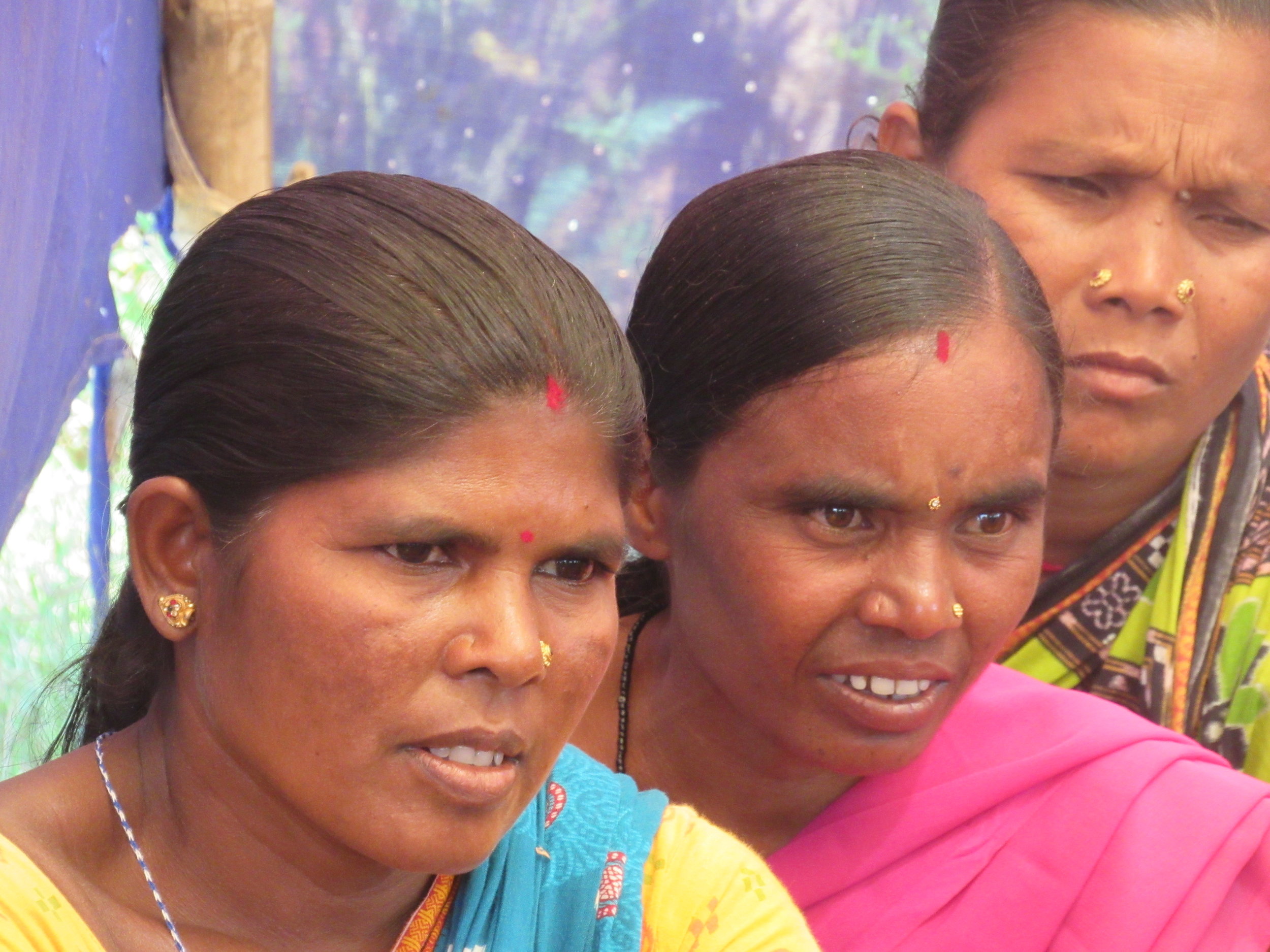
Nabita is a smallholder and a “seed guardian” at the Maa Lankeshwari seedbank of Bhimdanga village in Odisha, eastern India. The seedbank is a small room lined with rows of neatly-labelled earthen pots and stoppered glass bottles, all of them filled with varieties of millets, ladies finger (okra), pumpkin, and red gram seeds (lentil), along with cotton.

Nabita puts her hand into a pot and scoops out a fistful of paddy seeds which are a dull brown, the colour of the soil. “This is kalajira rice,” said Nabita, who is an organic and Fairtrade-certified farmer. “It’s a scented, local variety and gives us a high-yield. We are now conserving it.”

Seeds are at the heart of agriculture, but they are also a significant cost for farmers. Organic seeds are hard to come by in a market flooded with genetically modified and hybrid cotton seeds. More than 90% of cotton in India is genetically modified and input costs for Bt Cotton are high. Hybrid cotton seeds cannot be replanted post-harvest, which in turn forces farmers to add to their financial burden by buying new seeds from the market.
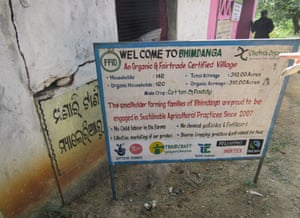
A sign in Kalahandi, Odisha

Nabita is one of 18 seed guardians who are part of Chetna Organic’s seed conservation project. Over the last two years, six seedbanks have been established in five villages in Odisha with 72 men and women conserving 50 varieties of fibre and food crops seeds. This is a much needed shot in the arm for these districts which are plagued with hunger, poverty and insecurity.

“The programme aims to promote women-managed and controlled seed enterprises,” said Arun Ambatipudi, one of the founders of Chetna Organic. Chetna was established 10 years ago to enhance sustainable livelihood options for smallholder families that are dependent on rain-fed agriculture. According to IndiaSpend, 56% of India is dependent on rain-fed agriculture, and farmers are often pushed into an endless cycle of debt because of unpredictable weather, high input costs, poor soil and pest management, and market fluctuations.

Traditionally, Odisha is not a cotton growing state but over the last two decades, small and marginal farmers have started growing the cash crop. Conserving organic cotton seeds that are suited to the soil and as a climate adaptation measure is a priority for smallholders. Over the last five years, Chetna has been conducting small-scale trials with farmers like Nabita to evaluate the suitability of indigenous cotton varieties such as Suraj and Anjali.

Kalajira rice makes for a sumptuous, aromatic rice pudding.

Driving through Odisha, it’s easy to spot the organic from the non-organic farms. The landscape is dotted with stretches of waist-length cotton. In sharp contrast are the organic farms that look like Ceres has run riot, planted with cotton, red gram, and food crops.

“We practice organic agriculture,” said Nabita, who farms on three acres of land. “There are challenges. The traditional variety of cotton has a lower yield than the hybrid one, but we know it’s good for the soil and the environment. And organic is better for health.” Bhimdanga’s residents take pride in being completely organic. Visitors to the village are greeted with a board that says, “Welcome to Bhimdanga, an Organic and Fairtrade-certified Village”. ”

In a volatile cotton market, the mixed cropping practice that Bhimdanga’s farmers follow ensures individual food security, even if their cotton crop fails. Farmers grow cotton alongside food crops such as pumpkin, ridge gourd, lentils, and millets. Some are for their own consumption, and the rest is sold in the market. Ramprasad Sana, an entomologist and the technical head at Chetna Organic, said that the seedbanks have given 600 families food security.

Chetna enables farmers to set up sustainable and multipliable open-source systems to share and store seeds, using traditional knowledge along with new concepts and technology. The enterprise operates like a bank, only with less bureaucracy. A farmer can “withdraw” a kilo of seed and has to repay the loan with one-and-a-half to two kilos of seed after harvest. With the establishment of seedbanks, organic farmers no longer need to buy seeds from the market. This year, 1,594 kilos of seeds were distributed to 603 farmers.

Empowering women farmers to manage their own seed enterprises enables them to become decision-makers in the community. This is significant, given that according to the 2011 census, 68.5% of women work in agriculture. Traditionally, women have been the custodians of seeds and Chetna hopes to revive the practice.

Last year, Nabita and her neighbours participated in a seed festival in the neighbouring village of Mading where they met other farmers and showcased their indigenous varieties of seeds. “Everyone loved our kalajira rice there,” said Nabita with a smile. The short-grained kalajira is one of the key scented rices of India (pdf) and gives a high yield in a short timespan. When cooked, the rice has a heady fragrance, earning it the market name of “white baby Basmati”.

Rice is a staple agriculture product but in most of India, farmers cultivate high-yield paddy for a homogenous market. The Food and Agriculture Organisation (FAO) estimates that at least 75% of the genetic diversity of agricultural crops had been lost by the beginning of this century.

Kalajira rice and indigenous cotton varieties are being conserved by seedbanks like Maa Lankeshwari at a time when indigenous species of food and fibre are rapidly disappearing from farms and plates. With women like Nabita taking back control of their seeds, soil and food security, the smallholders of Bhimdanga are becoming part of a thriving, sustainable community that is conserving India’s indigenous seed heritage and protecting its food sovereignty.

Lightroom Bookstore: The City’s Best-Kept Secret for Kids

https://lbb.in/bangalore/lightroom-bookstore/
Ten-second takeaway

A veritable Narnia for children’s books.

lightroom

A one-stop-shop for children’s books

The delight you feel when stepping into Lightroom Bookstore is comparable to what we think Lucy Pevensie might have felt when she crawled through the cupboard to reach the magical world of Narnia. You can’t help but be spellbound as you walk through the inviting space, surrounded by books and more books.

Aashti Mudnani started Lightroom in 2013, after dreaming about it for seven years. “From the beginning the idea was to have a handpicked selection, keeping books that we believed were good for our children to read,” said Mudnani. “Choosing books is quite an intensive task – we go over endless lists sent to us by publishers, online recommendations, friends’ book lists, reviews etc, to choose the books we keep.”

Go ahead, explore

Lightroom has a range of international and Indian books for children and young adults. Apart from the usual suspects such as Harry Potter, Julia Donaldson, and Percy Jackson, there’s The Amazing Remarkable Monsieur Leotard by Eddie Campbell and Dan Best, Miss Peregrine’s Home for Peculiar Children by Ransom Riggs, and Paper Planes by Dawn O’Porter. There are books published by Tulika, Hachette, Tara, Katha, Pratham, Duckbill, Red Turtle, Puffin, and Young Zubaan, selected by the team at Lightroom.

One wall looks like it belongs on the page of Brain Pickings, Maria Popova’s literary and cultural website. Here you will find displayed the gorgeously-illustrated Animalium: Welcome to the Museum by Katie Scott and Jenny Broom, Neil Gaiman and Chris Riddell’s The Sleeper and the Spindle, and I’ll Be You and You Be Me by Ruth Krauss and Maurice Sendak.

We spent a fair amount of time on the floor perusing Knock! Knock! by Kaori Takahashi. Some of the Lightroom team members joined us in unfolding the beautifully-crafted book. When we gushed over The Giant Game of Sculpture by Hervé Tullet, they opened the book, which transformed into a DIY installation for budding artists. You can also buy notebooks, block stamps and DIY craft kits, apart from children apparel by Hidden Harmony and hand-stitched toys by Blue Mango. Lightroom also holds two events per month.

Why we love them

What makes Lightroom special is its people. Mudnani and her helpful team are knowledgeable and unobtrusive. Need a book for a ten-year-old who loves monsters, a birthday gift, or a first book for your toddler, they know just what you want. And they even smile approvingly if you confess that the book’s actually meant for you.

Where: 1, Lewis Road, Cooke Town

When: Monday to Saturday, 10.30am-6.30pm

Contact: 080 25460466

Price: INR 100 upwards

Find them on Facebook here.

Review: Career of Evil

http://indiatoday.intoday.in/story/jk-rowling-career-of-evil-third-cormoran-strike-novel-robert-galbraith/1/523394.html

Review: JK Rowling’s Career of Evil keeps the reader guessing

Career of Evil, Rowling’s third Cormoran Strike novel, is an emotionally taut read.

Detective Cormoran Strike and his secretary-turned-partner Robin Ellacott are back for the third time with a case that’s equally bloody and emotional in parts. This time around, the investigative pair is embroiled in a mystery that is pretty personal–someone sends a woman’s severed leg to Robin accompanied by lyrics from a song by the American rock band, Blue Oyster Cult. It’s a chilling message for Strike, given his disability–he was injured and lost a leg in Afghanistan. It’s also clear that someone has a bone to pick with Strike and won’t stop at just a leg. Rather, as you find out from the killer’s perspective, his next target is Robin. What follows is a trip down memory lane for Strike, as he pursues four possible suspects, each with a sinister and bloodthirsty history. In an interview with NPR, JK Rowling, who writes this series under the pseudonym Robert Galbraith, said that she read Ted Bundy’s accounts to understand a killer’s perspective and also trawled through forums frequented by men who discuss women in terms of murder and sexual violence.

The suspects are twisted as they come with a long history of violence–Terence ‘Digger’ Malley, a gangster who is known for his body-cutting skills; sociopath Donald Laing who is a British veteran and blames Strike for all his misfortune and problems; Noel Brockbank who has a history of paedophilia and is not quite right in the head; and Jeff Whittaker, a junkie musician who was married to Strike’s mother and tried and acquitted for her murder. They all have one thing in common–they hate Strike. To complicate matters, after their last two cases–The Cuckoo’s Calling and The Silkworm–Strike is kind of famous and he is no longer able to go out and pursue persons of interests as he once could. And with the infamous publicity about the severed leg, Strike and Robin are losing cases and with that money as well. At the same time, Robin is grappling with a tense engagement – her fiance Matthew has always been vocal about his dislike for Strike but now their relationship has taken a turn for the worse. She’s also worried about her position at work – at times Strike calls her a business partner, at others he does everything to shield her from the nastier parts of the business.

For Robin, horrific memories of sexual violence resurface–you find out that she had been raped at a university. Your heart goes out to Robin and Strike, who for a change, shows his vulnerable side, especially with his bias towards his stepfather. You also get a bit closer to understanding the person behind the hulking, impassive facade. On top of all this is Robin’s impending wedding–dresses, flowers and seating arrangements add to the chaos, while both Robin and Strike are trying hard to ignore their feeling for each other. In her acknowledgements, Rowling writes, “I can’t remember ever enjoying writing a novel more than Career of Evil. This is odd, not only on account of the grisly subject matter…” And it shows. The author takes her time building the emotional tension in Career of Evil. At the same time, she lets the tension unwind slowly, following the suspects at an easy pace all across the country, while allowing personal emotions to bubble up to the forefront. Rowling runs through a gamut of bloody and violent crimes–sexual violence, serial killings, drug abuse, and paedophilia, it’s all in there. Yet she takes her time in telling the stories. And because of that, Career of Evil tends to flag a bit. Although it has a compelling and dark storyline, the narrative takes time to pick up, and you tend to lose interest in the middle.

Suspense

That said, the suspense builds up, and you’re hard-pressed to choose between the suspects. Strike is gunning for Whittaker with obvious reasons, but the others seem equally menacing and they all seem to have had an opportunity. And that’s where the author keeps the reader guessing, making it an immense emotionally taut read. PS: A request for the writer; can we please get Strike to mop up his curry with naan, instead of naan bread next time?

The reviewer is a Bengaluru-based writer.

On Shock Waves: Managing the Impacts of Climate Change on Poverty.

http://www.boomlive.in/forget-gm-seeds-go-organic-and-india-will-have-a-better-chance-at-weathering-climate-change/

Forget GM Seeds, Go Organic, And India Will Have A Better Chance At Weathering Climate Change

02 Dec 2015

Last month, while the Indian social media was going berserk over the many Khans of Bollywood, a World Bank report about climate change and poverty was published. It contained warnings about a horrible future that is right around the corner, but few paid attention to the concerns outlined in Shock Waves: Managing the Impacts of Climate Change on Poverty.

According to Shock Waves, by 2030, over 100 million people would have been forced into extreme poverty because of climate change. That’s just 15 years away.

The report offers two scenarios for the future of poverty by 2030 – optimistic prosperity, and pessimistic poverty. In the event of prosperity as a result of high-impact climate change, India would see two million people being brought into poverty. If things go the pessimistic poverty way, Shock Waves estimates as many as 50 million joining the impoverished in India.

The year 2030 is a deadline date. India has pledged to reduce emissions intensity by 33 per cent of the 2005 levels by 2030. We’ve also committed to generating 40 per cent power from non-fossil fuel sources. As goals go, it’s a good one. Like many life goals, however, attaining this one seems unlikely without some serious policy changes.

At the 2015 Paris Climate Conference (COP 21) talks this year, India has just announced the global solar alliance between countries and big industries. It aims to get affordable power to off-the-grid, remote and rural areas. That ambitious plan will be critically important, given that the International Energy Agency’s World Economic Outlook 2015 estimates that by 2040, India’s coal consumption will be second only to China. Our demand for oil is also set to rise.

Shock Waves’s insistence upon good, climate-informed development is particularly timely under the circumstances. This week, world leaders are meeting for COP 21, to try and negotiate an agreement to limit global temperature rise. The threat that rising temperatures poses are undeniable today, particularly in the way it affects food security in poorer regions such as Sub-Saharan Africa and South Asia, adding stress to an already fragile ecosystem.

Unpredictable weather and agriculture in India

Fifty six per cent of India’s agriculture is rain-fed. This year has been seared with news of extreme weather conditions and an erratic monsoon that wreaked havoc on crops across the country. In Punjab’s Malwa region, whiteflies destroyed 60 per cent of the Bt cotton crop, causing a loss of approximately Rs. 4,200 crore. Delayed monsoon and prolonged hot summers have already impacted cotton and food crops across the country. In November, a survey conducted by farmer activist group Swaraj Abhiyan showed the severity of drought and famine in the Bundelkhand region of Uttar Pradesh.

Over the last 17 years, three lakh farmers have committed suicide in India. This is a statistic that should punch each one of us in the gut. Their deaths are not just testaments to the severity that farmers encounter today, but also an ominous portent of times to come. In simple terms, poor yields, escalating input costs and fluctuating market prices push farmers into an endless cycle of debt. Some are pushed to commit suicide, and some leave agriculture to become labourers.


Climate-informed development

In developing countries, the poorest households already spend 40 to 60 per cent of their income on food and beverages. Organisations such as the Fair Trade Alliance Kerala are encouraging farmers to follow mixed agriculture practice, which acts as a safety net – if cash crops fail due to an erratic monsoon, farmers are at least food secure in these climate-challenged times.

“Each farming family that has for decades now been growing cash crops for the distant markets is committed to being net staple food suppliers,” said Tomy Mathew, the co-founder of the FTAK, a democratically-governed small-holder farmer organisation. “In terms of calorie value, the food that they produce will be more than the requirements of the family,” he added. The FTAK focus is on climate mitigation through fair terms of trade, biodiversity, food security, and gender justice.

These principals will be the foundation for climate justice for the poor, who are not the biggest contributors to climate change but are the ones who bear its brunt.

Shock Waves: Focus on India

In the section, “Bad Seed: Climate Change, Agriculture, and Food Security”, the authors of Shock Waves points out that by 2080, “the average yield declines estimated from all climate models could be as severe as 23 percent for South Asia”. This means there is no time to waste. It’s essential we develop climate-smart, smallholder farmer communities that will enable farmers to survive the new challenges and keep all of us food secure.

For instance, Shock Waves highlights the need to “develop higher yielding and more climate-resistant crop varieties and livestock breeds, adapted to developing country contexts and climate conditions”. It cites the example of Scuba or Swarna-Sub1, a “climate-ready rice” which is being field-tested in Odisha. Reports claim that the flood-resistant rice is not genetically-modified, but is a hybrid of two rice varieties.

One of the ways that some hope to tackle the problems of yield and climate change are GM seeds. In India, we’re seeing the debate heat up over genetically modified cotton, mustard and even mosquitos. The social and ecological impacts of these seeds will require a closer and objective look. What needs to be kept in mind is the larger picture. There may be immediate gains to GM seeds. For instance, over 90 per cent of cotton in India is genetically modified Bt Cotton, which is resistant to certain pests and has an initial high-yield. However, it has a high input cost. The seeds are expensive (approximately three to eight times the price of conventional seeds) and require specific pesticides that over time strip the soil of its richness. Once harvested, hybrid cotton seeds cannot be replanted. In the long run, this is more damaging than helpful.

Farmers need to be put in control of their seeds, rather than corporate entities. Take for example Chetna Organic, a group in Odisha that is working to enhance sustainable livelihood options for small-holder farmer families. It empowers women to manage and control local seed enterprises. The programme is in its third year, but already women farmers are conserving local and indigenous food and fibre seeds that are also high yielding.

According to the United Nations, India is home to one third of the world’s extreme poor population. It’s a figure that’s set to rise, until we and our government make a conscious choice towards equitable development that is climate-informed and inclusive. It’s good that there are speeches and conversations at the Paris Climate Conference, but Shock Waves is a reminder that development that is rapid, inclusive and climate-informed is the need of the hour.

11 Books That Will Get Children To Explore The Wild

http://www.natgeotraveller.in/web-exclusive/web-exclusive-month/11-books-that-will-get-children-to-explore-the-wild/

World Habitat Day Special: Let a book lead you into swamps, seas and more

TEXT & PHOTOGRAPHS: BIJAL VACHHARAJANI

POSTED  ON: OCTOBER 5, 2015 12:00 AM

Hitch a ride on the back of a glorious book about wildlife.

click me

Children’s books can work like portkeys to nature. Turn the pages and you can be whooshed into a dense green jungle full of mysterious tigers and merry bears, transported to a bleak desert landscape, or plunged deep into the ocean, swimming with sea turtles and dodging jellyfish. On World Habitat Day, we pick 11 books that will enchant young readers and introduce them to habitats where the wild things are.

Sundarbans with Tiger Boy

In Mitali Perkins’ Tiger Boy, Neel’s parents and teachers want him to study hard for a scholarship that will take him from the Sundarbans to Kolkata. But Neel loves his home – he can splash like a river dolphin in the freshwater pond, climb tall palm trees, and forage for wild guavas. Besides, he has a bigger problem than geometry and algebra to worry about: there’s a tiger cub missing from the reserve. With the help of his sister Rupa, a spunky girl who has been forced to drop out of school, Neel decides to find the cub and save it from being trafficked by the evil Gupta. After all, who knows the island better than him?

Tiger Boy takes children into the swampy forests of the Sundarbans. Perkins paints a vivid picture of what it’s like to live in a place threatened by climate change: islands bolstered against rising sea levels by sandbags and furious cyclones tearing away mangroves. Yet, Tiger Boy is a story of hope; it’s about the splendour of the mangrove forests and islands, the magnificence of the tiger and its vulnerability, and human resilience in the face of adversity.

Also see:The Honey Hunter by Karthika Nair and Joëlle Jolivet is a sumptuously illustrated book that brings alive the richness of the Sundarbans. Nair’s story takes children through the mangrove forest, while Jolivet’s candy-coloured illustrations bring to life the honeybees, tigers, and trees of the Sundarbans.

Africa with The Akimbo Series

“Imagine living in a place where the sun rises each morning over blue mountains and great plains with grass that grows taller than a man.” This is where Akimbo lives, on the edge of a large game reserve in Africa. Readers will be enchanted by young Akimbo and his home. British author Alexander McCall Smith is best known for The No. 1 Ladies’ Detective Agency series, but he has a delightful repertoire of children’s books as well, which includes the Akimbo series.

Set in the heart of Africa, Akimbo lives alongside zebras that graze in the plains and lions, leopards, and baboons in the hills and forest. Man-animal conflict, poaching, conservation, and endangered animals are all part of the narrative. In Akimbo And The Elephants, his father who works on the reserve points out an animal and cautions him, “Don’t make a noise. Just look over there.” If only everybody on a safari would listen to Akimbo’s father, we would have so many more quiet and pleasant trips into the forest.

Also see: You’ve watched the movie Duma, now read the book it is based on.How It Was With Dooms is the story of Xan Hopcraft who grew up with a cheetah at his home in Nairobi. There are some lovely photos by his mother Carol Hopcraft in the book as well.

The Western Ghats with The Adventures of Philautus Frog

If you thought frogs lived only in ponds, then Kartik Shanker’s book will make you think again. Shanker’s protagonist is Philautus or Thavalai, a tree frog who has never ever come down from his Big Tree home. One day, Thavalai decides to hop off to look for the big blue sea. He has many adventures, including getting directions from a snake who could have easily swallowed him whole.

Maya Ramaswamy’s illustrations recreate the dark, deep shola forest, the surrounding hills and grasslands, and their many denizens. A hornbill sits placidly in one corner of the page, while a balloon frog puffs up in purple glory on another. Venomous snakes slither across the book and a dragonfly flits over the words. The book is packed with nuggets of information, such as that grasslands are hot in the day and cold at night, but the shola is always cool. Readers also learn that Thavalai often gets teased because Philautus frogs bypass the tadpole stage and froglets hop straight out of eggs.

Also see: Children can Walk the Grasslands With Takuri, a pygmy hog who is the protagonist of this book by Nima Manjrekar and Nandita Hazarika. Part of the same series is Aparajita Datta and Nima Manjrekar’s Walk The Rainforest With Niwupah, where a hornbill takes readers on a tour of his rainforest. Both books have been illustrated by Ramaswamy.

Hingol National Park with Survival Tips For Lunatics

Shandana Minhas’ Survival Tips For Lunatics is a rollicking tale that throws together a motley bunch of characters. There’s a squabbling pair of siblings, a Protoliterodragon who cannot stand bad poetry, and an angry black bear “with a dislike of the species that had put him on the endangered list”. The story is set in Hingol National Park in south-west Pakistan which is home to Chandrakup, the largest mud volcano in South Asia.

Changez, 12, and his brother Taimur aka Timmy, 9, go camping with their parents. Next morning, Changez wakes up to realise that the parents left them behind by mistake. Help is at hand in the form of a talking sparrow and other animals. The unlikely group end up across the Pakistan-Afghanistan border where they find that the human world holds more dangers than the forest. Survival Tips For Lunatics also explores the multifarious wonderful and fraught relationships that humans and animals share, and while doing so, holds up a mirror to our flawed ideas of civilization. But Minhas’ touch is always light, keeping the reader chuckling and turning the page.

Also see: Jungu The Baiga Princess by Vithal Rajan is set in the jungles of Madhya Pradesh and spotlights conservation and tribal rights. It’s a story about the Baiga tribe and their commitment to protecting their forest.

Around the World with The Snail And The Whale

What happens when a snail has an itchy foot and wants to see the world? He hitches a ride on the tail of a humpback whale for the journey of a lifetime. Illustrated by Axel Scheffler, Julia Donaldson’s picture book is a real treat. Young readers will join the snail and the whale to see “towering icebergs and far-off lands” where penguins frolic in the water. Then they go on to “fiery mountains and golden sands” to say hello to monkeys and turtles. While Donaldson doesn’t dwell on any particular habitat, the book makes for a fun guessing game about possible locations. For instance, where in the world are caves beneath waves where sharks with hideous toothy grins lurk?  Or which place is sunny and blue and has thunderstorms?

Also see: In The One And Only Ivan, Katherine Applegate talks about the tyranny of captivity and the yearning for the wild. The story is narrated by Ivan, a silverback gorilla who lives in a glass cage in a performing mall. Ivan introduces himself in the most heartbreaking manner by saying, “I used to be a wild gorilla, and I still look the part.” Ivan chooses to not remember his real home, where his father had a bouncy belly that was the perfect trampoline for his sister Tag and him. It’s the only way he can cope with living in a cage. Based on a real life story, Ivan is both beautiful and moving – a poignant reminder of the absence of home.

Dead as a Dodo

http://www.mid-day.com/articles/book-review-dead-as-a-dodo/16424177
Book review: Dead as a Dodo

When it comes to being extinct, the first name that leaps to one’s mind is the Mauritian flightless dodo. After all, the dodo bird went extinct in the late 1600s and even has a famous morbid phrase dubbed after it. But in Venita Coelho’s Dead as a Dodo, the extinct bird gets a new lease of life. After Coelho’s first book, Tiger by the Tail, Agent No 11.5 Rana makes a comeback, along with Agent No 002, Bagha the brave tiger; and Agent No 13, Kela, the mischievous and always-in-trouble grey langur. Rana has a special gift — he can use ‘JungleSpeak’ to communicate to animals, and for this skill, he’s part of the Animal Intelligence Agency.

Dead as a Dodo

This time around, the three protagonists are on Mission: Dead as a Dodo. While on the heels of a missing hangul deer, the trio stumble upon an extinction operation, where a shadowy villain is hell bent on stealing the last specimens of highly endangered species. Now, this villain has managed to lay his hands on an actual live dodo aka the Raphus cucullatus. Their adventure takes Rana, Bagha and Kela from Delhi to Mauritius to North America, in a quest to save the most endangered of species.

Coelho spins a real tale about conservation and international wildlife trafficking, while managing to keep the reader chuckling and guessing right until the very end. Her characters are spunky and the narrative is a lovely way of introducing children to different aspects of natural history.

William Hartston wrote in his book, The Things that Nobody Knows: 501 Mysteries of Life, the Universe and Everything, about the coelacanth, a fish that was believed to be extinct for 65 million years ago, but was caught in 1938, by fishermen off the coast of South Africa. Unfortunately, Hartston adds that the chances of the dodo being alive are only three in a million. As the earth enters into its sixth extension phase — a recent report revealed that “vertebrates were vanishing at a rate 114 times faster than normal” — Dead as a Dodo takes on a special significance. As Coelho points out in her book, it’s in our hands to ensure that today’s endangered species, like the hangul deer, don’t go the way of the dodo.

Dead as a Dodo, Venita Coelho, Hachette India, Rs 350. Available at leading bookstores and e-stores

– See more at: http://www.mid-day.com/articles/book-review-dead-as-a-dodo/16424177#sthash.5xz1cHN9.dpuf

Three books for children that take bullying by the horns

http://scroll.in/article/732492/three-books-for-children-that-take-bullying-by-the-horns

YA fiction in India is increasingly pitching kids into real-life situations instead of fantasies, offering strategies for coping.
Bijal Vachharajani  · Jun 06, 2015 · 03:30 pm
Three books for children that take bullying by the horns
20.2K
Total Views

Bullying is often a staple theme in children’s literature – whether it’s Draco Malfoy bolstered by his cronies Crabbe and Goyle in the Harry Potter series or even a teacher like the horrid Miss Trunchbull in Matilda by Roald Dahl. These fictional worlds are not all that different from the ones that children grow up in, even without magical moving staircases or telekinetics.

Here in India, children’s books are tackling the subject of bullying with some solid storytelling and generous doses of humour. These books celebrate diversity, and in doing so remind kids that standing up to bullies takes courage and is the right thing to do. Here are three that take on the issue:

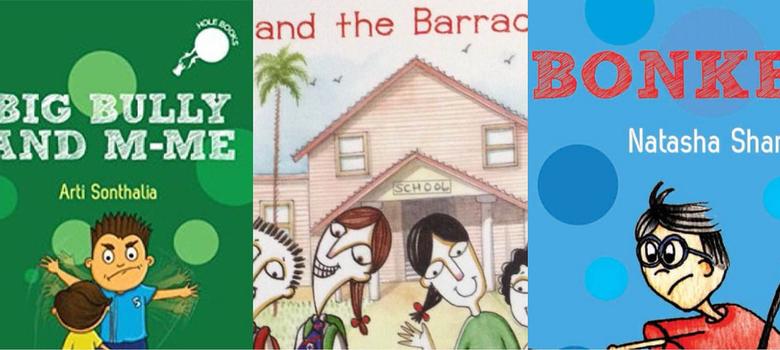
The Dugong and the Barracudas, Ranjit Lal
If you have spent your life hooked onto Animal Planet, you may know that a dugong is a large marine mammal that is known to be quite languid. In nature writer Ranjit Lal’s book, Sushmita is the dugong – a sweet 13-year-old girl who is “not quite like girls her age” because she’s overweight, big and slow.

When she joins Rugged Rocks High School, it’s like a battery of barracudas – her classmates – sinking their teeth into her good nature, pulling no punches while humiliating her. On the first day of her class, the children snicker among themselves, “Fat, fat, fat… everywhere!” and even call her “Mother of all hippos!”

As things take a turn for the worse, Sushmita fights back, but in her own sweet way. Lal tackles the difficult subjects of prejudice and bullying deftly with his usual incisiveness and quirkiness, making the reader chuckle, laugh out loud and think at the same time.

Big Bully and M-Me, Arti Sonthalia
Big Bully and M-Me is part of the delightful Hole Books Series. Meet Krishna, who prefers to be called “Krish without the Na!” You soon realise that Krish is the last one to be picked for team sport because he is the shortest, skinniest boy in class. He finds himself in a fix, when as part of a class assignment, he has to give an extempore speech. For Krish, that’s the hardest thing in the world because of his stammering. And, worst of all, his partner for the assignment is Ishaan, who happens to be “the tallest, meanest bully in the world”.

As Krish preps for the extempore, his Mom gives him some sound advice, “If you get stuck just say ‘I can, I can, I can’”. Arti Sonthalia’s story is short and sweet, and she compels the reader to put themselves into the shoes of Krish and think about his struggle with speech and how it impacts his confidence and relationships.

Also in this series is Bonkers, by Natasha Sharma, which features the bespectacled Armaan and Bonkers, his crazy dog who has just chewed up a cricket ball that belongs to TT, a bully who is the leader of the Ghastly Groundhog Grang. With a combination like that, only chaos can ensue, along with insane amounts of fun and a message that help can come from the most unlikely of sources.

Talking of Muskaan, Himanjali Sankar
Jay Asher’s book Thirteen Reasons Why was a dark book about a teenager who commits suicide and then through a series of audio tapes explains how bullying and abuse drove her to this desperate act. Himanjali Sankar’s protagonist Muskaan also tries to commit suicide in Talking of Muskaan.

As the 15-year-old is fighting for her life in the hospital, three of her classmates narrate the story from their perspective. Muskaan, the reader finds out, has always been different. And for that, her friends tease her brutally. When the teenager confesses to BFF Aaliya that she likes girls, the teasing takes on a cruel edge. Her one confidante Subhojoy has also been dubbed “weirdo” by his classmates because he’s a class topper and hails from a less privileged background. Talking of Muskaan is a compelling, coming-of-age book that brings to the forefront the subject of sexual orientation, class and individuality in an increasingly-homogenous world.

When Bijal Vachharajani is not reading Harry Potter, she can be found traipsing across tiger reserves. In her free time, she is a consultant with Fairtrade India. 

We welcome your comments at letters@scroll.in

Tiger Talk

http://natureconservation.blogspot.in/2007/05/lmno.html

Found an old old old story of mine online.

Copyright Protected
Date with Tiger:
================

Animals rank high in Bijal Vachharajani’s scheme of things whether as Special Projects Co-ordinator at PETA India or at her stint at Sanctuary Asia. She shares her experiences at the Ranthambore Tiger Reserve with ROUGE .

I was only vaguely aware of my surroundings—tourists were whispering urgently, bickering amiably about who gets the better photograph. But for me, time had stopped. After all, there she was, resplendent in her burnished gold and black striped coat, languidly lapping water from a gushing stream. Her cub, an adolescent tiger, ran around her, amused by the uncalled attention from the excited gawkers. It was my first glimpse of the magnificent Panthera Tigris.

A tip from another canter (that this area was frequented by a tigress with her cubs) had sent our vehicle heading towards this particular stream. The driver shut off the canter’s engine, leaving behind a tense silence. We squinted and strained our eyes, trying to see something through the green and yellow foliage in front of us. Whether it was the rickety boat ride in Periyar Tiger Reserve, where all we spotted was a lone drongo bird, or the unsuccessful quest at Sariska Tiger Reserve, my misadventures with spotting a tiger had left me with the morose feeling that the tigers were eluding me. Immensely adaptable animals, tigers can be found in a wide range of habitats from the arid Ranthambhore to the marshy Sunderbans and the evergreen forests of the Western Ghats. Solitary in nature, tigers are the largest of the cat family and are very territorial. Tigresses, like the one we were waiting to catch sight of, are extremely protective of their cubs.

Suddenly, the driver pointed out, exclaiming, “There she is, I can see her ear!” False alarm. Ready to call it a day, the driver restarted the canter. That was when the tigress suddenly moved from her camouflaged resting place. My date with the tiger was complete.

Most people ask — what’s the big deal about a tiger? As I learnt from Bittu Sahgal, the Editor of Sanctuary Asia, the tiger is a keystone species, the symbol of a thriving forest. He recites this mantra, “To save the tiger, you have to save its home — the forest.” And considering the fact that more than 300 rivers originate from the 28 tiger reserves of India, if you save the forest, you end up saving our water resources. The larger implication? That our subsistence on planet Earth is inextricably connected to the tiger’s survival. The tiger is caught in the throes of a rollercoaster ride to survive. Studies show that tigers only occupy a measly seven per cent of their historic range today, that’s 40 per cent less than a decade ago. Mindless destruction of forests has put India’s wildlife in peril. Worse, poaching for trophies and their body parts, for use in traditional Chinese medicine, only pushed the numbers further down. In 2004, the nation was shocked with news that poachers had wiped out Sariska’s tigers like an epidemic. Suddenly, alarming reports were making headlines in newspapers and magazines. Tiger numbers were dwindling across India and conservationists pegged the number to a meagre 1, 500 to 2, 000. Surely an abysmal report card for our national animal.

I remember chatting with Jaimini Pathak, the writer and director of the heartwarming children’s play Once Upon A Tigerwhich delved on the topic of tiger conservation. When I asked him what ails the tiger in India, Jaimini responded simply, “Human greed.” I rest my case!

Conservationists across India are fighting the battle. We too can help, by sensitively treading upon the Earth’s resources. Save water, paper, and electricity. Invest in corporates who work towards sustainable development. I hope the Earth doesn’t have to witness a time when the tiger draws dangerously close to getting tagged with the phrase “as dead as a dodo”.

Book Review: Eat the Sky, Drink the Ocean

http://www.livemint.com/Leisure/bqvMF5btJ0gyQnecxh9l3M/Book-Review-Eat-The-Sky-Drink-The-Ocean.html
A collection of stories for young adults that creates utopian realms for women

Bijal Vachharajani
Eat The Sky, Drink The Ocean: Young Zubaan, 264 pages, Rs295

Book Review: Eat The Sky, Drink The Ocean

What happens when a motley crew of women writers and illustrators from Australia and India come together to write a book, without actually meeting? Over a year ago, 20 artists and writers connected virtually, over copious emails and Skype sessions, to talk about the challenges of being a woman and to speculate on the endless possibilities. The result is Eat The Sky, Drink The Ocean, an anthology of speculative fiction stories for young adults.

Published by Young Zubaan, the book has been edited by Payal Dhar and Anita Roy from India, and Kirsty Murray from Australia. In the introduction, the editors explain that the idea stemmed from the storm that gathered in response to the violent crimes against women in Australia and India in 2012. They decided on the title, Eat The Sky, Drink The Ocean, because it suggested impossibilities, dreams, ambitions and a connection to something larger than humanity alone. They add that all the stories embrace the idea of not just eating pie but of taking big, hungry mouthfuls of life and embracing the world.

The book offers utopian realms that reflect alternate realities for girls and women. The stories—which take the form of black and white graphic tales, twisted fables, and a play—take on issues such as patriarchy, gender equality, molestation, body image and misogyny.

Murray teamed up with Manjula Padmanabhan for The Blooming, a play about reproductive technology and gender conditioning. The Runners, a graphic tale by Isobelle Carmody and Prabha Mallya, and Dhar’s Memory Lace are set in feminist utopian worlds, reminiscent of Sultana’s Dream, the iconic feminist sci-fi story written by Rokeya Sakhawat Hussain in 1905. Amruta Patil’s Appetite is a gorgeously rendered graphic story about a girl with a voracious appetite—she wants to devour the world. Given that men and boys are offered the world on a plate, Patil writes, “Appetite is such a boy’s club… Female bellies are allowed their moon curves only when swollen with baby.”

As the emails flew thick and fast, the story ideas took shape. Samhita Arni and Alyssa Brugman had a conversation about feminism and cultural differences and found themselves drawn to the way “capitalism and consumerism had co-opted the feminist movement”. Both writers explore the rigid conditions and expectations set for women: Arni writes about a community where girls are banned from being magicians, at the same time exploring female infanticide; Brugman narrates the story of a woman who trades a kidney for perfect hair (like broad hips, hair is also a sign of a woman’s “good breed”).

Fables also get reinterpreted and twisted. In Little Red Suit, Australian-American writer Justine Larbalestier retells Red Riding Hood. Poppy leaves a drought-ridden Sydney to check on her grandma, and finds herself being stalked. Anarkali by Annie Zaidi and Mandy Ord is a fantastic graphic retelling of the story of the court dancer being entombed alive on the orders of Mughal emperor Akbar. However, instead of pining for her lover, Prince Salim, Anarkali takes matters into her own hands.

Eat The Sky merges contemporary issues with sci-fi. In Cooking Time, Roy tosses together reality cooking shows with time travel to present a future where real food has been replaced by the artificial Newtri, which is luckily available in 70 great flavours. It’s eerily reminiscent of genetically engineered food and products like Soylent, a drink that the makers say is “designed for use as a staple meal by all adults… (and) provides maximum nutrition with minimum effort”.

The tapestry of Eat The Sky is essentially feminist, but it weaves in issues of food security, environmental destruction, class barriers, social justice, consumerism and human rights to create lustrous narratives. In our patriarchy-dominated country, the anthology stands out for its plucky writing and bold imagery.

Read more at: http://www.livemint.com/Leisure/bqvMF5btJ0gyQnecxh9l3M/Book-Review-Eat-The-Sky-Drink-The-Ocean.html?utm_source=copy

PhotoStop: ‘Organic’ reach at Fair Trade Alliance Kerala’s Seed Fest 2015

http://www.thealternative.in/lifestyle/organic-reach-at-fair-trade-alliance-keralas-seed-fest-2015/

The 5th Fair Trade Alliance Kerala Seed Fest saw organic farmers from Kerala showcase their produce and share how beneficial organic farming can be.

In 2011, farmers of the Fair Trade Alliance Kerala came together to host the very first Seed Fest. Four years on, it has become a space for farmers from the region to promote biodiversity, food security and gender justice by sharing knowledge, exchanging seeds and displaying their produce. The Seed Fest is an initiative of the Fair Trade Alliance Kerala, an organisation co-founded by Tomy Mathews which brings together farmers and enable them to trade on Fairtrade terms of minimum support pricing and the benefit of a Fairtrade Premium.

Here’s a pictorial tour of the FTAK Seed Fest 2015:

1. A farmer from the Mananthavady taluk in the Wayanad district of Kerala grows 26 kinds of chillies, welcome news at a time when the FAO estimates that since the “beginning of this century, about 75 per cent of the genetic diversity of agricultural crops has been lost.”

Fair Trade Alliance Kerala's Seed Fest 1_Chillies1

2. We eat more homogenously today and according to the FAO, “just nine crops (wheat, rice, maize, barley, sorghum/millet, potato, sweet potato/yam, sugar cane and soybean) account for over 75 percent of the plant kingdom’s contribution to human dietary energy”. Yet, farmers at the Seed Fest had different species of brinjal – from purple to yellow in colour.

Fair Trade Alliance Kerala's Seed Fest 2_Brinjal1

3. There were crimson coloured chillies and plum-coloured beans on display.

Fair Trade Alliance Kerala's Seed Fest

4. We were fascinated by the variety of bhindi there.

Fair Trade Alliance Kerala's Seed Fest 4_bhindi5

5. Shobhana (extreme right) is the secretary of the Thavinjal Panchayath from Mananthavady as well. The woman farmer’s stall had a banner up which read, “Gender Justice”. When we asked her what it means to her, she said that her being at the Seed Fest said it all.

Fair Trade Alliance Kerala's Seed Fest 5_Shobha

6. Shobhana showed us some gorgeous greens beautifully wrapped in plantains. She smiled and told us, “Who needs plastic, right?”

Fair Trade Alliance Kerala's Seed Fest 6_pack2

7. Sunni (centre), another organic and Fairtrade farmer told us that since the time (ten years ago) he switched to organic farming, he finds that his personal health has improved.

Fair Trade Alliance Kerala's Seed Fest 7_sunni1

8. His produce was staggering with different kinds of gourds, yams, tapioca, chillies, and grams.

Fair Trade Alliance Kerala's Seed Fest 8_sunnis produce

9. We went home with a variety of seeds for our balcony gardens and with an appreciation of the farmers who grow our food.

Fair Trade Alliance Kerala's Seed Fest 9_diversity