
Make-it-yourself

http://www.thehindu.com/news/cities/mumbai/entertainment/makeityourself/article7994680.ece
Displaying 20150503_194926.jpg20150503_194926

I have a confession to make — I can’t stand hobby kits. I look at them with as much loathing as Professor Snape reserved for Harry Potter. Although beautifully packaged, these kits are rarely Do-It-Yourself – everything comes pre-prepared, all the child has to do is cut, fold and glue the bits-and-bobs together. It makes me yearn for long summer days when to construct a candy stick pencil stand or a pistachio shell cottage, we had to make our way through countless mango dollies, choco-bars and salted dried fruits. Now, everything’s bundled neatly into a bag along with specific instructions. Somehow the idea of innovation and experimentation has got buried under mounds of cookie-cutter DIY kits.

Which is why I was excited about the MaKey Makey , an invention kit I bought for my nephew on the recommendation of a friend’s eight-year-old daughter. The kit comes from the hallowed MIT Media Lab and had promise written all over it. MaKey MaKey has been developed by two students, Jay Silver and Eric Rosenbaum, who crowdsourced money on Kickstarter to raise funds for the project. When my nephew ripped apart the wrapping paper, we both opened the box with barely concealed excitement. I couldn’t help but feel a twinge of disappointment as I picked my way through the circuit board, USB cable, alligator clips and jumper wires. I paid three grand for this?

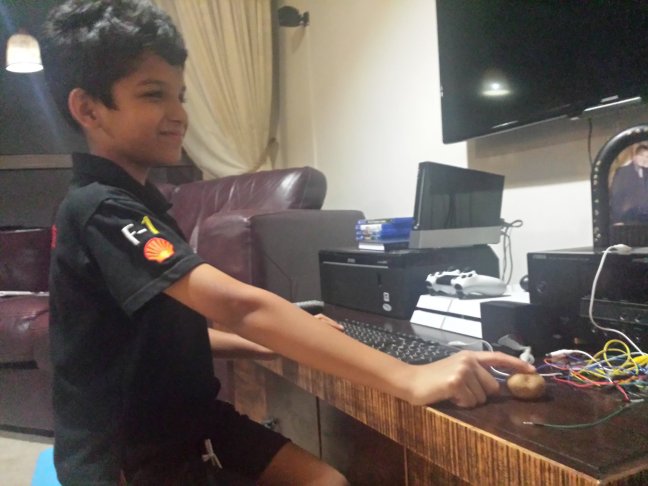
Perplexed, we took to the Internet to help us make sense of what looked like a jumble of wires. We pulled up an online piano page, and hooked up the MaKey MaKey to the computer. Next, we raided the kitchen. My mother came running out, wondering why we needed the French beans that she was prepping for lunch. We connected alligator clips to the veggies, and suddenly, we were playing the piano with a cluster of beans. We’d lift a bean, and it would play a note.

MaKey MaKey connects everyday objects that can conduct a bit of electricity such as fruits, plants, coins, Play-Doh and even marshmallows, and converts these “newly-found inputs into keyboard presses or mouse control”. That means you can play SuperMario with Play-Doh, make a doll cry with foil, and use vegetables and fruits to compose a song. And yes, you can play Minecraft as well.

For my nephew, the excitement was really about the interaction it provided. It got him thinking laterally, wondering what he could hook up to the kit next and transform into a touch pad. He deliberated about objects that conduct electricity – it took a few experiments to figure that potatoes and coins worked, but Lego was a no go.

The wonderful thing about this is that children can connect with science and technology through play. Many children today are familiar with technology, but few understand the workings of their app or game. MaKey MaKey gives another dimension to play – by offering them an insight into the workings of the technology they are experimenting with. Since there are barely any instructions provided by the inventors, it comes down to the child’s imagination and ideas. Without realising it, they end up learning the basics of physics, music, sound, technology. Since it’s participative, a play date can become the start of a music band or a group game.

As the makers wrote on their Kickstarter page, “We believe that everyone can create the future and change the world. So we have dedicated our lives to making easy-to-use invention kits. We believe that the whole world is a construction kit, if we choose to see it that way”. While the MaKey MaKey is a great interface design for children, it’s a handy tool for adults especially designers, artists and engineers. Actually scratch that, most of us would have fun experimenting with this kit.

MaKey MaKey is available on Amazon.com. The writer has now got her own MaKey MaKey kit and has a fridge-full of toys to play with. The writer is the former editor of Time Out Bengaluru and writes about education for sustainable development, conservation and food security.
Play mats

http://www.thehindu.com/news/cities/mumbai/entertainment/plays-mats/article8020403.ece
IMG_7686

Keeping kids occupied at mealtimes just got a tad easier thanks to these activity placemats

Restaurants often offer puzzle placemats to keep diners occupied while waiting for their order. Spot-the-difference puzzles, word games and number challenges serve as appetisers until the real food arrives. Now, entrepreneurs are creating interesting placemats that can keep the little ’uns occupied at the dining table at home as well.

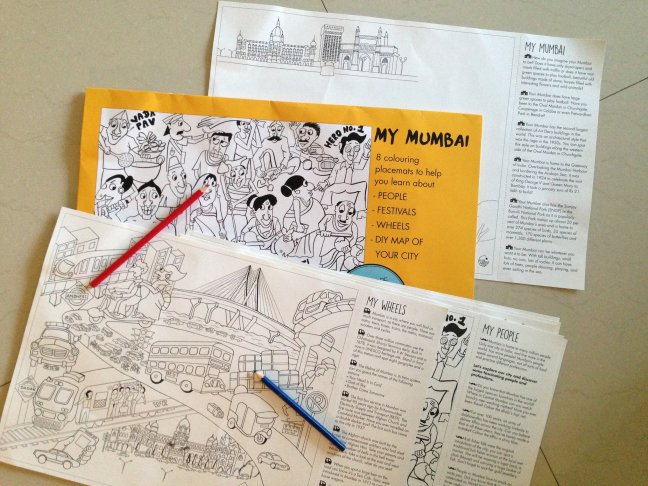
My Mumbai (Rs 500) is a set of eight colouring placemats that introduces Maximum City to children. Perfect for children aged four and above, the black-and-white posters by Yellow Pinwheel Kids Project offer a slice of Mumbai’s life. In one of the placemats, commuters are seen wending their way around the city, passing through the sea link, boarding a local train, and hopping on board a BEST bus. Another one is crammed with the city’s people — street vendors frying vadas for vada pao, Bollywood actors, Koli fisherfolks, paan wallahs, and of course, the dabba wallas. And the third is a glimpse into festivities. The illustrations are done by Abhishek Panchal, who founded Bombay Pencil Jammers.

The placemats encourage children to explore their city with the help of trivia pull-outs. Young explorers will engage with Mumbai’s architecture, the diverse cross-section of its people, and understand its geography. There’s a DIY map of Mumbai, which children have to draw themselves — the map starts at Gateway of India and ends at the Sanjay Gandhi National Park in Borivali. “My Mumbai is targeted for an age group of four to 10. It seems wide but the activity is different for each age segment. The four to six-year-olds will possibly use it just for colouring, but older children will use it as a mapping exercise to discover their city,” said Shinibali Mitra Saigal, who created the activity kit along with Shivani Lath. The entrepreneurs are former journalists, while Mitra Saigal is the co-founder of Kahani Karnival, a Mumbai-based children’s festival.

The Mealtime series by BrownBox Toys (Rs 450) is another charming set of sticker placemats that offer a culinary tour of India, China and England. Each set comes with four posters of typical Indian, Chinese or English meals, with stickers of the food items. The series introduces toddlers to different cultures and helps them understand food habits across the world. For instance, Mealtime England has a poster for fish n’ chips, complete with stickers of tartare sauce, mustard, crisps, peas, vinegar, and other sauces and condiments. Toddlers paste the stickers on the brown paper illustration on the page, to learn what a complete fish n’ chips meal would include. Mealtime India has a range of samosa, thali, kebabs, and dosa and idli. The selection is a mix of familiar and new food, which encourages children to try new dishes as well. The idea is to spark curiosity in young minds.

Then there’s PoppadumArt’s adorable Chalkboard Puzzle Mats (Rs 390) with a range of shapes such as sheep, goats, and bunnies. The animal’s head detaches to become a coaster. Children can write on the mat with chalk, wipe it off, and then scribble again. Made out of medium density fibreboard with a foam backing, the placemat is easy to wipe and reusable, said Saanwari Gorwaney, who started PoppadumArt four years ago to make what she calls “happy things to make spaces happy and bright”. Gorwaney, who is now based out of Gurgaon, worked in advertising before she embarked on this online venture. Out of the three, the chalkboard puzzle mats are easily reusable when it comes to dealing with messy hands. Both Mealtime and My Mumbai would need to be laminated before they can be used as permanent placemats. Of course, they might just end up being displayed on the refrigerator as works of art instead.

To order My Mumbai, visit http://www.facebook.com/My-Mumbai-1701714190047560/?fref=ts. The Mealtime series can be ordered online on http://www.brownboxtoys.com/ and the Chalkboard Puzzle Mats on http://www.poppadumart.com.

Entrepreneurs are creating interesting placemats that can keep the little ones occupied at the dining table

Shopping for dreams

http://www.thehindu.com/news/cities/mumbai/entertainment/the-shop-of-dreams/article8044145.ece?ref=tpnews
IMG_7885

A few weeks ago, I went to a Shop of Dreams, a pop-up store which was actually an exhibition. It was a collaboration between Edinburgh-based artist Symon MacIntyre, faculty/artist Amruta Shah and students of the Srishti School of Art and Design in Bengaluru, as part of their interim project.

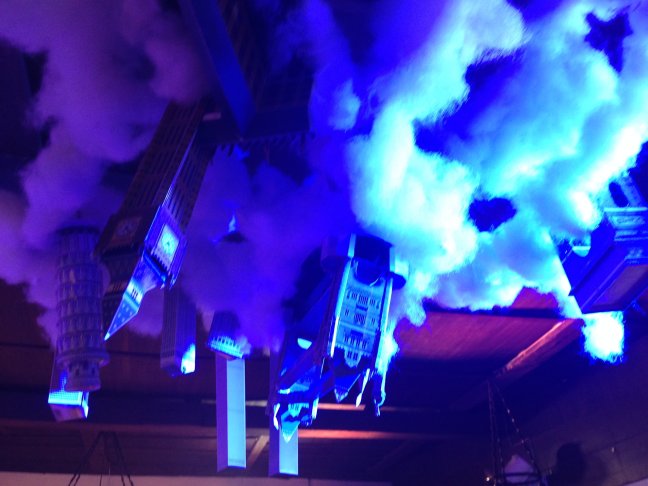
Along with a group of children, I was welcomed into a pop-up store that looked like it belonged in the pages of an Enid Blyton book or a Neil Gaiman short story. Like me, the children felt like they had climbed atop the Magic Faraway Tree and were whisked into the fantastical land that was the Shop of Dreams.

The children, a boisterous bunch, excitedly window-shopped for dream jars, where owls nestled in tree holes and upside-down houses, pixie dust in purple and turquoise blue, and the stuff of nightmares was ensconced in matchboxes. You needed drupees, dream currency, to shop and for that, you had to earn them by playing games.

What fascinated me about the exhibition was how it engaged children (also adults) with something as familiar as dreams and nightmares. Play blended with art to become a space where reality was suspended for a little while. Children could explore the exhibits that were not just sterile objects hung on walls. They could pick them up, and examine them to their heart’s content. Well, until the next tot shoved them aside at least.

Since you couldn’t shop with money, you could almost see the conundrum children faced about ‘earning’ enough dream currency to be able to ‘buy’ their favourite fancies. One parent complained that the announcement didn’t mention money, until the students pointed out the concept of a dream currency. She relaxed and set off to make some herself.

In many ways, the exhibition was a stark reminder of growing up in a capitalistic world where even dreams can be traded for the right currency. On the Srishti website, the project was explained: “Every day, in and around us, we see advertisement hoardings selling us some kind of dream. This concept is about the essence of dreams. It is about the de-commercialisation of dreams. Although it is a shop of dreams, the dreams can only be bought by someone prepared to give us something in return. It’s a barter system. There is no currency in our shop. It’s a room full of ideas, imagination and little triggers that can trigger your own imagination.”

And truly, there was a sense of wonder in getting something without actual rupees passing hands, taking them away from their consumerism-centric world. A hark back to the history of money and the barter system. Moreover, the exhibition didn’t have any videos or screens.

In fact, the games were based on traditional board games, word puzzles and a dart board. The Shop of Dreams was all about discovery. A Cheetah-branded matchbox opened to show a skull and bones or a fluffy cloud studded with stars. Inviting bottles were filled with curious potions, where we had to use our imagination to think what a nightmare concoction would taste like. Everyday, objects were transformed into the extraordinary. And I heard a boy and girl decide they were going to try to replicate one of the exhibits for a class project.

As I left the shop — clutching my precious stash of pixie dust, a dream jar, and a nightmare potion — I couldn’t help but think that increasingly what we see and what we touch is becoming homogenised. Our visual culture is more and more limited to screens where images are beamed to us constantly, and games packaged for us. Yet, right here was an example that our experiences don’t have to be limited to screens.

In a city like Mumbai, we are starved for open and play areas, and green spaces. Our idea of a weekend well spent is going to the mall. It would be wonderful if more artists and educators would come to create such spaces where children can play, explore, and innovate. And where going out doesn’t have to be about ‘shopping’.

(The writer is the former editor of Time Out Bengaluru and writes about education for sustainable development, conservation and food security)