
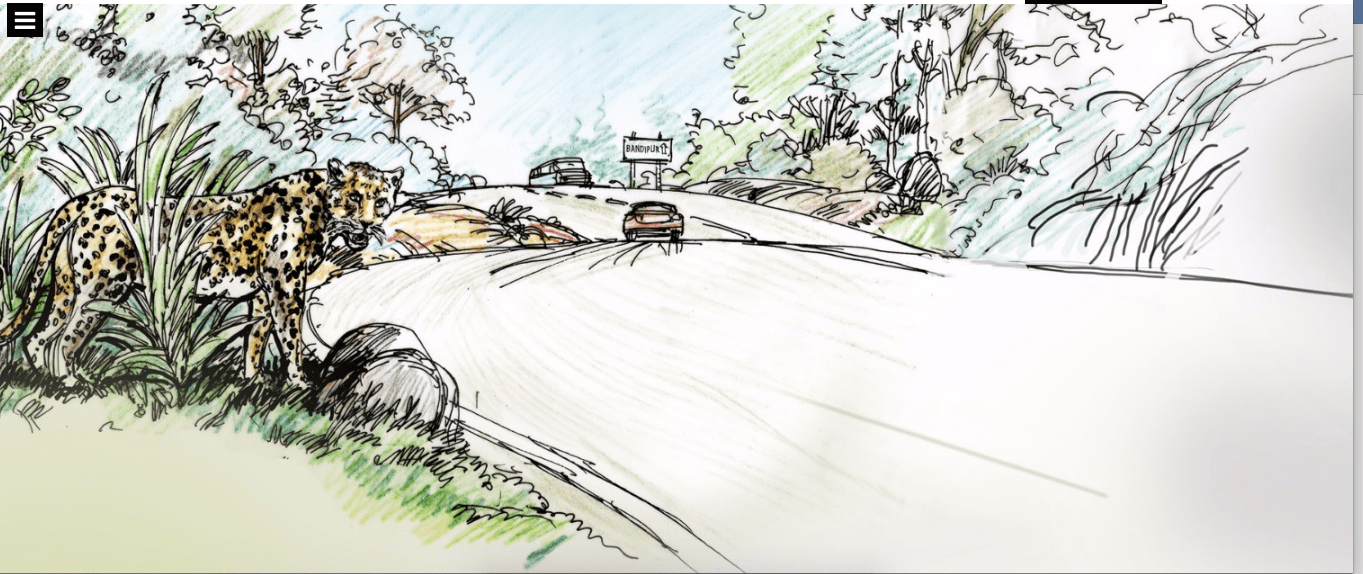
Why did the leopard cross the road?

screen-shot-2016-12-23-at-12-46-17-pm.png

https://www.natureinfocus.in/page/why-did-the-leopard-cross-the-road

Here’s a riddle.

Why did the leopard cross the road?

Because she was hungry, and she saw a zebra crossing.

Actually, that’s not true. Unlike us, leopards don’t understand that you need to look first left, then right, then left again, before crossing the road. They don’t know the rules behind the zebra crossing stripes on the road either (honestly, who can blame them, motorists also don’t seem to know that they shouldn’t stand on the zebra crossing; pedestrians have the right of way there). All these rules are made by humans, and it is silly of us to pave a road in the middle of a forest, and then expect leopards or elephants or other animals to know road crossing rules.

Nor do animals get boundaries. Your house or apartment block must have a wall and a gate to mark its perimeter. You know that you can’t just jump into another person’s house (unless you know them) because one, it’s not polite, and two, it’s not safe, and hello, it’s trespassing. But these are man-made boundaries. We don’t ask for permission from forest animals before mowing their trees down to build houses, grow crops, or mine for minerals. According to the World Wildlife Fund’s Living Planet Report 2016, the Global Forest Resources Assessment reports that since 1990, on a gross basis, we have lost a total of 239 million hectares of natural forest!

This means that there is lesser forest cover for animals to call their home, and it’s not that surprising when you hear news of a leopard coming into a school on a Sunday. After all, we can’t expect them to know these man-made boundary walls.

Further, our roads are becoming a point for human-animal conflict. Roadkill — that is wildlife killed on the road by motor accidents — has become a major threat to conservation. A study conducted by Panthera showed that 23 leopards were killed in Karnataka between July 2009 and June 2014 because of road accidents.

In a research paper titled Roadkill Animals on National Highways of Karnataka, by Selvan et. al, the authors conducted a survey to understand how many animals were killed on National Highways NH212 and NH67, which pass through Bandipur Tiger Reserve in Karnataka in 2007. They found that 423 animals of 29 species were killed between January and June. Isn’t that awful?

According to the Wildlife Conservation Foundation (WCF), at least three large animals are killed in accidents on these highways. And these include tigers, elephants, leopards, deer, sloth bears, snakes and birds. The good news is that in 2010, the group, with the help of the Wildlife Trust of India and the High Court, was able to ban night traffic in Bandipur. A good thing because 65 per cent of wildlife roadkills until that time were being documented at night.

This is, of course, only Karnataka. But there are so many instances of leopards and other animals becoming victims of accidents — either road or rail — across the country. What can be done about this? Plenty. For instance, not allowing roads or rail networks to be built inside forests or corridors, which animals use to pass from one jungle to another. Many forest departments now have installed neon boards and speed breakers to slow those hurtling vehicles going at top speed in the night. Or like the WCF managed to do — restricting vehicular traffic at night.

The good folks at the Nature Conservation Foundation – India have come up with a fabulous strategy in Tamil Nadu. They have installed seven canopy bridges in the rainforests of the Valparai region — aerial bridges (high up above the ground) that connect tree canopies that were otherwise too far apart across the roads. And it’s already showing results — lion-tailed macaques can cross the road without having to look left, right, and left again, and they don’t have to get down from their trees and dodge passing traffic.

What else do you think can be done? We’d love to hear from you with your ideas. Write to us at comments@natureinfocus.in
Play mats

http://www.thehindu.com/news/cities/mumbai/entertainment/plays-mats/article8020403.ece
IMG_7686

Keeping kids occupied at mealtimes just got a tad easier thanks to these activity placemats

Restaurants often offer puzzle placemats to keep diners occupied while waiting for their order. Spot-the-difference puzzles, word games and number challenges serve as appetisers until the real food arrives. Now, entrepreneurs are creating interesting placemats that can keep the little ’uns occupied at the dining table at home as well.

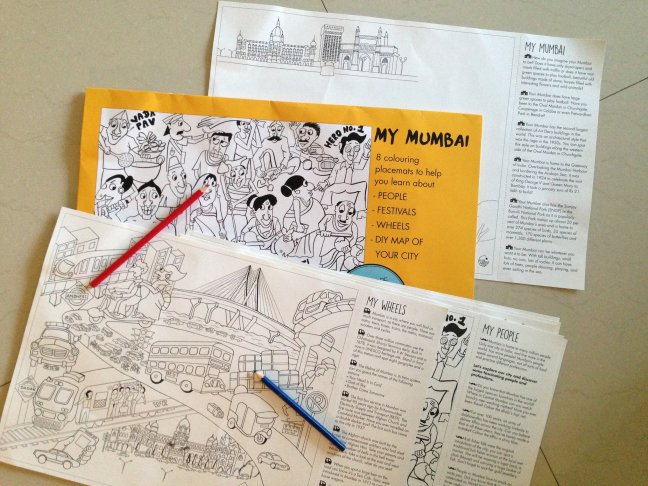
My Mumbai (Rs 500) is a set of eight colouring placemats that introduces Maximum City to children. Perfect for children aged four and above, the black-and-white posters by Yellow Pinwheel Kids Project offer a slice of Mumbai’s life. In one of the placemats, commuters are seen wending their way around the city, passing through the sea link, boarding a local train, and hopping on board a BEST bus. Another one is crammed with the city’s people — street vendors frying vadas for vada pao, Bollywood actors, Koli fisherfolks, paan wallahs, and of course, the dabba wallas. And the third is a glimpse into festivities. The illustrations are done by Abhishek Panchal, who founded Bombay Pencil Jammers.

The placemats encourage children to explore their city with the help of trivia pull-outs. Young explorers will engage with Mumbai’s architecture, the diverse cross-section of its people, and understand its geography. There’s a DIY map of Mumbai, which children have to draw themselves — the map starts at Gateway of India and ends at the Sanjay Gandhi National Park in Borivali. “My Mumbai is targeted for an age group of four to 10. It seems wide but the activity is different for each age segment. The four to six-year-olds will possibly use it just for colouring, but older children will use it as a mapping exercise to discover their city,” said Shinibali Mitra Saigal, who created the activity kit along with Shivani Lath. The entrepreneurs are former journalists, while Mitra Saigal is the co-founder of Kahani Karnival, a Mumbai-based children’s festival.

The Mealtime series by BrownBox Toys (Rs 450) is another charming set of sticker placemats that offer a culinary tour of India, China and England. Each set comes with four posters of typical Indian, Chinese or English meals, with stickers of the food items. The series introduces toddlers to different cultures and helps them understand food habits across the world. For instance, Mealtime England has a poster for fish n’ chips, complete with stickers of tartare sauce, mustard, crisps, peas, vinegar, and other sauces and condiments. Toddlers paste the stickers on the brown paper illustration on the page, to learn what a complete fish n’ chips meal would include. Mealtime India has a range of samosa, thali, kebabs, and dosa and idli. The selection is a mix of familiar and new food, which encourages children to try new dishes as well. The idea is to spark curiosity in young minds.

Then there’s PoppadumArt’s adorable Chalkboard Puzzle Mats (Rs 390) with a range of shapes such as sheep, goats, and bunnies. The animal’s head detaches to become a coaster. Children can write on the mat with chalk, wipe it off, and then scribble again. Made out of medium density fibreboard with a foam backing, the placemat is easy to wipe and reusable, said Saanwari Gorwaney, who started PoppadumArt four years ago to make what she calls “happy things to make spaces happy and bright”. Gorwaney, who is now based out of Gurgaon, worked in advertising before she embarked on this online venture. Out of the three, the chalkboard puzzle mats are easily reusable when it comes to dealing with messy hands. Both Mealtime and My Mumbai would need to be laminated before they can be used as permanent placemats. Of course, they might just end up being displayed on the refrigerator as works of art instead.

To order My Mumbai, visit http://www.facebook.com/My-Mumbai-1701714190047560/?fref=ts. The Mealtime series can be ordered online on http://www.brownboxtoys.com/ and the Chalkboard Puzzle Mats on http://www.poppadumart.com.

Entrepreneurs are creating interesting placemats that can keep the little ones occupied at the dining table

9 Green Gifts For The Festive Season

http://www.natgeotraveller.in/web-exclusive/web-exclusive-month/9-green-gifts-for-the-festive-season/

Spread the holiday spirit by cheering on artisanal, social, and eco-friendly enterprises.

    • TEXT: BIJAL VACHHARAJANI
POSTED  ON: OCTOBER 21, 2015 12:00 AM

These single-origin chocolates are handcrafted in Karnataka. Photo courtesy Earth Loaf

click me

Artisanal Chocolates

What’s sweeter than gifting chocolates for Diwali, Eid or Christmas? Making sure that those treats are organic and handmade. Mason & Co. sources their organic cacao beans from a family-run smallholding in Tamil Nadu. Try their 75 per cent Zesty Orange or 70 per cent Sea Salt Dark Chocolate that they make at their factory in Auroville. A far bigger temptation is their eight-bar dark chocolate collection gift pack.

Earth Loaf’s organic chocolates are handcrafted in small batches from cacao beans from a single estate in Karnataka, and their gorgeous wrappers are silk-screened by hand in Mysore. Try their 72 per cent Raw Dark Chocolate bar and the Gondhoraj & Apricot one.
Available at www.placeoforigin.in.

Handcrafted Pottery

Curators of Clay pottery is perfect for those with a sweet tooth. Photo courtesy Curators of Clay

Curators of Clay pottery is perfect for those with a sweet tooth. Photo courtesy Curators of Clay

click me

Bhairavi Naik and Rohit Kulkarni’s ceramic studio, Curators of Clay, will make you want to trade your space-saving, stacking Tupperware for their bespoke pottery. Their tableware and home decor accessories are handcrafted in small batches by the two potters in Bhugaon, Pune. Tea drinkers will be delighted by their gorgeous range of teapots, creamers, tumblers, and mugs. For those who have a sweet tooth, Curators of Clay pottery is perfect for baking; they even have custard jugs! They also have handcrafted porcelain tea lights for the festival season.
To order or customise a gift, drop in at their Pune store, visit their Facebook page or write to bhairavi@curatorsofclay.com and rohit@curatorsofclay.com.

Fairtrade And Organic Tea Hamper

Look for the Fairtrade and Organic Mark on a tea carton.

Look for the Fairtrade and Organic Mark on a tea carton.

click me

If you’re planning on assembling a food hamper, choose a tea carton with the Fairtrade and Organic Mark. The Fairtrade Mark means that apart from meeting social and environmental standards, an additional premium is paid to the producers for the purchase you make. Oothu green and black teas come directly from the Nilgiris, while Monteviot and Makaibari Tea have a dazzling range from Darjeeling. Pukka Tea’s Vanilla Chai, Supreme Matcha Green, Clean Green, and Cool Mint Green are perfect for detox after a festive binge. Best of all, you can feel zen knowing that the money will be democratically spent by farmer and producer committees on community projects such as education, eco centres, and smokeless chulhas.
Available on Amazon and Makaibari.

Single-Origin Honey

Over the last few years, Under the Mango Tree has become known for its fair-trade sourcing practices, in which they procure honey directly from beekeepers. Their fabulous Bees for Poverty Reduction programme enables farmers to generate additional income through honey, with the bees boosting yield through cross-pollination – a sweet deal for both bees and farmers. UTMT has a range of single-origin honeys – Eucalyptus Honey is perfect to soothe sore throats after a night of inhaling firecracker fumes, while their Sweet Clover Honey is a delicious addition to sweets.
Available at most grocery stores and on www.bigbasket.com

Handmade Books

It's hard to part with these gorgeous children's books. Photo courtesy Tara Books

It’s hard to part with these gorgeous children’s books. Photo courtesy Tara Books

click me

We’ll be honest: it’s hard to actually give away Tara Books’ stunning children’s books to kids. The Chennai-based independent publisher of picture books for adults and children has an eclectic list of titles created by writers, tribal artists and designers. To Market, To Market! by Anushka Ravishankar and Emanuele Scanziani charmingly portrays an Indian market, and is perfect for curious toddlers. Adults will love The Nightlife of Trees, an award-winning handmade book by Gond artists Bhajju Shyam, Durga Bai, and Ram Singh Urveti. The arresting visuals are a tribute to the magnificence of trees, and draw from the art and folklore of the Gond tribe. Don’t forget to check out their stationery section for the one-of-a-kind Flukebooks, perfect for jotting down organic recipes.

A funky Flukebook is great for jotting down organic recipes. Photo courtesy Tara Books

A funky Flukebook is great for jotting down organic recipes. Photo courtesy Tara Books

click me

Bengaluru-based Little Latitude has a range of books and toys which are not only beautiful but also environment-friendly. For instance, Vinay Diddee, who started Little Latitude, makes toys with rubber wood that is not treated with harmful chemicals.
Available at www.tarabooks.com. Find the store list for Little Latitude here.

Organic Cotton

Organic cotton is not only good for your skin but also for the soil, and farmers. With the use of integrated pest management measures, the soil retains its fertility, and farmers practise inter-cropping, which ensures their food security. Good Earth’s Gumdrops kids collection is eco-friendly and adorable. There are elephant soft toys, sleeping sets for infants, and quilts to choose from.

No Nasties clothing uses organic and Fairtrade cotton. Photo courtesy No Nasties

No Nasties clothing uses organic and Fairtrade cotton. Photo courtesy No Nasties

click me

Grown-ups can head to No Nasties to buy colour-block pocket tees made with organic and Fairtrade cotton. Each purchase comes in organic cotton bags and recycled cardboard tags made by a women’s self-help group near Pondicherry. While you’re at it, slip in a little Doug accessory as part of your gift. No Nasties’ Once Upon A Doug project supports women cotton farmers who make these adorable clouds with a silver lining, from scraps of recycled cotton during the lean season.

Once Upon A Doug supports women cotton farmers. Photo courtesy Once Upon A Doug

Once Upon A Doug supports women cotton farmers. Photo courtesy Once Upon A Doug

click me

If you’re looking for something more ethnic, check out Ethicus and Tula, two fabulous seed-to-stitch enterprises that are revolutionising the cotton supply chain.
Available at all Good Earth Stores. Shop at www.nonasties.in,www.onceuponadoug.com, www.jaypore.com, and www.tula.org.in.

Natural And Seasonal Cosmetics

It’s tough finding cosmetics that are made completely with natural ingredients. SoulTree is certified by BDIH Germany. The brand pays fair price to farmers, ensures that plants are not picked clean of flowers or fruits, and that harmful chemicals are not used in their products. They have a wide range of beauty products, but check out their Traveller Essential Miniature Kit which has 30ml bottles of moisturiser, shower gel, and shampoo. Their lipsticks use organic ghee as a base.
Available at www.soultree.in.

Coffee Subscription

Fuel that caffeine addiction with a coffee subscription to Blue Tokai. The hand-picked, single-origin coffee is roasted and then ground as per your specifications and delivered to your doorstep. Whether you like the full-bodied, low acid Monsoon Malabar coffee or the dark, oaky Vienna roast, there’s plenty to choose from. If you are not sure of which blend to gift, choose the Mixed Bag.
Available at www.bluetokaicoffee.com.

Gentle Detergents And Cleaners

Most homes get a thorough cleaning before Diwali, so eco-friendly soaps and detergents make an offbeat but handy gift. Common Oxen products use safe or natural ingredients, and are also a great gift to yourself. Their detergent Swish Wash is free of synthetic fragrances, phosphates, and carcinogenic chemicals. It is made of botanical oil soap, washing soda, baking soda, borax, rock salt, and lime and orange essential oils, and leaves your laundry smelling of the sun. Common Oxen also has kitchen dishwashing soaps, bathroom cleaners, and body soaps.
Available at www.commenoxen.in.

When Bijal Vachharajani is not reading Harry Potter, she can be found pottering about in the jungles of India. In her spare time, she works so she can fund the trips and those expensive Potter books. She did this by working as the Editor at Time Out Bengaluru. She writes about education for sustainable development and sustainable livelihood.

11 Books That Will Get Children To Explore The Wild

http://www.natgeotraveller.in/web-exclusive/web-exclusive-month/11-books-that-will-get-children-to-explore-the-wild/

World Habitat Day Special: Let a book lead you into swamps, seas and more

TEXT & PHOTOGRAPHS: BIJAL VACHHARAJANI

POSTED  ON: OCTOBER 5, 2015 12:00 AM

Hitch a ride on the back of a glorious book about wildlife.

click me

Children’s books can work like portkeys to nature. Turn the pages and you can be whooshed into a dense green jungle full of mysterious tigers and merry bears, transported to a bleak desert landscape, or plunged deep into the ocean, swimming with sea turtles and dodging jellyfish. On World Habitat Day, we pick 11 books that will enchant young readers and introduce them to habitats where the wild things are.

Sundarbans with Tiger Boy

In Mitali Perkins’ Tiger Boy, Neel’s parents and teachers want him to study hard for a scholarship that will take him from the Sundarbans to Kolkata. But Neel loves his home – he can splash like a river dolphin in the freshwater pond, climb tall palm trees, and forage for wild guavas. Besides, he has a bigger problem than geometry and algebra to worry about: there’s a tiger cub missing from the reserve. With the help of his sister Rupa, a spunky girl who has been forced to drop out of school, Neel decides to find the cub and save it from being trafficked by the evil Gupta. After all, who knows the island better than him?

Tiger Boy takes children into the swampy forests of the Sundarbans. Perkins paints a vivid picture of what it’s like to live in a place threatened by climate change: islands bolstered against rising sea levels by sandbags and furious cyclones tearing away mangroves. Yet, Tiger Boy is a story of hope; it’s about the splendour of the mangrove forests and islands, the magnificence of the tiger and its vulnerability, and human resilience in the face of adversity.

Also see:The Honey Hunter by Karthika Nair and Joëlle Jolivet is a sumptuously illustrated book that brings alive the richness of the Sundarbans. Nair’s story takes children through the mangrove forest, while Jolivet’s candy-coloured illustrations bring to life the honeybees, tigers, and trees of the Sundarbans.

Africa with The Akimbo Series

“Imagine living in a place where the sun rises each morning over blue mountains and great plains with grass that grows taller than a man.” This is where Akimbo lives, on the edge of a large game reserve in Africa. Readers will be enchanted by young Akimbo and his home. British author Alexander McCall Smith is best known for The No. 1 Ladies’ Detective Agency series, but he has a delightful repertoire of children’s books as well, which includes the Akimbo series.

Set in the heart of Africa, Akimbo lives alongside zebras that graze in the plains and lions, leopards, and baboons in the hills and forest. Man-animal conflict, poaching, conservation, and endangered animals are all part of the narrative. In Akimbo And The Elephants, his father who works on the reserve points out an animal and cautions him, “Don’t make a noise. Just look over there.” If only everybody on a safari would listen to Akimbo’s father, we would have so many more quiet and pleasant trips into the forest.

Also see: You’ve watched the movie Duma, now read the book it is based on.How It Was With Dooms is the story of Xan Hopcraft who grew up with a cheetah at his home in Nairobi. There are some lovely photos by his mother Carol Hopcraft in the book as well.

The Western Ghats with The Adventures of Philautus Frog

If you thought frogs lived only in ponds, then Kartik Shanker’s book will make you think again. Shanker’s protagonist is Philautus or Thavalai, a tree frog who has never ever come down from his Big Tree home. One day, Thavalai decides to hop off to look for the big blue sea. He has many adventures, including getting directions from a snake who could have easily swallowed him whole.

Maya Ramaswamy’s illustrations recreate the dark, deep shola forest, the surrounding hills and grasslands, and their many denizens. A hornbill sits placidly in one corner of the page, while a balloon frog puffs up in purple glory on another. Venomous snakes slither across the book and a dragonfly flits over the words. The book is packed with nuggets of information, such as that grasslands are hot in the day and cold at night, but the shola is always cool. Readers also learn that Thavalai often gets teased because Philautus frogs bypass the tadpole stage and froglets hop straight out of eggs.

Also see: Children can Walk the Grasslands With Takuri, a pygmy hog who is the protagonist of this book by Nima Manjrekar and Nandita Hazarika. Part of the same series is Aparajita Datta and Nima Manjrekar’s Walk The Rainforest With Niwupah, where a hornbill takes readers on a tour of his rainforest. Both books have been illustrated by Ramaswamy.

Hingol National Park with Survival Tips For Lunatics

Shandana Minhas’ Survival Tips For Lunatics is a rollicking tale that throws together a motley bunch of characters. There’s a squabbling pair of siblings, a Protoliterodragon who cannot stand bad poetry, and an angry black bear “with a dislike of the species that had put him on the endangered list”. The story is set in Hingol National Park in south-west Pakistan which is home to Chandrakup, the largest mud volcano in South Asia.

Changez, 12, and his brother Taimur aka Timmy, 9, go camping with their parents. Next morning, Changez wakes up to realise that the parents left them behind by mistake. Help is at hand in the form of a talking sparrow and other animals. The unlikely group end up across the Pakistan-Afghanistan border where they find that the human world holds more dangers than the forest. Survival Tips For Lunatics also explores the multifarious wonderful and fraught relationships that humans and animals share, and while doing so, holds up a mirror to our flawed ideas of civilization. But Minhas’ touch is always light, keeping the reader chuckling and turning the page.

Also see: Jungu The Baiga Princess by Vithal Rajan is set in the jungles of Madhya Pradesh and spotlights conservation and tribal rights. It’s a story about the Baiga tribe and their commitment to protecting their forest.

Around the World with The Snail And The Whale

What happens when a snail has an itchy foot and wants to see the world? He hitches a ride on the tail of a humpback whale for the journey of a lifetime. Illustrated by Axel Scheffler, Julia Donaldson’s picture book is a real treat. Young readers will join the snail and the whale to see “towering icebergs and far-off lands” where penguins frolic in the water. Then they go on to “fiery mountains and golden sands” to say hello to monkeys and turtles. While Donaldson doesn’t dwell on any particular habitat, the book makes for a fun guessing game about possible locations. For instance, where in the world are caves beneath waves where sharks with hideous toothy grins lurk?  Or which place is sunny and blue and has thunderstorms?

Also see: In The One And Only Ivan, Katherine Applegate talks about the tyranny of captivity and the yearning for the wild. The story is narrated by Ivan, a silverback gorilla who lives in a glass cage in a performing mall. Ivan introduces himself in the most heartbreaking manner by saying, “I used to be a wild gorilla, and I still look the part.” Ivan chooses to not remember his real home, where his father had a bouncy belly that was the perfect trampoline for his sister Tag and him. It’s the only way he can cope with living in a cage. Based on a real life story, Ivan is both beautiful and moving – a poignant reminder of the absence of home.

Five Indian children’s books on tiger everyone must read

http://www.dailyo.in/arts/world-tiger-day-books-children-national-animal-india-poachers-wildlife-environment/story/1/5300.html

On World Tiger Day, it’s time to show your stripes for India’s national animal.

GROWING PANGS  |  4-minute read |   29-07-2015

It’s time to show your stripes for India’s national animal on World Tiger Day. We give you a round-up of five books about this magnificent animal that should be part of your children’s bookshelves.

1. Ambushed by Nayanika Mahtani:

9780143333609.201503_072915102718.jpg

The ten-year-old Tara is a gadget geek, she even thinks her Papa’s birthday cake should be shaped like his BlackBerry phone. Which is why when her banker-turned-photographer father decides to take her to Ranibagh, a tiger reserve in the Himalayan foothills for the summer, she’s horrified. After all, nothing ever happens there, does it? But then Tara lands splat in the middle of an adventure – who would have thought that the forest was not only home to the beautiful tiger, but also to an international gang of ruthless poachers? Satya, a tribal boy, enlists Tara’s help to literally save the skin of a tigress and her cubs.Ambushed is a fast-paced read that puts the spotlight firmly on conservation. Nayanika Mahtani’s debut novel is peppered with trivia, such as tigers are hard to spot and that some hundred years ago, there were over one lakh tigers in the world. While doing so, she also touches upon themes of social inequalities and the politics of conservation and poaching.

2. Ranthambore Adventures by Deepak Dalal:

deepakdalal_072915102733.jpg

For any child who has visited Ranthambore Tiger Reserve, Deepak Dalal’s Ranthambore Adventures is sure to transport them straight back into the Rajasthan forest. Aditya is planning to join his friend Vikram in Ranthambore, when he stumbles upon the diary of a tiger poacher. Aditya is grabbed by the poachers and his friend Aarti follows their trail, all the way to Ranthambore. At the same time, readers are invited into the world of Genghis, a magnificent tiger and his family. An action-packed adventure, Deepak Dalal’s story is an informative read about tigers and their home, the forest. It’s also a story of friendship and courage, harking back to timeless books such as Enid Blyton’s Famous Five series. Although Ranthambore Adventures was first published in 1998, its message about tiger and forest conservation remains as evocative as ever.

3. The Tigers of Taboo Valley by Ranjit Lal:

27isbs_tiger_2292203_072915102752.jpg

One of the best explanation of a poacher comes from Raat-ki-Rani, a tigress who lives in Sher-Kila National Park. She explains to her cubs that “A poacher is one of those two-legged hairless cowards who will kill you if he can. He might use any revolting method he can think of – poison, traps or guns”. Tragically, the brave tigress dies at the hands of poacher Khoon-Pyaasa, leaving an unwilling boss tiger Rana Shaan-Bahadur to take care of his four cubs, Hasti, Masti, Phasti and Zafraan. But like many forest, this one too is brimming with gossiping animals, a vulture squad called Diclo-Fenac, a photographer from the National Geographic, and an underground group of porcupine terrorists who have it in for tigers. Ranjit Lal offers a hilarious wild rumpus, where readers learn about the fascinating animals, while sparking concern for the forests and its denizens.

4. Tiger by the Tail by Venita Coelho:

full-cover-tiger-by-_072915102803.jpg

Venita Coelho’s book comes with a tagline, “Save the Animals, Save the World” – which happens to be the motto of the Animal Intelligence Agency (AIA). The back of the book explains that the AIA is “a multi-species non-governmental agency. Specially trained animal and human agents work undercover to save animals and save the world. Some of them have the licence to kill”. One of the agents with a licence to kill is Agent No 002 aka Bagha, a member of the Panthera tigris species. The tiger is 250kgs of sheer intelligence and muscle. He’s really what one could call a cool cat. Bagha and Rana, a boy who can communicate with animals because he can JungleSpeak, embark on a mission to investigate the disappearance of tigers from wildlife reserves across South Asia. Tiger by the Tail is a wonderful read, interspersed with pages of trivia and facts about tigers.

5. Tiger on a Tree by Anushka Ravishankar:

61qmujrca0l._sx377_b_072915102813.jpg

Published in 1997, Tiger on a Tree is one of the most iconic books about the big cat. Resplendent in orange and black, the picture book has been illustrated by Pulak Biswas. Anushka Ravishankar tells the story of a scaredy-cat tiger who gets stuck on a tree. As the villagers “Get him! Net Him! Tie Him Tight!” they need to decide what to do with this tiger. Written in verse form, Ravishankar talks about the man-animal conflict, courage, and kindness, in a simple yet beautiful way. Biswas’ illustrations carry forward the tale, bringing the forests, the river and the village alive with his brush.

Tiger Talk

http://natureconservation.blogspot.in/2007/05/lmno.html

Found an old old old story of mine online.

Copyright Protected
Date with Tiger:
================

Animals rank high in Bijal Vachharajani’s scheme of things whether as Special Projects Co-ordinator at PETA India or at her stint at Sanctuary Asia. She shares her experiences at the Ranthambore Tiger Reserve with ROUGE .

I was only vaguely aware of my surroundings—tourists were whispering urgently, bickering amiably about who gets the better photograph. But for me, time had stopped. After all, there she was, resplendent in her burnished gold and black striped coat, languidly lapping water from a gushing stream. Her cub, an adolescent tiger, ran around her, amused by the uncalled attention from the excited gawkers. It was my first glimpse of the magnificent Panthera Tigris.

A tip from another canter (that this area was frequented by a tigress with her cubs) had sent our vehicle heading towards this particular stream. The driver shut off the canter’s engine, leaving behind a tense silence. We squinted and strained our eyes, trying to see something through the green and yellow foliage in front of us. Whether it was the rickety boat ride in Periyar Tiger Reserve, where all we spotted was a lone drongo bird, or the unsuccessful quest at Sariska Tiger Reserve, my misadventures with spotting a tiger had left me with the morose feeling that the tigers were eluding me. Immensely adaptable animals, tigers can be found in a wide range of habitats from the arid Ranthambhore to the marshy Sunderbans and the evergreen forests of the Western Ghats. Solitary in nature, tigers are the largest of the cat family and are very territorial. Tigresses, like the one we were waiting to catch sight of, are extremely protective of their cubs.

Suddenly, the driver pointed out, exclaiming, “There she is, I can see her ear!” False alarm. Ready to call it a day, the driver restarted the canter. That was when the tigress suddenly moved from her camouflaged resting place. My date with the tiger was complete.

Most people ask — what’s the big deal about a tiger? As I learnt from Bittu Sahgal, the Editor of Sanctuary Asia, the tiger is a keystone species, the symbol of a thriving forest. He recites this mantra, “To save the tiger, you have to save its home — the forest.” And considering the fact that more than 300 rivers originate from the 28 tiger reserves of India, if you save the forest, you end up saving our water resources. The larger implication? That our subsistence on planet Earth is inextricably connected to the tiger’s survival. The tiger is caught in the throes of a rollercoaster ride to survive. Studies show that tigers only occupy a measly seven per cent of their historic range today, that’s 40 per cent less than a decade ago. Mindless destruction of forests has put India’s wildlife in peril. Worse, poaching for trophies and their body parts, for use in traditional Chinese medicine, only pushed the numbers further down. In 2004, the nation was shocked with news that poachers had wiped out Sariska’s tigers like an epidemic. Suddenly, alarming reports were making headlines in newspapers and magazines. Tiger numbers were dwindling across India and conservationists pegged the number to a meagre 1, 500 to 2, 000. Surely an abysmal report card for our national animal.

I remember chatting with Jaimini Pathak, the writer and director of the heartwarming children’s play Once Upon A Tigerwhich delved on the topic of tiger conservation. When I asked him what ails the tiger in India, Jaimini responded simply, “Human greed.” I rest my case!

Conservationists across India are fighting the battle. We too can help, by sensitively treading upon the Earth’s resources. Save water, paper, and electricity. Invest in corporates who work towards sustainable development. I hope the Earth doesn’t have to witness a time when the tiger draws dangerously close to getting tagged with the phrase “as dead as a dodo”.

PhotoStop: ‘Organic’ reach at Fair Trade Alliance Kerala’s Seed Fest 2015

http://www.thealternative.in/lifestyle/organic-reach-at-fair-trade-alliance-keralas-seed-fest-2015/

The 5th Fair Trade Alliance Kerala Seed Fest saw organic farmers from Kerala showcase their produce and share how beneficial organic farming can be.

In 2011, farmers of the Fair Trade Alliance Kerala came together to host the very first Seed Fest. Four years on, it has become a space for farmers from the region to promote biodiversity, food security and gender justice by sharing knowledge, exchanging seeds and displaying their produce. The Seed Fest is an initiative of the Fair Trade Alliance Kerala, an organisation co-founded by Tomy Mathews which brings together farmers and enable them to trade on Fairtrade terms of minimum support pricing and the benefit of a Fairtrade Premium.

Here’s a pictorial tour of the FTAK Seed Fest 2015:

1. A farmer from the Mananthavady taluk in the Wayanad district of Kerala grows 26 kinds of chillies, welcome news at a time when the FAO estimates that since the “beginning of this century, about 75 per cent of the genetic diversity of agricultural crops has been lost.”

Fair Trade Alliance Kerala's Seed Fest 1_Chillies1

2. We eat more homogenously today and according to the FAO, “just nine crops (wheat, rice, maize, barley, sorghum/millet, potato, sweet potato/yam, sugar cane and soybean) account for over 75 percent of the plant kingdom’s contribution to human dietary energy”. Yet, farmers at the Seed Fest had different species of brinjal – from purple to yellow in colour.

Fair Trade Alliance Kerala's Seed Fest 2_Brinjal1

3. There were crimson coloured chillies and plum-coloured beans on display.

Fair Trade Alliance Kerala's Seed Fest

4. We were fascinated by the variety of bhindi there.

Fair Trade Alliance Kerala's Seed Fest 4_bhindi5

5. Shobhana (extreme right) is the secretary of the Thavinjal Panchayath from Mananthavady as well. The woman farmer’s stall had a banner up which read, “Gender Justice”. When we asked her what it means to her, she said that her being at the Seed Fest said it all.

Fair Trade Alliance Kerala's Seed Fest 5_Shobha

6. Shobhana showed us some gorgeous greens beautifully wrapped in plantains. She smiled and told us, “Who needs plastic, right?”

Fair Trade Alliance Kerala's Seed Fest 6_pack2

7. Sunni (centre), another organic and Fairtrade farmer told us that since the time (ten years ago) he switched to organic farming, he finds that his personal health has improved.

Fair Trade Alliance Kerala's Seed Fest 7_sunni1

8. His produce was staggering with different kinds of gourds, yams, tapioca, chillies, and grams.

Fair Trade Alliance Kerala's Seed Fest 8_sunnis produce

9. We went home with a variety of seeds for our balcony gardens and with an appreciation of the farmers who grow our food.

Fair Trade Alliance Kerala's Seed Fest 9_diversity

What Indian CEOs Can Learn From This Tea Company About Having Women In The Boardroom

http://www.thebetterindia.com/16089/indian-ceos-can-learn-south-indian-worker-board-women-boardroom/

Paneerselvam, with her left leg poised gracefully behind the right, shoulders and arms bent gently, braced her body for the run. In her sunny yellow and cobalt blue sari, the 50-year-old looked more like a dancer, than an athlete. But that perception changed as she sprinted across the tea field, stopping to turn back and laugh. “I love running,” Paneerselvam says in Tamil.

Pannerselvam-the runner

She is not a marathon runner in training, but a tea plucker who has been working at The Bombay Burmah Trading Corporation Limited, a Fairtrade-certified tea estate for the last 25 years in south India. She is also a member of the Mudis Foundation Joint Body which democratically decides how to invest the Fairtrade Premium. Being a Fairtrade-certified tea estate ensures that a premium – an extra price over the market one – benefits the workers, who on average draw a daily wage of Rs 300.

The joint body is unique in another way – it has an equal representation of men and women workers who mutually decide how the premium should be invested. This is mandated by Fairtrade standards, which requires the committee to have an equal or proportionate representation of men and women.

BBTC Tea Factory, women

The committee has been striving to work towards gender equality long before India became one of the first developing nations to pass a law to make women representation on corporate boards mandatory. Corporate honchos can well take a few lessons from this joint body, given that reports reveal that India has one of the worst ratios of women directors to their male counterparts on company boards.

Using the Fairtrade Premium on the OOTHU tea, they grow, 2,100 families of tea pluckers chose to get Cello Casseroles to keep their lunches and dinners warm.

The committee’s meetings are meticulously recorded, and each member represents a division of the tea estate. Decisions are taken after the tea workers’ consultation and approval as well as in accord with the BBTC management. Lakshmi, who has worked for 18 years at the BBTC, said that the work force she represents meets at a tea shop in the evening. “We talk about the meetings, they give their responses – yes or no to a certain suggestion – and I bring it back to the board,” she explained. “It’s a two-way system.

Over the last 19 years, the premium has been used for short term to long term projects including education scholarships for college-going children of workers, a retirement fund, a computer centre for the community school, and smokeless chulhas and emergency lights for all households.

What’s evident is that this decision-making has taken big strides in making the women feel more confident and vocal about the divisions they represent, their rights and their future. While most of them, like Paneerselvam grew up in these same tea estates where their parents worked, they are much more ambitious about their children’s future. Most are arts and engineering graduates, while one of the workers, whose name curiously is Indira Gandhi – her daughter is a finance manager at an accounting firm.

BBTC tea estate, computer centre

BBTC tea estate, women empowerment

Of course long standing patriarchal conditioning cannot be easily abandoned and decisions such as buying insulated lunch boxes or smokeless chulhas seem to be mainly the purview of the women, while education scholarships and retirement funds discussions are agreed jointly by both men and women.

“It may seem like a small thing,” said Paneerselvam, holding up a pressure cooker funded by the premium. “But I can cook more than one item in this pressure cooker and that means I get time to do other things. Small things like this make a bigger impact.”

And of course, this means Paneerselvam has more time to pursue her passion – athletics. “My parents always encouraged me to take part in athletics,” she said. “Today my children also love running. But of course when we race, I usually win.”

Like this story? Or have something to share? Write to us: contact@thebetterindia.com, or connect with us on Facebook and Twitter (@thebetterindia)

About the Author: When Bijal Vachharajani is not reading Harry Potter, she can be found looking for tigers in the jungles of India. In her spare time, she works so she could fund the trips and those expensive Potter books. She did this by working as the Editor at Time Out Bengaluru. She is now a consultant with Fairtrade India.

– See more at: http://www.thebetterindia.com/16089/indian-ceos-can-learn-south-indian-worker-board-women-boardroom/#sthash.WxGj3wzT.dpuf

Packing Guide For The Travelling Parent

http://www.natgeotraveller.in/web-exclusive/web-exclusive-month/how-to-pack-when-travelling-with-kids/

Blankies, scrapbooks, apps – gear up for a child-friendly vacation.

    • TEXT: BIJAL VACHHARAJANI
POSTED  ON: OCTOBER 21, 2014

Packing for kids can be tricky. In one instalment of Bill Watterson’s iconic comic strip Calvin and Hobbes, Calvin goes off on a trip with his parents and forgets to bring Hobbes the tiger along. His parents, of course, never hear the end of it throughout the car journey.

Travelling with kids, especially younger ones, is never easy, with checklists threatening to be longer than a foot ruler and parents wishing they had an extra pair of eyes and hands to keep an eye on their wards. However, packing is one element of travel that, although quite a chore, can be made easier with simple ideas and checklists.

Pack in advance

Sit your children down and ask them to help you draw a list of the toys, games and clothes that they simply can’t do without. Don’t forget their favourite security blanket if they are attached to one. Negotiate your way around unwieldy accessories – for instance, why that pirate’s chest simply cannot be lugged along. Next, throw everything in the final list into your bag, so that you don’t leave them behind.

Keep them engaged

Each child has different sets of interests, but pack essential games and sports accessories. For instance, Lego, Frisbees and inflatable beach balls are easy to carry and barely take up any space. Of course, you do need a strong pair of lungs to inflate the beach ball. Make sure you carry a drawing pad along with a case of pencils and colours to keep them busy. Toy stores such as Hamleys have nifty travel games like magnetic Snakes and Ladders and Ludo, which means you don’t have to scramble on all fours looking for missing pieces every time the car or bus hits a speed bump.

If you plan to carry some “educational material” along with you, then publishing house Parragon has excellent Gold Star activity books that you can tuck into your handbag and whip out every time your child complains that he or she is bored.

And of course, don’t forget to carry a stack of books – some old favourites and a few new ones.

Let them stay app-friendly

Like it or hate it, the tablet is here to stay. In many ways, a tablet can be a boon while travelling – they are relatively light as compared to laptops and have enough games and stories on them to keep the kids busy during long journeys. Ensure that your tablet is charged before you leave, and your child’s favourite apps are loaded, especially those that don’t need the Internet to operate.

Be weather-ready

Yahoo! has a neat weather app that will tell you what kind of weather to expect, and help you pack accordingly. If you’re travelling during the monsoon, carry a raincoat and gum boots. As a rule of thumb, avoid packing light- or pastel-coloured clothes or anything that gets creased easily.

Keep presents handy

If you plan to buy new toys or books for the journey, save them as presents and hand them out during exceptionally cranky moods; we can promise you instant smiles.

Let them behind the camera

Most kids love to pose, but even more, they love to take pictures. Buy them a cheap camera for their own use and let them take responsibility for the gadget.

Give them their own bag

Pack a small bag for your child, which includes a towel, water, a snack, a book and an address slip with your contact details and the hotel you are staying at. Most kids love to shoulder this responsibility, often lugging their little backpacks across the airport, and refusing to part with them.

Maintain a diary or scrapbook

Lastly, don’t forget to pack a small diary or travel journal. Encourage your child to fill it for 10 minutes daily, recording the trip’s highlight by way of a note, a drawing or even pressing a flower.

Checklist

•    Organic mosquito repellent free of harmful chemicals, such as citronella oil.
•    Medicine kit: Make a DIY medicine kit at home with some basic pills for cold, cough, tummy and motion sickness, band-aids, cotton, wipes, antiseptic cream and a thermometer. Make sure prescription medicines are in, along with the doctor’s prescriptions for the kid. Add a candy or lollipop, it does wonders to soothe aching wounds.
•    Carry a small travel-pouch with bottles that can hold tiny amounts of toiletries for your child. This means you can carry them in hand baggage instead of checking them with your luggage.
•    Gadget chargers and spare batteries for toys.
•    Professor Dumbledore said, “One can never have enough socks.” Can’t argue with that.
•    If you’re travelling by air, keep a pack of chewing gum. Kids can have that in case of ear aches due to cabin pressure.
•    Cap, sun hat, sunglasses, scarves, mufflers, gloves.
•    Slippers or flip-flops, comfortable closed sneakers.
•    Swimwear if there will be a pool or a beach.
•    Water bottles and juice cartons to keep the kids hydrated.
•    Snacks on the go, such as biscuits, dry fruits and fruit bars.
•    A mini night-light to keep the monsters away in hotel rooms.
•    Hand sanitiser or wipes.

Key lessons from travelling with kids

1.    Astalakshmi Venkatesh lives in Bengaluru and often travels with her husband and daughter on holidays. “My daughter is six years old, and she’s prone to motion sickness. If we are travelling by car, I pack lots of plastic bags!” she said.

2.    Venkatesh who works with Fairtrade India remembered another holiday when they were trekking in Thekkady in Tamil Nadu. “She had rubber boots on but leeches kept getting in to her normal shoes,” recalled Venkatesh. “I realised then that I should have packed proper trekking boots. But she didn’t mind, in fact, she was fascinated by the leeches and kept saying, ‘Mamma, see!’” Venkatesh also has a travel pouch with small sterilised bottles in which she keeps small amounts of toiletries and medicines. But her best tip is for infants who cannot sleep without a cradle – “I would carry a sari and we’d tie it between the two berths in a train,” she said. “That would become a makeshift cradle.”

3.    Two years ago, Chaitali Airan was travelling with her family including her five-year-old son to Singapore. “I thought my son was too big for a stroller,” she said. “But after walking around for one day in the hot and humid weather of Singapore, I decided to rent a stroller immediately. I found a ‘Rent-a-Stroller’ service online. Universal Studios, which we visited, was more fun when you don’t have to juggle between lifting your son and your bags and countless other things.”

4.    Airan, who works in the banking sector in Dubai, also suggests that parents carry small change in the local currency. “My son wanted to go to the toilet, minutes after we reached our next destination – a boat ride,” she recalled. “All I had was100 Euro notes. By the time we managed to get change, the ship had literally sailed. We had to go back to the hotel instead. I now carry lots of change – most airports have change machines.”

5.    Jayshree V. and her family are vegetarians. “After four days in South Africa, my three-year-old daughter absolutely refused to have pizza,” she said. “Now on a foreign trip, I carry an electric hot plate, pans and staples like lentils and rice in a zip-lock bag. The content look on my daughter’s face is worth the hotel complaints about smells emanating from our room.”

Kidspeak

Seven-year-old Reyansh Airan draws up his own checklist:

“Sometimes, your parents don’t allow you to carry your iPad or laptop. But that’s not always a good idea. Here are my suggestions for stuff to bring on a holiday.

•    Get your parents to load the laptop with your favourite games and movies.
•    A book that you would read for entertainment, and not a study book.
•    An iPad that is fully charged and has the right apps.
•    Milk, candy, fruits and biscuits.
•    Your own bag
•    Medicine
•    Sunscreen
•    Water
•    Mints for the plane”

When Bijal Vachharajani is not reading Harry Potter, she can be found pottering about in the jungles of India. In her spare time, she works so she could fund the trips and those expensive Potter books. She did this by working as the Editor at Time Out Bengaluru. She is now a consultant with Fairtrade India.

Cloud atlas

http://www.timeoutmumbai.net/travel/features/cloud-atlas

Time Out visits the world’s happiest country and returns with its share of bliss

When travelling to Bhutan by air, we have one piece of advice – check in early to ensure you get a window seat. According to Druk Air, the country’s national carrier, Bhutan’s international airport is nestled in a valley that stands 7,300ft above sea level and is surrounded by hills as high as 16,000ft. As the plane swoops down, it leaves the plump white clouds behind to reveal lush mountains, dotted with traditional Bhutanese houses. The landing approach, the airline’s website reveals, is carried out entirely by visual flight rules. A wing dips and the aircraft weaves deftly around the mountains, like a graceful dancer, before finally touching down in the valley of Paro.

Bhutan is often referred to as the Last Shangri La, a nod to it being akin to a mystical Himalayan utopian land. Locals call it the Land of the Thunder Dragon, while most visitors know it for its alternative development metric, the Gross National Happiness. Sandwiched between India and Tibet, it is a land-locked country. Thimphu, the capital, is an hour away from Paro and the journey is scenic – our van vended its way through winding roads, which were fenced by gently rolling mountains, with the river Paro Chhu gurgling at the foothills and stout apple trees and giant rose bushes nodding at every corner.

Centre stage

Our destination was Taj Tashi, a five star hotel situated in the heart of Thimphu market. Offering panoramic mountain views, the hotel amalgamates the dzong architecture of Bhutan with modern amenities. The Thimphu market is a bustling one with furry mountain dogs lounging on the pavement, baskets full of bright green asparagus and chillies and Bhutanese people dressed in traditional threads – men wear the gho, a knee-length kimono-style robe, while women wear an ankle-length blouse and skirt called the kira. Its many shops offer everything from local SIM cards and pizzas to ATM machines and handloom souvenirs.

Adjoining the hotel is the newly opened Crafts Bazaar – a row of bamboo huts that display and sell traditional arts and crafts at mostly reasonable prices. We took a leisurely stroll in the evening, stopping to watch artistes weave colourful belts on handlooms, and ended up buying reams of soft handmade Bhutanese paper, wooden wares and a scroll that had a painting of the tiger, the lion, the thunder dragon and Garuda the eagle, who are believed to watch over the land.

The next morning, our gracious guide Sonam Pelden took us to the Buddha Dordenma statue which is located on a hill in the Kuensel Phodrang National Park. Pelden works with the Tourism Council of Bhutan and told us that at 169ft, this is probably the tallest bronze, gold-gilded statue of Buddha in the world. It is omnipresent in Thimphu and you can see it from most places in the city. Construction started in 2004, and continues so far – when completed the meditation hall will have 100,000 Buddha statues.

Local flavours

A visit to the capital, we discovered, is incomplete without a trip to the Folk Heritage Museum, which was started in 2001 by Kesang Choeden, a former police officer. The highlight for us was the traditional Bhutanese lunch served at the restaurant there. The meal started with hot Bhutanese butter tea and then a wooden bowl was filled with ara, a traditional fermented rice drink. “I don’t keep a menu,” said Choeden, “The menu is decided on what local and seasonal produce is available.” The table groaned as bowl after bowl of steaming hot food came from the kitchen – we tucked into buckwheat pancakes; eggplant sautéed with Schezwan peppers; sautéed asparagus; cucumber and carrot salad with nigella seeds; potato and cheese stew; ema datshi (a chilli and cheese stew) and curries of beef and chicken with cauliflower. Dessert was ripe purple plums plucked from their orchard and they were teamed with bowls of home-brewed smoky mistletoe tea. “I have always been interested in food,” said Choeden. “I would get upset about the feedback that I got on Bhutanese cuisine – a lot of people said that it lacked variety and originality. I wanted to prove them wrong and show that Bhutanese food has a lot of range and variety.”

Sacred sights

The next day, we headed west to Punakha. The drive was one of the most spectacular so far, cutting through lush valleys and gushing rivers on cloud-wrapped paths cut into the mountains. Punakha is home to the Punakha Dzongkhag, Bhutan’s oldest and second largest dzong (a kind of fortress unique to Bhutan and Tibet). Pelden told us that Punakha is known as the place where the Pho Chhu, a male river meets the Mo Chhu, a female. The magnificent structure with its white-washed walls and ornate architecture stands against a backdrop of yellow laburnum trees and a busy river. The dzong is historically significant as well – it used to be the state capital from 1637 to 1907, it’s where the first national assembly took place in 1953 and in 2011 the king of Bhutan got married here. The Punakha Dzongkhag also contains archives and the Ranjung Karsapani, the spine of the monk Tsangpa Gyarey, which is considered to be a sacred relic.

Near Punakha lies the Chimi Lhakhang monastery which was built as a tribute to the tantric Buddhist master Lama Drukpa Kunley who lived sometime between the 15th and16th centuries. The monastery is replete with traditional symbols of a phallus – the priests even bless you with one, along with a bow and arrow – which is meant to keep away the evil eye. It’s also considered a fertility temple where couples come from all corners of the country to seek blessings for a child.

It was time to head back to Paro, but only after a quick pit stop at the Druk Wangyal chortens, where 108 chortens (a kind of stupa) are built on a mountain pass. On clear days, this pass offers a panoramic view of the Himalayas, but since we were visiting in the summer, which is characterised by heavy rains and clouds, what we instead saw were tall Himalayan cypress (Bhutan’s national tree) swathed in clouds giving us an illusion of having stepped into another Narnia-like world.

Indeed, most of Bhutan is ethereal – its forest cover extends to 72 percent of the country. Its people are focussed on an alternative model of development which doesn’t look at merely economic growth, and beauty lurks in every nook and corner.

When to go
Plan your visit during the summer months, between March and September.

Getting there
Flights are available from Mumbai, Delhi, Kolkata and Guwahati. Bhutan’s international airport is located at Paro, while Druk Air and Bhutan Airlines are the two main carriers.

Getting around
All visitors must employ the services of a certified Bhutanese tour operator to book their travel and accommodation. Visa clearance must be obtained prior to landing, but Indian, Bangladeshi and Maldivian nationals are entitled to receive a visa upon arrival.

Tourist information
http://www.tourism.gov.bt

By Bijal Vachharajani on September 01 2014
Photos by Avikgenxt | Dreamstime.com, Steve Allen | Dreamstime.com