Out of line but in your mind

10bmdjc-pg4-kid_10_2730900g.jpg

http://www.thehindu.com/news/cities/mumbai/entertainment/out-of-line-but-in-your-mind/article8216855.ece

What does a Chuppertyhoover look like? We know it makes a good pet once it’s been fished out of a chamber pot, because Jerry Pinto says so in Monster Garden : A Draw-It-Yourself Picture Book . And that means it can look like whatever our idea of a good animal companion is. The Chuppertyhoover could have eyes like a dog, ears like a rabbit, a face like an elephant, a body like a giraffe, and legs like an alien. Or it could look like a chapati that’s just been hoovered off the carpet. Or it could be a hoov that’s gone chup and ’ert. Basically, no one’s been told what it looks like. Then, there’s another conundrum. The Chuppertyhoover only eats Asumptivet. And that too, only if it’s fresh. No stale Asumptivet for our Chuppertyhoover. But again, what does an Asumptivet look like?

The answer is not in Pinto’s latest book published by Duckbill. Rather, it’s in your child’s imagination. Because that’s what Monster Garden is about: being imaginative and creative to draw and colour your own picture book. Pinto’s prose frolics delightfully across the pages with the help of Priya Kuriyan’s illustrations. There’s a tree looking slightly nervous and the child has to draw a Scrumpeelious under it, while a Sharmistickle has to be drawn to hover in the air. Hairy feet poke out in an Asumptivets field, as Pinto offers a hilarious, but complicated way to get to an Asumptivet. And in all of that, the child creates his or her very own monsters, plucking them straight out of his or her fancy.

Pinto said he wanted Monster Garden to be free of preconceived adult notions about what children like to draw and paint. “Do they really like to paint ducks who wear shirts and caps but no trousers,” he asks. “Do they like to paint lady mice in frilly knickers? Wouldn’t they like to imagine what a Chuppertyhoover is? And how it looks when it eats a Floover? I thought I would, so that’s the book I gave them.” That’s why there aren’t any kinda-obvious ‘Join the Dots’ or ‘Copy and Colour this Picture’ pages in this whimsical and quirky book. “I was given a series of dot-to-dot books when I was a child, by a peculiar aunt who kept giving them to me when I was way into my teens,” said Pinto, via email. “But even as a child, I could see what the dots were joining up to make and I couldn’t see the point of joining them. And then I could never decide whether to use straight lines or curvy lines — and if the latter, then should they be convex or concave or just plain wriggly.”

Monster Garden is a mischievous book, sparkling with humour and ingenuity. Children are fascinated and spooked by monsters, most anyway lurk in their imagination. Monster Garden brings that to the forefront. Priced at Rs 150, the book will make for a super goody bag filler as well. There’s a pull-out colour poster where Kurian has created a fabulous gallery of monsters including the Bubbleganoosh and Pinkiporous.

But what makes Monster Garden an important addition to the library is its spunkiness — it is a clarion call to get children to think outside the colouring lines, rummage through their own thoughts and create what they want. For a change, no one is telling them what to draw and how to draw it. Pinto and Kurian offer hints and nudges, but that’s about it. And that is a rarity in a world that’s full of staid, run-of-the-mill colouring and activity books, which are extremely popular with parents, who want their children to “be constructive” in their play or reading time as well.

Pinto hopes that parents will encourage children to get this book and draw all over it. “I hope they won’t tell their kids that you must draw a better monster than that, come on beta, I know you have it in you, because what is a better monster?” said Pinto. “I hope they will buy two copies and save one for themselves and draw the monsters themselves because Pama-Muppy also have inner children, starving inner children who must be fed.” Given the popularity of colouring books for adults across the world, and the universal appeal of Monster Garden , this might actually happen. As a child, Pinto said that he had poor hand-eye coordination, mostly because his bad eyesight went undiagnosed until eighth standard. “So I would get failing grades at drawing in school because I did not stay within the lines,” said Pinto. “So this book was designed for all those kids out there who like their colours to break out of the lines, who find that their washes wash everything else out, who have no sense of proportion. It’s for genius kids and we know from Picasso that every child starts out as a grandmaster and then they grow up and lose all sense of great art. This is for those children who did not grow up but who are chronologically called adults too.”

The author writes about education for sustainable development, conservation, and food security. She’s the former editor of Time Out Bengaluru .

11 Books That Will Get Children To Explore The Wild

http://www.natgeotraveller.in/web-exclusive/web-exclusive-month/11-books-that-will-get-children-to-explore-the-wild/

World Habitat Day Special: Let a book lead you into swamps, seas and more

TEXT & PHOTOGRAPHS: BIJAL VACHHARAJANI

POSTED  ON: OCTOBER 5, 2015 12:00 AM

Hitch a ride on the back of a glorious book about wildlife.

click me

Children’s books can work like portkeys to nature. Turn the pages and you can be whooshed into a dense green jungle full of mysterious tigers and merry bears, transported to a bleak desert landscape, or plunged deep into the ocean, swimming with sea turtles and dodging jellyfish. On World Habitat Day, we pick 11 books that will enchant young readers and introduce them to habitats where the wild things are.

Sundarbans with Tiger Boy

In Mitali Perkins’ Tiger Boy, Neel’s parents and teachers want him to study hard for a scholarship that will take him from the Sundarbans to Kolkata. But Neel loves his home – he can splash like a river dolphin in the freshwater pond, climb tall palm trees, and forage for wild guavas. Besides, he has a bigger problem than geometry and algebra to worry about: there’s a tiger cub missing from the reserve. With the help of his sister Rupa, a spunky girl who has been forced to drop out of school, Neel decides to find the cub and save it from being trafficked by the evil Gupta. After all, who knows the island better than him?

Tiger Boy takes children into the swampy forests of the Sundarbans. Perkins paints a vivid picture of what it’s like to live in a place threatened by climate change: islands bolstered against rising sea levels by sandbags and furious cyclones tearing away mangroves. Yet, Tiger Boy is a story of hope; it’s about the splendour of the mangrove forests and islands, the magnificence of the tiger and its vulnerability, and human resilience in the face of adversity.

Also see:The Honey Hunter by Karthika Nair and Joëlle Jolivet is a sumptuously illustrated book that brings alive the richness of the Sundarbans. Nair’s story takes children through the mangrove forest, while Jolivet’s candy-coloured illustrations bring to life the honeybees, tigers, and trees of the Sundarbans.

Africa with The Akimbo Series

“Imagine living in a place where the sun rises each morning over blue mountains and great plains with grass that grows taller than a man.” This is where Akimbo lives, on the edge of a large game reserve in Africa. Readers will be enchanted by young Akimbo and his home. British author Alexander McCall Smith is best known for The No. 1 Ladies’ Detective Agency series, but he has a delightful repertoire of children’s books as well, which includes the Akimbo series.

Set in the heart of Africa, Akimbo lives alongside zebras that graze in the plains and lions, leopards, and baboons in the hills and forest. Man-animal conflict, poaching, conservation, and endangered animals are all part of the narrative. In Akimbo And The Elephants, his father who works on the reserve points out an animal and cautions him, “Don’t make a noise. Just look over there.” If only everybody on a safari would listen to Akimbo’s father, we would have so many more quiet and pleasant trips into the forest.

Also see: You’ve watched the movie Duma, now read the book it is based on.How It Was With Dooms is the story of Xan Hopcraft who grew up with a cheetah at his home in Nairobi. There are some lovely photos by his mother Carol Hopcraft in the book as well.

The Western Ghats with The Adventures of Philautus Frog

If you thought frogs lived only in ponds, then Kartik Shanker’s book will make you think again. Shanker’s protagonist is Philautus or Thavalai, a tree frog who has never ever come down from his Big Tree home. One day, Thavalai decides to hop off to look for the big blue sea. He has many adventures, including getting directions from a snake who could have easily swallowed him whole.

Maya Ramaswamy’s illustrations recreate the dark, deep shola forest, the surrounding hills and grasslands, and their many denizens. A hornbill sits placidly in one corner of the page, while a balloon frog puffs up in purple glory on another. Venomous snakes slither across the book and a dragonfly flits over the words. The book is packed with nuggets of information, such as that grasslands are hot in the day and cold at night, but the shola is always cool. Readers also learn that Thavalai often gets teased because Philautus frogs bypass the tadpole stage and froglets hop straight out of eggs.

Also see: Children can Walk the Grasslands With Takuri, a pygmy hog who is the protagonist of this book by Nima Manjrekar and Nandita Hazarika. Part of the same series is Aparajita Datta and Nima Manjrekar’s Walk The Rainforest With Niwupah, where a hornbill takes readers on a tour of his rainforest. Both books have been illustrated by Ramaswamy.

Hingol National Park with Survival Tips For Lunatics

Shandana Minhas’ Survival Tips For Lunatics is a rollicking tale that throws together a motley bunch of characters. There’s a squabbling pair of siblings, a Protoliterodragon who cannot stand bad poetry, and an angry black bear “with a dislike of the species that had put him on the endangered list”. The story is set in Hingol National Park in south-west Pakistan which is home to Chandrakup, the largest mud volcano in South Asia.

Changez, 12, and his brother Taimur aka Timmy, 9, go camping with their parents. Next morning, Changez wakes up to realise that the parents left them behind by mistake. Help is at hand in the form of a talking sparrow and other animals. The unlikely group end up across the Pakistan-Afghanistan border where they find that the human world holds more dangers than the forest. Survival Tips For Lunatics also explores the multifarious wonderful and fraught relationships that humans and animals share, and while doing so, holds up a mirror to our flawed ideas of civilization. But Minhas’ touch is always light, keeping the reader chuckling and turning the page.

Also see: Jungu The Baiga Princess by Vithal Rajan is set in the jungles of Madhya Pradesh and spotlights conservation and tribal rights. It’s a story about the Baiga tribe and their commitment to protecting their forest.

Around the World with The Snail And The Whale

What happens when a snail has an itchy foot and wants to see the world? He hitches a ride on the tail of a humpback whale for the journey of a lifetime. Illustrated by Axel Scheffler, Julia Donaldson’s picture book is a real treat. Young readers will join the snail and the whale to see “towering icebergs and far-off lands” where penguins frolic in the water. Then they go on to “fiery mountains and golden sands” to say hello to monkeys and turtles. While Donaldson doesn’t dwell on any particular habitat, the book makes for a fun guessing game about possible locations. For instance, where in the world are caves beneath waves where sharks with hideous toothy grins lurk?  Or which place is sunny and blue and has thunderstorms?

Also see: In The One And Only Ivan, Katherine Applegate talks about the tyranny of captivity and the yearning for the wild. The story is narrated by Ivan, a silverback gorilla who lives in a glass cage in a performing mall. Ivan introduces himself in the most heartbreaking manner by saying, “I used to be a wild gorilla, and I still look the part.” Ivan chooses to not remember his real home, where his father had a bouncy belly that was the perfect trampoline for his sister Tag and him. It’s the only way he can cope with living in a cage. Based on a real life story, Ivan is both beautiful and moving – a poignant reminder of the absence of home.

Dead as a Dodo

http://www.mid-day.com/articles/book-review-dead-as-a-dodo/16424177
Book review: Dead as a Dodo

When it comes to being extinct, the first name that leaps to one’s mind is the Mauritian flightless dodo. After all, the dodo bird went extinct in the late 1600s and even has a famous morbid phrase dubbed after it. But in Venita Coelho’s Dead as a Dodo, the extinct bird gets a new lease of life. After Coelho’s first book, Tiger by the Tail, Agent No 11.5 Rana makes a comeback, along with Agent No 002, Bagha the brave tiger; and Agent No 13, Kela, the mischievous and always-in-trouble grey langur. Rana has a special gift — he can use ‘JungleSpeak’ to communicate to animals, and for this skill, he’s part of the Animal Intelligence Agency.

Dead as a Dodo

This time around, the three protagonists are on Mission: Dead as a Dodo. While on the heels of a missing hangul deer, the trio stumble upon an extinction operation, where a shadowy villain is hell bent on stealing the last specimens of highly endangered species. Now, this villain has managed to lay his hands on an actual live dodo aka the Raphus cucullatus. Their adventure takes Rana, Bagha and Kela from Delhi to Mauritius to North America, in a quest to save the most endangered of species.

Coelho spins a real tale about conservation and international wildlife trafficking, while managing to keep the reader chuckling and guessing right until the very end. Her characters are spunky and the narrative is a lovely way of introducing children to different aspects of natural history.

William Hartston wrote in his book, The Things that Nobody Knows: 501 Mysteries of Life, the Universe and Everything, about the coelacanth, a fish that was believed to be extinct for 65 million years ago, but was caught in 1938, by fishermen off the coast of South Africa. Unfortunately, Hartston adds that the chances of the dodo being alive are only three in a million. As the earth enters into its sixth extension phase — a recent report revealed that “vertebrates were vanishing at a rate 114 times faster than normal” — Dead as a Dodo takes on a special significance. As Coelho points out in her book, it’s in our hands to ensure that today’s endangered species, like the hangul deer, don’t go the way of the dodo.

Dead as a Dodo, Venita Coelho, Hachette India, Rs 350. Available at leading bookstores and e-stores

– See more at: http://www.mid-day.com/articles/book-review-dead-as-a-dodo/16424177#sthash.5xz1cHN9.dpuf

Three books for children that take bullying by the horns

http://scroll.in/article/732492/three-books-for-children-that-take-bullying-by-the-horns

YA fiction in India is increasingly pitching kids into real-life situations instead of fantasies, offering strategies for coping.
Bijal Vachharajani  · Jun 06, 2015 · 03:30 pm
Three books for children that take bullying by the horns
20.2K
Total Views

Bullying is often a staple theme in children’s literature – whether it’s Draco Malfoy bolstered by his cronies Crabbe and Goyle in the Harry Potter series or even a teacher like the horrid Miss Trunchbull in Matilda by Roald Dahl. These fictional worlds are not all that different from the ones that children grow up in, even without magical moving staircases or telekinetics.

Here in India, children’s books are tackling the subject of bullying with some solid storytelling and generous doses of humour. These books celebrate diversity, and in doing so remind kids that standing up to bullies takes courage and is the right thing to do. Here are three that take on the issue:

The Dugong and the Barracudas, Ranjit Lal
If you have spent your life hooked onto Animal Planet, you may know that a dugong is a large marine mammal that is known to be quite languid. In nature writer Ranjit Lal’s book, Sushmita is the dugong – a sweet 13-year-old girl who is “not quite like girls her age” because she’s overweight, big and slow.

When she joins Rugged Rocks High School, it’s like a battery of barracudas – her classmates – sinking their teeth into her good nature, pulling no punches while humiliating her. On the first day of her class, the children snicker among themselves, “Fat, fat, fat… everywhere!” and even call her “Mother of all hippos!”

As things take a turn for the worse, Sushmita fights back, but in her own sweet way. Lal tackles the difficult subjects of prejudice and bullying deftly with his usual incisiveness and quirkiness, making the reader chuckle, laugh out loud and think at the same time.

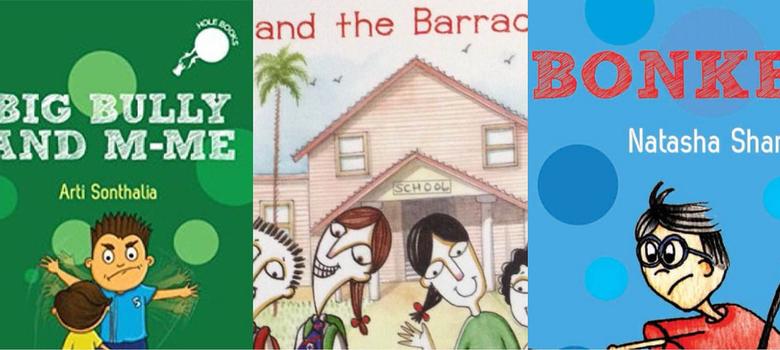
Big Bully and M-Me, Arti Sonthalia
Big Bully and M-Me is part of the delightful Hole Books Series. Meet Krishna, who prefers to be called “Krish without the Na!” You soon realise that Krish is the last one to be picked for team sport because he is the shortest, skinniest boy in class. He finds himself in a fix, when as part of a class assignment, he has to give an extempore speech. For Krish, that’s the hardest thing in the world because of his stammering. And, worst of all, his partner for the assignment is Ishaan, who happens to be “the tallest, meanest bully in the world”.

As Krish preps for the extempore, his Mom gives him some sound advice, “If you get stuck just say ‘I can, I can, I can’”. Arti Sonthalia’s story is short and sweet, and she compels the reader to put themselves into the shoes of Krish and think about his struggle with speech and how it impacts his confidence and relationships.

Also in this series is Bonkers, by Natasha Sharma, which features the bespectacled Armaan and Bonkers, his crazy dog who has just chewed up a cricket ball that belongs to TT, a bully who is the leader of the Ghastly Groundhog Grang. With a combination like that, only chaos can ensue, along with insane amounts of fun and a message that help can come from the most unlikely of sources.

Talking of Muskaan, Himanjali Sankar
Jay Asher’s book Thirteen Reasons Why was a dark book about a teenager who commits suicide and then through a series of audio tapes explains how bullying and abuse drove her to this desperate act. Himanjali Sankar’s protagonist Muskaan also tries to commit suicide in Talking of Muskaan.

As the 15-year-old is fighting for her life in the hospital, three of her classmates narrate the story from their perspective. Muskaan, the reader finds out, has always been different. And for that, her friends tease her brutally. When the teenager confesses to BFF Aaliya that she likes girls, the teasing takes on a cruel edge. Her one confidante Subhojoy has also been dubbed “weirdo” by his classmates because he’s a class topper and hails from a less privileged background. Talking of Muskaan is a compelling, coming-of-age book that brings to the forefront the subject of sexual orientation, class and individuality in an increasingly-homogenous world.

When Bijal Vachharajani is not reading Harry Potter, she can be found traipsing across tiger reserves. In her free time, she is a consultant with Fairtrade India. 

We welcome your comments at letters@scroll.in

Inked heart

http://www.timeoutbengaluru.net/books/featuresfeatures/inked-heart

A sneak-peek into Penguin’s new imprint Inked

The behemoth publishing house, Penguin, has expanded its footprint in India with a new subdivision, Inked, which is meant for young adults. This one is separate from Puffin, the group’s children’s imprint. Their debut offering comprises a mix of books by Indian and international authors, including Cracked by Eliza Crowe, a story about a half-demon girl;Seventeen and Done: You Bet! by Vibha Batra; a teen romance and Karmaby Cathy Ostlere, written in verse. Batra’s book is a breezy read and reminiscent of high school books such as the Sweet Valley High series, and Crowe’s book follows the Twilight vampire books phenomena. Ostelere’s book is a riveting read, but feels a bit archaic. In the future, Inked plans to release books by blogger and writer Meenakshi Reddy Madhavan, author Ranjit Lal, Shiv Ramdas, who has worked in radio previously, and Unmukt Chand, the captain of India’s under-19 cricket team. In an email interview with Time Out, Ameya Nagarajan, the assistant commissioning editor of Penguin Books India and the editor of Inked, shared their plans for the near future.

Why do you think the Young Adult (YA) category is now seeing a spurt of growth in India?
I wouldn’t say that the category is seeing a spurt now—it’s being going strong for a while. Just look at the popularity of Rick Riordan, Stephenie Meyer, Jeff Kinney and so on. It is true that publishing houses here are making a concerted effort at the moment, but I can’t speak for anyone else. At Penguin, Inked has been on the cards for a while, and we are launching now that our plan is in place.

What made Penguin decide to launch a separate YA category?
No one can deny that children today are growing up very fast. There’s a whole new stage of emotional growth that’s popped up, and teenagers want and enjoy far more autonomy than they ever have before. They demand and get the freedom to access information, to express themselves and to make choices for themselves. This means that the traditional division of children’s writing vs adult writing just doesn’t work anymore. Children’s writing, especially in India, tends to be nostalgic and occasionally didactic, and seems to come from an external voice that is directed at the children. Your modern teenager wants none of that! Internationally the YA space has taken off in the past few years, with Harry Potter and Twilight becoming overall sensations, which led us to believe it was time we started to explore this space in India.

What are the different genres we can expect to see from Inked?
Well, my whole philosophy with Inked is very simple — if it’s a good book, well plotted and well written, and it speaks to the audience, let’s do it. I will say though that there is a tendency in YA to gravitate towards fantasy, especially paranormal, and romance, and I find this a bit problematic, because the interests of such a large demographic cannot be so limited! We definitely want to publish across all genres, so later this year you will be seeing science fiction, non-fiction and a coming-of-age novel. I’m hoping to publish more genres next year, more non-fiction for sure, maybe some horror and humour. Both fantasy and chick lit will continue to feature in our list.
What is the kind of readership that Inked is looking at?
Anyone who likes our books! Technically our readership is about 13-19 years, but the beauty of YA is that, because the themes transcend generations and age, they can be read by anyone!

Inked books are available on flipkart.com

By Bijal Vachharajani

Purr desi

Hand-drawn beasts are the star of a new book series about life in India, finds Bijal Vachharajani.

When cartoonist Ananth Shankar looks at people, he sees them not as bipeds; but as animals. When I met him (and co-author Nidhi Jaipuria) to talk about their latest book, The CrazyDesi Book!, he pronounced that I looked like a Sarus Crane to him and proceeded to describe the characteristics I shared with the bird. Then he asked me to draw a squiggle on a blank page, and the S-shaped line was turned into an elephant, sloth bear, owl and tiger, in just a few minutes. Shankar is nothing if not prolific. And this is evident in the book, a series of animal cartoons that are focused on the theme of travel.

Planned as a series, the first volume is rendered in black-andwhite by Shankar and written by Jaipuria. “Each CrazyDesi Book! is a take on a typical Indian slice of life looked at by the most unique animal characters that come alive as ‘Man’imals!” A range of characters – ‘Cow’alli, ‘Cat’reena, Yo!bra, Ratappa, ‘Woof’adar Bhai, Durga Murga, Goa‘tee’, KA Raddy and ‘Ullu’da – navigate the perilous Indian roads to narrate stereotypical travel anecdotes. The cartoon book is presented in an alphabetic manner, with each letter attributed to a word. For instance, N stands for “Naturalist”, and it talks about how “the naturalists [are] ‘pee’s-fully working at keeping our highways green!” And this is accompanied by an image of a car parked on the highway and four “naturalists” peeing on the green patches.

Each page presents questions such as environment degradation and social conduct and takes a gentle dig at some of the typical behaviour of Indian tourists. “It’s a velvet glove within an iron fist,” said Jaipuria, who has been an English teacher with Mallya Aditi International School in Bangalore for a decade, and now conducts a range of workshops for children. “The series uses an unusual style of cartoons and wit to present India back to Indians.”In many ways the book manages to do that, but we could do without the many quotation marks that are used to emphasise the obvious puns in the text, which only serves to distract from the narrative.

Shankar and Jaipuria said that the book grew out of their daily banter, which usually revolves around puns. In the book, Shankar dubs himself as Draw Dog, Jaipuria is Word Bird and the book designer Vivek Krishnappa is called Tool Toad. Travel is the first in a series for The CrazyDesi Book! Next, the authors are working on the theme of shopping.

The CrazyDesi Book, WagsintheBags, Rs1,000 for a limited-edition Collector’s Pack (set of four). Rs300 for each book. Visit wagsinthebags.comfor details.

 http://www.timeoutbengaluru.net/books/features/purr-desi

Urban aria

Urban aria

Lavanya Sankaran’s new book examines the complexities inherent in a postindustrialised metropolis, says Time Out

The Bangalore that’s presented in the pages of The Hope Factory, a book by Lavanya Sankaran, is a familiar city, constrained by bureaucracy, corruption and of course, the limitation of class. The author describes the flesh and bones of this metropolis by way of two parallel stories: that of Anand, an upper middle class entrepreneur whose dream is to expand his factory by buying new land in the city, and Kamala, who works as a maid in Anand’s bungalow, and purposes her life around that of her son, Narayan.

“It’s a personal exploration using whatever talent sets I have, and what I am capable of,” said Sankaran, who worked on the novel for the last six years. “When you’re writing literary fiction, you are not just being a sociologist, you’re being a political analyst, an economic analyst; it’s more multi-layered.”

Sankaran examines the impact of industrialisation and the resultant urbanisation. “We are seeing this huge urban boom – the expansion of cities in what were earlier fields, slums,” said Sankaran, referring to Anand’s plan to buy up for farm land for his factory and Kamala’s home being swallowed up by the city gradually “It’s happening, not just from one generation to the other. It’s happening every five to ten years now.” Through her two protagonists, Sankaran explores the country’s many contradictions – the haves and the havenots, the middle class and the poor, the individual and the family – while steering clear of stereotypes that are often a mainstay in Indian literary fiction. For instance, while Anand is busy negotiating with the Japanese for a new automobile contract, his staff insists on following auspicious temple rituals for the deal to go smoothly.

To colour the character of a young entrepreneur, Sankaran shadowed people who worked in industries to figure out how Anand’s daily life would play out. “If you’re writing about something, you have to do it with an understanding of all the issues involved,” she explained. “But to construct characters that are complete in themselves, that is the crux – one of the reasons why it took six years. I didn’t want to handle anyone with the stamp of a stereotype.” This is Sankaran’s second book – her first, The Red Carpet, is an anthology of short stories about Bangalore. This time around, the city she visits could be any metropolis in the country. “You can think of something complex, and India will out-bizarre it,” laughed Sankaran. “I wanted very everyday characters, driven by very everyday concerns. They are not victims. They are reaching for opportunities. They have to manoeuvre the obstacle race of life.” Sankaran deftly evokes empathy for her characters. In fact, Kamala, who is a single mother and has migrated to the city, turns out to be a strong feminist voice who defies the usual fatalist behaviour expected of her.

What makes Sankaran’s book a refreshing read is that it’s not melancholic. Her characters brave the odds of migration, single parenthood, scheming relatives and keep moving forward. “This is a country that doesn’t give up,” she said. “There is poverty, poor infrastructure and incredibly bad governance, to corruption on an epic scale. Yet we deal with it, we wake up and continue. That’s one of the reasons why I like the title… because India is the hope factory. But, hope is a doubleedged sword, there is epic failure on the other, you can’t look at one without the other.”

Lavanya Sankaran Hachette India, R550

By Bijal Vachharajani

Status: Spooked out

Really enjoyed an email interview with Suzanne Sangi, the author of Facebook Phantom, who’s debut novel has a gay protagonist.

http://t.co/SpvK6jJu3H

It’s only supernatural, Suzanne Sangi, the teenage writer of paranormal fiction, tells Time Out

At first glance, Suzanne Sangi’s book Facebook Phantom is easy to dismiss as one of the countless young adult books that deal with the paranormal. After the Twilight series by Stephenie Meyer, the market has been flooded with vampire clone literature. But a closer read reveals some solid and plucky writing by this 17-yearold debutant writer. Bangalorebased Sangi writes about the fascination that social media holds for teenagers through the story of three friends – Sonali, Neel and Joanne. “Facebook Phantom is a paranormal romance,” Sangi wrote, in an email interview with Time Out. “It is more or less a psychological thriller which takes you into the world of the supernatural right at the heart of technology.

In the book, Sonali, better known as Li, starts chatting with a mysterious stranger called Omi Daan on Facebook. Daan is “melancholic and extremely good looking”, with a penchant for putting up beautiful cover photos on Facebook. The harmless flirting soon reveals a stalker side to Daan, plunging Li into a dark world full of dangers. “As Li and her friends try to free themselves from the hold of this Omi Daan, they realise that it is not easy to escape such darkness once you’ve been drawn in, and discover the depth of their friendship,” said Sangi, a student of Mount Carmel College. “Facebook Phantom was inspired by this world’s general obsession with the fascinating social networking site – Facebook – and also my personal taste for all things paranormal.”

For a debut book, Sangi’s writing is assured. Further, she takes on the topic of social media, a theme that most young adults can easily relate to. “As a teenager, I very much know what it is to be obsessed about something and I’ve tried my best to bring this to light in the book,” said Sangi. “Whether it is chatting with a crush or gossiping with friends or reaping crops on Farmville, Facebook is a whole new level of obsession. I am in absolute awe of the addictive  nature of this site, and since we’re all only human, we tend to overdo things a bit sometimes. But whatever the matter, long live the Facebook Era!”

Sangi is an avid reader and it’s evident in her book – Li loves reading as well but all that takes a back seat when she starts chatting to Daan. While some of the twists in the plot seem forced and slightly contrived, Sangi’s characters are very real.

Interestingly, she introduces the dapper Neel as a gay teenager, most probably a first for an Indian young adult fiction book. “Neel Sarathy is my favourite character in the book,” said Sangi. “He is insanely hot, with an impeccable fashion sense, free, humorous and kind. His relationship with Li has been so exciting to write, and I have to admit, I’ve always had a soft side for gay people and find them to be the most frank and humorous friends you could ever have – they always seem to cut through all the crap in life and look straight into the heart of a person. And I absolutely admire their immaculate fashion sense!”

As an extension to exploring her fascination with alternate sexuality, (spoiler alert) Neel later finds himself attracted to his best friend, Li. “There is an interesting story to Neel turning straight,” Sangi revealed. “When I was in high school, I had a surprisingly strong crush on a girl and this boggled my mind since I am/was absolutely sure that I am straight; she just made me so happy and it was nothing sexual. I did get over her in a month or so and it never happened again. When I was writing about Neel, I imagined the same thing happening the other way round – where a usually gay person suddenly falls for the opposite sex – and it made sense to me.”

Facebook Phantom, apart from being a paranormal romance, is also a Bangalore book, where the characters vend their way through the city. “[I am] a Bangalorean in heart and soul, I have written the entire book based on Bangalore and its cool people,’ explained Sangi. “This familiarity is something I cherish about the book.”

Facebook PhantomDuckbill. R199.

Ask a silly question

 Who would you rather befriend on Facebook – a ghost or a vampire? A vampire. Hee hee. The aftermath of Twilight still hasn’t left me, and I would rather date/ befriend a vampire any day.

What do you think a ghost’s Facebook wall would look like?Frequent status updates of how hell sucks, dangerous trips back to earth and cool sneak peeks of heaven. A profile picture which keeps flickering and changing every two seconds – that would be killer!

Stephenie Meyer or JK Rowling or…? JK Rowling forever. Nothing beats the brilliance of the Harry Potter series. Oh! And Rick Riordan can make me laugh!


Suzzane Sanghi Duckbill, R199

By Bijal Vachharajani


Tale spin

Time Out listens in to some city storytellers

Coomi Vevaina loves to tell children the story of Beeblebean and Beebleboo, a poem about a stone wall built between the two kingdoms with those names. “It’s a story about walls that exist between people,” said Vevaina, who heads the department of English at the University of Mumbai. The last time Vevaina recited the poem, the young audience had many things to say about imaginary walls. One child said that a wall exists between his mother and grandmother, while another pointed out that there’s a wall between India and Pakistan. The reading that triggered this discussion was organised by Word-fully Yours, an association that is trying to promote peace and conservation through stories.

Traditionally, our storytellers have been our grandparents, our parents or our teachers. They first introduced us to Indian folklore, myths and fables. But the upsurge in professional storytellers – Word-fully Yours is just one of many groups that organise storytelling sessions – suggests that the activity is moving beyond the realm of home and school. “Oral traditions are best passed down the family, but with nuclear families this is getting to be a bigger challenge,” said Vijay Prabhat-Kamalakara, the managing director of Storytrails, a Chennai-based group that conducts outings replete with stories. “Professional storytellers are an alternative,” he added. “For example, our stories are not the kind that grandparents would tell. How many times have you heard the story of Martha Benz and the first cars or the story of Operation Fortitude from grandparents?”

Prabhat-Kamalakara said that Storytrails was born out of the idea that almost every activity, however mundane, has a story behind it. “We attempt to research, script and creatively present such stories through theme-based trails,” he said. “Storytrails has trails for different age groups – some indoor and some which take kids through bakeries, cinema studios and car service centres.” This summer, Storytrails organised workshops at the Landmark bookstores in Mumbai, through stories, role play, songs and dance, kids learnt about countries, inventions and book characters.

If the storytellers and the narratives have changed, so has the telling of the story. It is no longer limited to reading aloud from a book. While voice modulation, song and dance have always been part of the tool kit, storytellers are increasingly using aids such as drama, costume and sets to enhance the experience for young listeners with short attention spans. Vevaina, the president of Word-fully Yours, said that her team blends storytelling with drama, puppets, art and craft. “We weave in these forms to consciously create a story,” she said. “For us, stories are a powerful form of passing on the right values in this shrinking and rapidly threatening world.”

For others like Blue Fun Umbrella, storytelling has translated into a profit-making venture. Started three years ago by Meenakshi Kishore and Sonu Mehrotra, Blue Fun Umbrella’s clients include Disney, Crossword Bookstore and Hamleys. Kishore said that they combine story-telling with concept building. “One of the concepts we try to instil is about saving,” said Kishore. “We have a pig puppet who tells the kids that he wants to earn money. He takes the kids to imaginary shops and to a bank where they have to save money.”

Blue Fun Umbrella also organises performance-based sessions. They have narrated the story of Beauty and the Beast, complete with a castle, live music and actors reading from the book. Activities are part of the session, where kids need to solve puzzles in order to get the key to a forbidden castle. In a storytelling session to promote the film Pirates of the Caribbean: On Stranger Tides, kids got eye patches and bandanas.

However, some like Storytrails don’t believe that they need to put on different voices or make faces to engage children. “The first step is to choose an appropriate subject that would be of interest to the age group being addressed,” said Prabhat-Kamalakara.

Another challenge is building a team that can work with a varied group of children. Most groups devote a substantial amount of time training their storytellers. Kishore said that Blue Fun Umbrella mainly hires professional actors for their sessions, but Storytrails draws upon a motley crew of travel writers, architects, lawyers, teachers, engineers and students who have a desire to tell stories to kids in their spare time. Word-fully Yours trains its members to conduct storytelling modules. “What’s really important is having a passion for storytelling,” said Vevaina.

By Bijal Vachharajani on June 23 2011 6.30pm
Photos by Tejal Pandey

Minor accomplishments

Time Out looks back at 2010 and realised that it was the year the kids held the reins

children's Books, dvds, art 4 all, Suar Chala Space Ko, aria panchal, jalebi ink

What happened in 2010? Hundreds of children’s books, tons of toys and dozens of DVDs lined the shelves of bookstores. Over the year, puppet plays, film screenings and clowns entertained kids as well. A study by the TV channel Nick India threw up disturbing results: only 25 per cent of children across six metros actually played outdoors on a daily basis. While there was lots of activities for kids, 2010 was really the year when children held art exhibitions, wrote books and even worked on a commercial play, with a little help from adults, of course.

Authors
When he was just 15, Christopher Paolini began writing Eragon, a story about a boy who takes up a quest along with his pet dragon. The book became a bestseller and was even turned into a Hollywood movie. Bollywood isn’t exactly enthused about signing movie deals with children, but this year two books written by children found mainstream publishers. Anshuman Mohan, 15, wrote Potato Chips (Harper), an earnest work about Aman Malhotra, who switches schools to join the prestigious St Xavier’s and tries desperately to fit in. Written with almost frank brutality, the book is packed with adolescent jokes and teen angst.  Another author, the 17-year-old Arun Vajpai, teamed up with Anu Kumar to write On Top of the World (Puffin), an account of his expedition to Mount Everest. Vajpai is the youngest Indian to have climbed the mountain.

Publishers
At Jalebi Ink, a media company for young adults, children got a chance to air their views about their neighbourhood, the environment and the world around them. In October, young reporters from Jalebi Ink’s Green Squad published Junknama, a newspaper about the environment. They wrote about garbage disposal, water woes and the diminishing green cover. They also visited Dharavi to witness waste recycling, interviewed environmentalists and covered programmes such as the Carter Road Car-Free Day. In a story titled “Trash Troopers”, the reporters  pointed out that Mumbai produces more than 6,500 tonnes of garbage every day, “roughly equivalent to17 fully loaded Airbus A380s”. On October 10, the children distributed copies of the newspapers to evening walkers at Carter Road in Bandra and marched holding solar lanterns.

Artists
At Dreammakers 2010, students of Art 4 All managed to do what most adults haven’t. They displayed their paintings at Chemould Prescott Road Art Gallery and even sold some. “Mumbai through the eyes of children” featured iconic landmarks such as Flora Fountain surrounded by Gothic buildings and hoardings, the Bandra-Worli Sea Link and Rajabai Tower, all painted by children. Images of traffic jams, petrol pumps and fishing colonies were rendered in bright colours. The kids were understandably excited about their paintings being displayed, but a few were concerned that if someone other than their parents bought their work, they wouldn’t be able to take it home.

Playwrights
When director Shaili Sathyu wanted to produce a children’s play this summer, she delved into a pool of ideas generated by kids. The result wasSuar Chala Space Ko, a quirky play about a smelly pig who travels to space. “The play is based on a puppet play originally written by children during a workshop that I conducted in 2001,” said Sathyu. “The play developed in an organic way, with children thinking of different plots and putting them together. The title of the play was conceived by the kids.” In May, Thespo, a youth theatre initiative from Q Theatre Productions, conducted “Dramabaazi”, a children’s workshop. The result was The Mighty Mirembayanna and the Prisoners of Peace, a play about peace and war. Toral Shah of Q Theatre said that they thought the workshop was a great way for kids to experience “what it’s like to go through a rehearsal process, learn lines, get into costume, wait in the wings for their entry and have an audience”. With most plays for children being written and performed by adults, this summertime was a welcome change.

By Bijal Vachharajani on December 23 2010