Bullying is often a staple theme in children’s literature – whether it’s Draco Malfoy bolstered by his cronies Crabbe and Goyle in the Harry Potter series or even a teacher like the horrid Miss Trunchbull in Matilda by Roald Dahl. These fictional worlds are not all that different from the ones that children grow up in, even without magical moving staircases or telekinetics.
Here in India, children’s books are tackling the subject of bullying with some solid storytelling and generous doses of humour. These books celebrate diversity, and in doing so remind kids that standing up to bullies takes courage and is the right thing to do. Here are three that take on the issue:
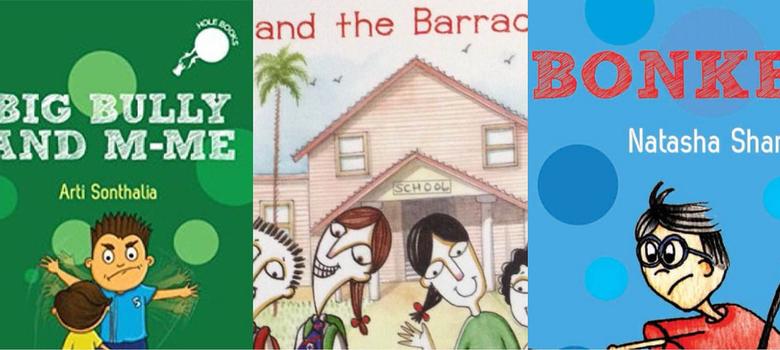
The Dugong and the Barracudas, Ranjit Lal
If you have spent your life hooked onto Animal Planet, you may know that a dugong is a large marine mammal that is known to be quite languid. In nature writer Ranjit Lal’s book, Sushmita is the dugong – a sweet 13-year-old girl who is “not quite like girls her age” because she’s overweight, big and slow.
When she joins Rugged Rocks High School, it’s like a battery of barracudas – her classmates – sinking their teeth into her good nature, pulling no punches while humiliating her. On the first day of her class, the children snicker among themselves, “Fat, fat, fat… everywhere!” and even call her “Mother of all hippos!”
As things take a turn for the worse, Sushmita fights back, but in her own sweet way. Lal tackles the difficult subjects of prejudice and bullying deftly with his usual incisiveness and quirkiness, making the reader chuckle, laugh out loud and think at the same time.
Big Bully and M-Me, Arti Sonthalia
Big Bully and M-Me is part of the delightful Hole Books Series. Meet Krishna, who prefers to be called “Krish without the Na!” You soon realise that Krish is the last one to be picked for team sport because he is the shortest, skinniest boy in class. He finds himself in a fix, when as part of a class assignment, he has to give an extempore speech. For Krish, that’s the hardest thing in the world because of his stammering. And, worst of all, his partner for the assignment is Ishaan, who happens to be “the tallest, meanest bully in the world”.
As Krish preps for the extempore, his Mom gives him some sound advice, “If you get stuck just say ‘I can, I can, I can’”. Arti Sonthalia’s story is short and sweet, and she compels the reader to put themselves into the shoes of Krish and think about his struggle with speech and how it impacts his confidence and relationships.
Also in this series is Bonkers, by Natasha Sharma, which features the bespectacled Armaan and Bonkers, his crazy dog who has just chewed up a cricket ball that belongs to TT, a bully who is the leader of the Ghastly Groundhog Grang. With a combination like that, only chaos can ensue, along with insane amounts of fun and a message that help can come from the most unlikely of sources.
Talking of Muskaan, Himanjali Sankar
Jay Asher’s book Thirteen Reasons Why was a dark book about a teenager who commits suicide and then through a series of audio tapes explains how bullying and abuse drove her to this desperate act. Himanjali Sankar’s protagonist Muskaan also tries to commit suicide in Talking of Muskaan.
As the 15-year-old is fighting for her life in the hospital, three of her classmates narrate the story from their perspective. Muskaan, the reader finds out, has always been different. And for that, her friends tease her brutally. When the teenager confesses to BFF Aaliya that she likes girls, the teasing takes on a cruel edge. Her one confidante Subhojoy has also been dubbed “weirdo” by his classmates because he’s a class topper and hails from a less privileged background. Talking of Muskaan is a compelling, coming-of-age book that brings to the forefront the subject of sexual orientation, class and individuality in an increasingly-homogenous world.
When Bijal Vachharajani is not reading Harry Potter, she can be found traipsing across tiger reserves. In her free time, she is a consultant with Fairtrade India.

 Bijal Vachharajani